
|
xtd
1.0.0
|
Loading...
Searching...
No Matches
xtd::forms::control Class Reference
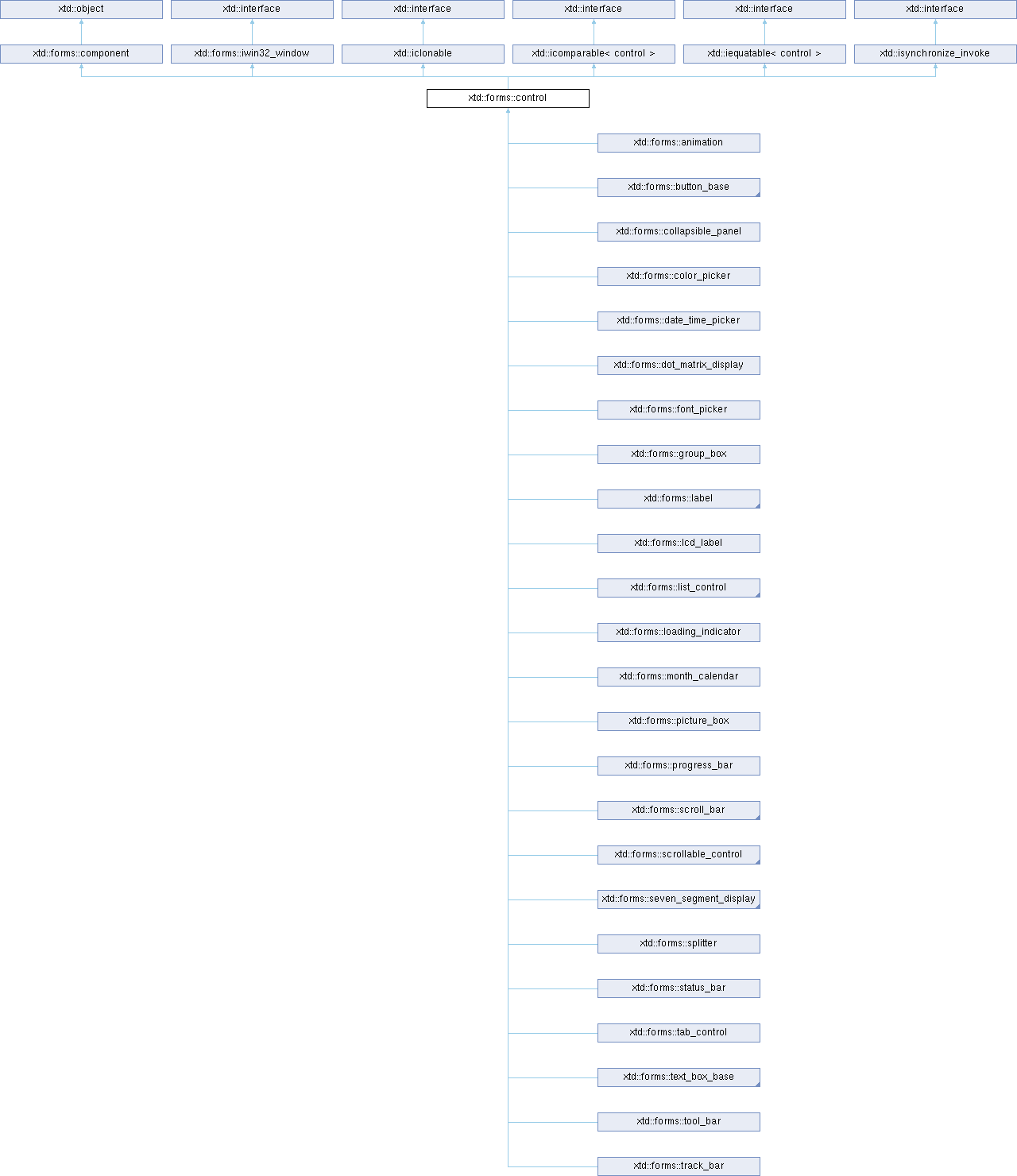
Inheritance diagram for xtd::forms::control:
Definition
Defines the base class for controls, which are components with visual representation.
- Header
- #include <xtd/forms/control>
- Namespace
- xtd::forms
- Library
- xtd.forms
- Remarks
- To create your own control class, inherit from the xtd::forms::user_control, xtd::forms::control classes, or from the other Windows Forms provided controls.
- The xtd::forms::control class implements very basic functionality required by classes that display information to the user. It handles user input through the keyboard and pointing devices. It handles message routing and security. It defines the bounds of a control (its position and size), although it does not implement painting. It provides a window handle (hWnd).
- Windows Forms controls use ambient properties so child controls can appear like their surrounding environment. An ambient property is a control property that, if not set, is retrieved from the xtd::forms::control::parent control. If the control does not have a parent, and the property is not set, the control attempts to determine the value of the ambient property through the site property. If the control is not sited, if the site does not support ambient properties, or if the property is not set on the ambient_properties, the control uses its own default values. Typically, an ambient property represents a characteristic of a control, such as xtd::forms::control::back_color, that is communicated to a child control. For example, a button will have the same xtd::forms::control::back_color as its parent form by default. Ambient properties provided by the control class include: xtd::forms::control::cursor, xtd::forms::control::font, xtd::forms::control::back_color, xtd::forms::control::fore_color, and xtd::forms::control::right_to_left.
- The majority of the controls in the xtd::forms namespace use the underlying Windows common control as a base to build on.
- Examples
- The following code example demonstrates the use of control control. #include <xtd/xtd>namespace control_example {public:form1() {text("Control example");control1.parent(*this);control1.cursor(cursors::hand());control1.back_color(colors::spring_green());control1.location({50, 50});control1.size({100, 50});control1.click += delegate_ {control1.back_color(control1.back_color() == colors::spring_green() ? colors::orange_red() : colors::spring_green());};}private:control control1;};}auto main() -> int {application::run(control_example::form1 {});}friend class formThe form data allows you to specify the box of a form control.Definition control.hpp:1865virtual auto text() const noexcept -> const xtd::string &Gets the text associated with this control.static auto hand() -> xtd::forms::cursorGets the hand cursor, typically used when hovering over a Web link.#define delegate_The declaration of a delegate type is similar to a method signature. It has a return value and any nu...Definition delegate.hpp:1018@ controlThe left or right CTRL modifier key.Definition console_modifiers.hpp:28
Classes | |
| class | control_collection |
| Represents a collection of controls. More... | |
Public Aliases | |
| using | context_menu_ref |
| Represent an xtd::forms::context_menu reference. | |
Public Constructors | |
| control () | |
| Initializes a new instance of the xtd::forms::control class with default settings. | |
| control (const xtd::string &text) | |
| Initializes a new instance of the xtd::forms::control class with specific text. | |
| control (const control &parent, const xtd::string &text) | |
| Initializes a new instance of the xtd::forms::control class as a child control, with specific text. | |
| control (const xtd::string &text, int32 left, int32 top, int32 width, int32 height) | |
| Initializes a new instance of the control class with specific text, size, and location. | |
| control (const control &parent, const xtd::string &text, int32 left, int32 top, int32 width, int32 height) | |
| Initializes a new instance of the xtd::forms::control class as a child control, with specific text, size, and location. | |
Public Properties | |
| virtual auto | anchor () const noexcept -> xtd::forms::anchor_styles |
| Gets the edges of the container to which a control is bound and determines how a control is resized with its parent. | |
| virtual auto | anchor (xtd::forms::anchor_styles value) -> control & |
| Gets the edges of the container to which a control is bound and determines how a control is resized with its parent. | |
| virtual auto | auto_scroll_point () const noexcept -> xtd::drawing::point |
| Gets where this control is scrolled to in scroll_control_into_view(control). | |
| virtual auto | auto_size () const noexcept -> bool |
| Gets a value that indicates whether the control resizes based on its contents. | |
| virtual auto | auto_size (bool value) -> control & |
| Sets a value that indicates whether the control resizes based on its contents. | |
| virtual auto | back_color () const noexcept -> xtd::drawing::color |
| Gets the background color for the control. | |
| virtual auto | back_color (const xtd::drawing::color &value) -> control & |
| Sets the background color for the control. | |
| virtual auto | back_color (xtd::null_ptr) -> control & |
| Resets the background color for the control. | |
| virtual auto | background_image () const noexcept -> const xtd::drawing::image & |
| Gets the background image displayed in the control. | |
| virtual auto | background_image (const xtd::drawing::image &value) -> control & |
| Sets the background image displayed in the control. | |
| virtual auto | background_image_layout () const noexcept -> xtd::forms::image_layout |
| Gets the background image layout as defined in the xtd::forms::image_layout enumeration. | |
| virtual auto | background_image_layout (xtd::forms::image_layout value) -> control & |
| Sets the background image layout as defined in the xtd::forms::image_layout enumeration. | |
| virtual auto | bottom () const noexcept -> xtd::int32 |
| Gets the distance, in pixels, between the bottom edge of the control and the top edge of its container's client area. | |
| virtual auto | bounds () const noexcept -> xtd::drawing::rectangle |
| Gets the size and location of the control including its nonclient elements, in pixels, relative to the parent control. | |
| virtual auto | bounds (const xtd::drawing::rectangle &value) -> control & |
| Sets the size and location of the control including its nonclient elements, in pixels, relative to the parent control. | |
| virtual auto | can_focus () const noexcept -> bool |
| Gets a value indicating whether the control can receive focus. | |
| virtual auto | can_select () const noexcept -> bool |
| Gets a value indicating whether the control can be selected. | |
| auto | can_raise_events () const noexcept -> bool override |
| Determines if events can be raised on the control. | |
| virtual auto | client_rectangle () const noexcept -> const xtd::drawing::rectangle & |
| Gets the rectangle that represents the client area of the control. | |
| virtual auto | client_size () const noexcept -> const xtd::drawing::size & |
| Gets the height and width of the client area of the control. | |
| virtual auto | client_size (const xtd::drawing::size &value) -> control & |
| Sets the height and width of the client area of the control. | |
| virtual auto | company_name () const noexcept -> xtd::string |
| Gets the name of the company or creator of the application containing the control. | |
| virtual auto | context_menu () const noexcept -> std::optional< context_menu_ref > |
| Gets the xtd::forms::context_menu that is displayed in the control. | |
| virtual auto | context_menu (xtd::forms::context_menu &value) -> control & |
| Sets the xtd::forms::context_menu that is displayed in the control. | |
| virtual auto | context_menu (xtd::null_ptr) -> control & |
| Resets the xtd::forms::context_menu that is displayed in the control. | |
| virtual auto | control_appearance () const noexcept -> xtd::forms::control_appearance |
| Gets control appearance. | |
| virtual auto | control_appearance (xtd::forms::control_appearance value) -> control & |
| Sets control appearance. | |
| virtual auto | controls () noexcept -> control_collection & |
| Gets the collection of controls contained within the control. | |
| virtual auto | controls () const noexcept -> const control_collection & |
| Gets the collection of controls contained within the control. | |
| virtual auto | created () const noexcept -> bool |
| Gets a value indicating whether the control has been created. | |
| virtual auto | cursor () const noexcept -> xtd::forms::cursor |
| Gets the cursor that is displayed when the mouse pointer is over the control. | |
| virtual auto | cursor (const xtd::forms::cursor &value) -> control & |
| Sets the cursor that is displayed when the mouse pointer is over the control. | |
| virtual auto | cursor (xtd::null_ptr) -> control & |
| Resets the cursor that is displayed when the mouse pointer is over the control. | |
| virtual auto | display_rectangle () const noexcept -> xtd::drawing::rectangle |
| Gets the rectangle that represents the display area of the control. | |
| virtual auto | dock () const noexcept -> xtd::forms::dock_style |
| Gets which control borders are docked to its parent control and determines how a control is resized with its parent. | |
| virtual auto | dock (xtd::forms::dock_style value) -> control & |
| Sets which control borders are docked to its parent control and determines how a control is resized with its parent. | |
| virtual auto | double_buffered () const noexcept -> bool |
| Gets a value indicating whether this control should redraw its surface using a secondary buffer to reduce or prevent flicker. | |
| virtual auto | double_buffered (bool value) -> control & |
| Sets a value indicating whether this control should redraw its surface using a secondary buffer to reduce or prevent flicker. | |
| virtual auto | enabled () const noexcept -> bool |
| Gets a value indicating whether the control can respond to user interaction. | |
| virtual auto | enabled (bool value) -> control & |
| Sets a value indicating whether the control can respond to user interaction. | |
| virtual auto | focused () const noexcept -> bool |
| Gets a value indicating whether the control has input focus. | |
| virtual auto | font () const noexcept -> xtd::drawing::font |
| Gets the font of the text displayed by the control. | |
| virtual auto | font (const xtd::drawing::font &value) -> control & |
| Sets the font of the text displayed by the control. | |
| virtual auto | font (xtd::null_ptr) -> control & |
| Resets the font of the text displayed by the control. | |
| virtual auto | fore_color () const noexcept -> xtd::drawing::color |
| Gets the foreground color of the control. | |
| virtual auto | fore_color (const xtd::drawing::color &value) -> control & |
| Sets the foreground color of the control. | |
| virtual auto | fore_color (xtd::null_ptr) -> control & |
| Resets the foreground color of the control. | |
| auto | handle () const -> xtd::intptr override |
| Gets the window handle that the control is bound to. | |
| virtual auto | height () const noexcept -> xtd::int32 |
| Gets the height of the control. | |
| virtual auto | height (xtd::int32 value) -> control & |
| Sets the height of the control. | |
| auto | invoke_required () const noexcept -> bool override |
| Gets a value indicating whether the caller must call an invoke method when making method calls to the control because the caller is on a different thread than the one the control was created on. | |
| auto | is_handle_created () const noexcept -> bool |
| Gets a value indicating whether the control has a handle associated with it. | |
| virtual auto | left () const noexcept -> xtd::int32 |
| Gets the distance, in pixels, between the left edge of the control and the left edge of its container's client area. | |
| virtual auto | left (xtd::int32 value) -> control & |
| Sets the distance, in pixels, between the left edge of the control and the left edge of its container's client area. | |
| virtual auto | location () const noexcept -> xtd::drawing::point |
| Gets the coordinates of the upper-left corner of the control relative to the upper-left corner of its container. | |
| virtual auto | location (const xtd::drawing::point &value) -> control & |
| Sets the coordinates of the upper-left corner of the control relative to the upper-left corner of its container. | |
| virtual auto | margin () const noexcept -> xtd::forms::padding |
| Gets the space between controls. | |
| virtual auto | margin (const xtd::forms::padding &value) -> control & |
| Sets the space between controls. | |
| virtual auto | maximum_client_size () const noexcept -> const xtd::drawing::size & |
| Gets the client size that is the upper limit that xtd::forms::control::get_preferred_size can specify. | |
| virtual auto | maximum_client_size (const xtd::drawing::size &size) -> control & |
| Sets the client size that is the upper limit that xtd::forms::control::get_preferred_size can specify. | |
| virtual auto | maximum_size () const noexcept -> const xtd::drawing::size & |
| Gets the size that is the upper limit that xtd::forms::control::get_preferred_size can specify. | |
| virtual auto | maximum_size (const xtd::drawing::size &value) -> control & |
| Sets the size that is the upper limit that xtd::forms::control::get_preferred_size can specify. | |
| virtual auto | minimum_client_size () const noexcept -> const xtd::drawing::size & |
| Gets the client size that is the lower limit that xtd::forms::control::get_preferred_size can specify. | |
| virtual auto | minimum_client_size (const xtd::drawing::size &value) -> control & |
| Sets the client size that is the lower limit that xtd::forms::control::get_preferred_size can specify. | |
| virtual auto | minimum_size () const noexcept -> const xtd::drawing::size & |
| Gets the size that is the lower limit that xtd::forms::control::get_preferred_size can specify. | |
| virtual auto | minimum_size (const xtd::drawing::size &value) -> control & |
| Sets the size that is the lower limit that xtd::forms::control::get_preferred_size can specify. | |
| auto | native_handle () const noexcept -> xtd::intptr |
| Gets the native handle that the control is bound to. | |
| virtual auto | name () const noexcept -> const xtd::string & |
| Gets the name of the control. | |
| virtual auto | name (const xtd::string &value) -> control & |
| Sets the name of the control. | |
| virtual auto | padding () const noexcept -> xtd::forms::padding |
| Gets padding within the control. | |
| virtual auto | padding (const xtd::forms::padding &value) -> control & |
| Sets padding within the control. | |
| virtual auto | parent () const noexcept -> std::optional< xtd::forms::control_ref > |
| Gets the parent container of the control. | |
| virtual auto | parent (const control &value) -> control & |
| Sets the parent container of the control. | |
| virtual auto | parent (xtd::null_ptr) -> control & |
| Resets the parent container of the control. | |
| virtual auto | product_name () const noexcept -> xtd::string |
| Gets the product name of the assembly containing the control. | |
| auto | recreating_handle () const noexcept -> bool |
| Gets a value indicating whether the control is currently re-creating its handle. | |
| virtual auto | region () const noexcept -> const xtd::drawing::region & |
| Gets the window region associated with the control. | |
| virtual auto | region (const xtd::drawing::region &value) -> control & |
| Sets the window region associated with the control. | |
| virtual auto | right () const noexcept -> xtd::int32 |
| Gets the distance, in pixels, between the right edge of the control and the left edge of its container's client area. | |
| virtual auto | right_to_left () const noexcept -> xtd::forms::right_to_left |
| Gets a value indicating whether control's elements are aligned to support locales using right-to-left fonts. | |
| virtual auto | right_to_left (xtd::forms::right_to_left value) -> control & |
| Sets a value indicating whether control's elements are aligned to support locales using right-to-left fonts. | |
| virtual auto | right_to_left (xtd::null_ptr) -> control & |
| Resets a value indicating whether control's elements are aligned to support locales using right-to-left fonts. | |
| virtual auto | size () const noexcept -> xtd::drawing::size |
| Gets the height and width of the control. | |
| virtual auto | size (const xtd::drawing::size &value) -> control & |
| Sets the height and width of the control. | |
| virtual auto | style_sheet () const noexcept -> xtd::forms::style_sheets::style_sheet |
| Gets the contol style sheet. | |
| virtual auto | style_sheet (const xtd::forms::style_sheets::style_sheet &value) -> control & |
| Sets the contol style sheet. | |
| virtual auto | style_sheet (const xtd::string &value) -> control & |
| Sets the contol style sheet. | |
| virtual auto | style_sheet (xtd::null_ptr) -> control & |
| Resets the contol style sheet. | |
| virtual auto | tab_stop () const noexcept -> bool |
| Gets a value indicating whether the user can give the focus to this control using the TAB key. | |
| virtual auto | tab_stop (bool value) -> control & |
| Sets a value indicating whether the user can give the focus to this control using the TAB key. | |
| virtual auto | tag () const noexcept -> const xtd::any_object & |
| Gets the object that contains data about the control. | |
| virtual auto | tag (const xtd::any_object &value) -> control & |
| Sets the object that contains data about the control. | |
| virtual auto | text () const noexcept -> const xtd::string & |
| Gets the text associated with this control. | |
| virtual auto | text (const xtd::string &value) -> control & |
| Sets the text associated with this control. | |
| auto | toolkit_handle () const noexcept -> xtd::intptr |
| Gets the toolkit handle that the control is bound to. | |
| virtual auto | top () const noexcept -> xtd::int32 |
| Gets the distance, in pixels, between the top edge of the control and the top edge of its container's client area. | |
| virtual auto | top (xtd::int32 value) -> control & |
| Sets the distance, in pixels, between the top edge of the control and the top edge of its container's client area. | |
| virtual auto | top_level_control () const noexcept -> std::optional< xtd::forms::control_ref > |
| Gets the parent control that is not parented by another Windows Forms control. Typically, this is the outermost Form that the control is contained in. | |
| virtual auto | visible () const noexcept -> bool |
| Gets a value indicating whether the control and all its child controls are displayed. | |
| virtual auto | visible (bool value) -> control & |
| Sets a value indicating whether the control and all its child controls are displayed. | |
| virtual auto | width () const noexcept -> xtd::int32 |
| Gets the width of the control. | |
| virtual auto | width (xtd::int32 value) -> control & |
| Sets the width of the control. | |
Public Methods | |
| auto | begin_invoke (xtd::delegate< void()> method) -> xtd::async_result override |
| Executes the specified delegate asynchronously on the thread that the control's underlying handle was created on. | |
| auto | begin_invoke (xtd::delegate< void(xtd::array< xtd::any_object >)> method, const xtd::array< xtd::any_object > &args) -> xtd::async_result override |
| Executes the specified delegate asynchronously with the specified arguments, on the thread that the control's underlying handle was created on. | |
| virtual auto | bring_to_front () -> void |
| Brings the control to the front of the z-order. | |
| auto | compare_to (const control &value) const noexcept -> xtd::int32 override |
| auto | create_control () -> void |
| Forces the creation of the visible control, including the creation of the handle and any visible child controls. | |
| auto | create_graphics () const -> xtd::drawing::graphics |
| Creates the xtd::drawing::graphics for the control. | |
| virtual auto | destroy_control () -> void |
| Forces the destruction of the visible control, including the destruction of the handle and any visible child controls. | |
| auto | end_invoke (xtd::async_result async) -> std::optional< xtd::object_ref > override |
| Retrieves the return value of the asynchronous operation represented by the async_result_invoke passed. | |
| auto | equals (const xtd::object &obj) const noexcept -> bool override |
| Determines whether the specified object is equal to the current object. | |
| auto | equals (const control &value) const noexcept -> bool override |
| Determines whether the specified object is equal to the current object. | |
| auto | focus () -> bool |
| Sets input focus to the control. | |
| auto | get_auto_size_mode () const -> xtd::forms::auto_size_mode |
| Gets a value indicating how a control will behave when its auto_size property is enabled. | |
| auto | get_child_index (xtd::intptr child) const -> xtd::usize |
| Retrieves the index of a control within the control collection. | |
| auto | get_child_index (xtd::intptr child, bool &throw_exception) const -> xtd::usize |
| Retrieves the index of the specified child control within the control collection, and optionally raises an exception if the specified control is not within the control collection. | |
| auto | get_hash_code () const noexcept -> xtd::usize override |
| Serves as a hash function for a particular type. | |
| virtual auto | hide () -> void |
| Conceals the control from the user. | |
| virtual auto | invalidate () const -> void |
| Invalidates the entire surface of the control and causes the control to be redrawn. | |
| virtual auto | invalidate (bool invalidate_children) const -> void |
| Invalidates a specific region of the control and causes a paint message to be sent to the control. Optionally, invalidates the child controls assigned to the control. | |
| virtual auto | invalidate (const xtd::drawing::rectangle &rect) const -> void |
| Invalidates the specified region of the control (adds it to the control's update region, which is the area that will be repainted at the next paint operation), and causes a paint message to be sent to the control. | |
| virtual auto | invalidate (const xtd::drawing::rectangle &rect, bool invalidate_children) const -> void |
| Invalidates the specified region of the control (adds it to the control's update region, which is the area that will be repainted at the next paint operation), and causes a paint message to be sent to the control. Optionally, invalidates the child controls assigned to the control. | |
| virtual auto | invalidate (const xtd::drawing::region ®ion) const -> void |
| Invalidates the specified region of the control (adds it to the control's update region, which is the area that will be repainted at the next paint operation), and causes a paint message to be sent to the control. | |
| virtual auto | invalidate (const xtd::drawing::region ®ion, bool invalidate_children) const -> void |
| Invalidates the specified region of the control (adds it to the control's update region, which is the area that will be repainted at the next paint operation), and causes a paint message to be sent to the control. Optionally, invalidates the child controls assigned to the control. | |
| auto | invoke (xtd::delegate< void()> method) -> std::optional< xtd::object_ref > override |
| Executes the specified delegate on the thread that owns the control's underlying window handle. | |
| auto | invoke (xtd::delegate< void(xtd::array< xtd::any_object >)> method, const xtd::array< xtd::any_object > &args) -> std::optional< xtd::object_ref > override |
| Executes the specified delegate, on the thread that owns the control's underlying window handle, with the specified list of arguments. | |
| auto | invoke (xtd::delegate< void(xtd::array< xtd::any_object >)> method, const xtd::any_object &arg) -> std::optional< xtd::object_ref > override |
| Executes the specified delegate, on the thread that owns the control's underlying window handle, with the specified list of arguments. | |
| auto | perform_layout () -> void |
| Forces the control to apply layout logic to all its child controls. | |
| auto | point_to_client (const xtd::drawing::point &p) const -> xtd::drawing::point |
| Computes the location of the specified screen point into client coordinates. | |
| auto | point_to_screen (const xtd::drawing::point &p) const -> xtd::drawing::point |
| Computes the location of the specified client point into screen coordinates. | |
| auto | post_message (xtd::intptr hwnd, xtd::int32 msg, xtd::intptr wparam, xtd::intptr lparam) const -> bool |
| Places (posts) a message in the message queue with specified hwnd, message, wparam and lparam. | |
| virtual auto | pre_process_message (const xtd::forms::message &message) -> bool |
| Preprocesses keyboard or input messages within the message loop before they are dispatched. | |
| virtual auto | refresh () const -> void |
| Forces the control to invalidate its client area and immediately redraw itself and any child controls. | |
| auto | resume_layout () -> void |
| Resumes usual layout logic. | |
| auto | resume_layout (bool perform_layout) -> void |
| Resumes usual layout logic, optionally forcing an immediate layout of pending layout requests. | |
| auto | send_message (xtd::intptr hwnd, xtd::int32 msg, xtd::intptr wparam, xtd::intptr lparam) const -> xtd::intptr |
| Send a message with specified hwnd, message, wparam and lparam. | |
| auto | set_auto_size_mode (xtd::forms::auto_size_mode auto_size_modeauto_size_mode) -> void |
| Sets a value indicating how a control will behave when its auto_size property is enabled. | |
| auto | set_bounds (xtd::int32 x, xtd::int32 y, xtd::int32 width, xtd::int32 height) -> void |
| Sets the bounds of the control to the specified location and size. | |
| auto | set_bounds (xtd::int32 x, xtd::int32 y, xtd::int32 width, xtd::int32 height, xtd::forms::bounds_specified specified) -> void |
| Sets the specified bounds of the control to the specified location and size. | |
| virtual auto | show () -> void |
| Displays the control to the user. | |
| auto | suspend_layout () -> void |
| Temporarily suspends the layout logic for the control. | |
| auto | to_string () const noexcept -> xtd::string override |
| Returns a string containing the name of the control, if any. | |
| virtual auto | update () const -> void |
| Causes the control to redraw the invalidated regions within its client area. | |
Operators | |
| auto | operator<< (control &child) -> control & |
| Add child control. | |
| auto | operator>> (control &child) -> control & |
| Remove child control. | |
Public Static Properties | |
| static auto | check_for_illegal_cross_thread_calls () noexcept -> bool |
| Gets a value indicating whether to catch calls on the wrong thread that access a xtd::forms::contrtol::handle property when an application is being debugged. | |
| static auto | check_for_illegal_cross_thread_calls (bool value) -> void |
| Sets a value indicating whether to catch calls on the wrong thread that access a xtd::forms::contrtol::handle property when an application is being debugged. | |
| static auto | modifier_keys () noexcept -> xtd::forms::keys |
| Gets a value indicating which of the modifier keys (SHIFT, CTRL, and ALT) is in a pressed state. | |
| static auto | mouse_buttons () noexcept -> xtd::forms::mouse_buttons |
| Gets a value indicating which of the mouse buttons is in a pressed state. | |
| static auto | mouse_position () noexcept -> xtd::drawing::point |
| Gets the position of the mouse cursor in screen coordinates. | |
Public Static Methods | |
| static auto | create () -> control |
| A factory to create a specified control. | |
| static auto | create (const xtd::drawing::point &location) -> control |
| A factory to create a specified control with specified location. | |
| static auto | create (const xtd::drawing::point &location, const xtd::drawing::size &size) -> control |
| A factory to create a specified control with specified location, and size. | |
| static auto | create (const xtd::drawing::point &location, const xtd::drawing::size &size, const xtd::string &name) -> control |
| A factory to create a specified control with specified location, size, and name. | |
| static auto | create (const control &paren) -> control |
| A factory to create a specified control with specified parent. | |
| static auto | create (const control &parent, const xtd::drawing::point &location) -> control |
| A factory to create a specified control with specified parent, location, size, and name. | |
| static auto | create (const control &parent, const xtd::drawing::point &location, const xtd::drawing::size &size) -> control |
| A factory to create a specified control with specified parent, location, and size. | |
| static auto | create (const control &parent, const xtd::drawing::point &location, const xtd::drawing::size &size, const xtd::string &name) -> control |
| A factory to create a specified control with specified parent, location, size, and name. | |
| template<typename control_t> | |
| static auto | create () -> control_t |
| A factory to create a specified control. | |
| template<typename control_t> | |
| static auto | create (const xtd::drawing::point &location) -> control_t |
| A factory to create a specified control with specified location. | |
| template<typename control_t> | |
| static auto | create (const xtd::drawing::point &location, const xtd::drawing::size &size) -> control_t |
| A factory to create a specified control with specified location, and size. | |
| template<typename control_t> | |
| static auto | create (const xtd::drawing::point &location, const xtd::drawing::size &size, const xtd::string &name) -> control_t |
| A factory to create a specified control with specified location, size, and name. | |
| template<typename control_t> | |
| static auto | create (const control &parent) -> control_t |
| A factory to create a specified control with specified parent. | |
| template<typename control_t> | |
| static auto | create (const control &parent, const xtd::drawing::point &location) -> control_t |
| A factory to create a specified control with specified parent, and location. | |
| template<typename control_t> | |
| static auto | create (const control &parent, const xtd::drawing::point &location, const xtd::drawing::size &size) -> control_t |
| A factory to create a specified control with specified parent, location, and size. | |
| template<typename control_t> | |
| static auto | create (const control &parent, const xtd::drawing::point &location, const xtd::drawing::size &size, const xtd::string &name) -> control_t |
| A factory to create a specified control with specified parent, location, size, and name. | |
| template<typename control_t> | |
| static auto | create (const xtd::string &text) -> control_t |
| A factory to create a specified control with specified text. | |
| template<typename control_t> | |
| static auto | create (const xtd::string &text, const xtd::drawing::point &location) -> control_t |
| A factory to create a specified control with specified text, and location. | |
| template<typename control_t> | |
| static auto | create (const xtd::string &text, const xtd::drawing::point &location, const xtd::drawing::size &size) -> control_t |
| A factory to create a specified control with specified text, location, and size. | |
| template<typename control_t> | |
| static auto | create (const xtd::string &text, const xtd::drawing::point &location, const xtd::drawing::size &size, const xtd::string &name) -> control_t |
| A factory to create a specified control with specified text, location,size, and name. | |
| template<typename control_t> | |
| static auto | create (const control &parent, const xtd::string &text) -> control_t |
| A factory to create a specified control with specified parent, and text. | |
| template<typename control_t> | |
| static auto | create (const control &parent, const xtd::string &text, const xtd::drawing::point &location) -> control_t |
| A factory to create a specified control with specified parent, text, and location. | |
| template<typename control_t> | |
| static auto | create (const control &parent, const xtd::string &text, const xtd::drawing::point &location, const xtd::drawing::size &size) -> control_t |
| A factory to create a specified control with specified parent, text, location, and size. | |
| template<typename control_t> | |
| static auto | create (const control &parent, const xtd::string &text, const xtd::drawing::point &location, const xtd::drawing::size &size, const xtd::string &name) -> control_t |
| A factory to create a specified control with specified parent, text, location, size, and name. | |
| static auto | from_child_handle (xtd::intptr handle) -> std::optional< xtd::forms::control_ref > |
| Retrieves the control that contains the specified handle. | |
| static auto | from_handle (xtd::intptr handle) -> std::optional< xtd::forms::control_ref > |
| Returns the control that is currently associated with the specified handle. | |
Protected Properties | |
| auto | control_state () const noexcept -> xtd::forms::visual_styles::control_state |
| Gets state. | |
| virtual auto | create_params () const noexcept -> xtd::forms::create_params |
| Gets the required creation parameters when the control handle is created. | |
| virtual auto | default_back_color () const noexcept -> xtd::drawing::color |
| Gets the default background color of the control. | |
| virtual auto | default_cursor () const noexcept -> xtd::forms::cursor |
| Gets the default cursor for the control. | |
| virtual auto | default_font () const noexcept -> xtd::drawing::font |
| Gets the default font of the control. | |
| virtual auto | default_fore_color () const noexcept -> xtd::drawing::color |
| Gets the default foreground color of the control. | |
| virtual auto | default_size () const noexcept -> xtd::drawing::size |
| Gets the default size of the control. | |
Protected Methods | |
| virtual auto | create_handle () -> void |
| Creates a handle for the control. | |
| virtual auto | destroy_handle () -> void |
| Destroys the handle associated with the control. | |
| virtual auto | def_wnd_proc (xtd::forms::message &message) -> void |
| Sends the specified message to the default window procedure. | |
| auto | get_style (xtd::forms::control_styles flag) const noexcept -> bool |
| Retrieves the value of the specified control style bit for the control. | |
| virtual auto | measure_control () const noexcept -> xtd::drawing::size |
| Measure this control. | |
| auto | measure_text () const noexcept -> xtd::drawing::size |
| Measure this control text. | |
| virtual auto | on_auto_size_changed (const xtd::event_args &e) -> void |
| Raises the xtd::forms::control::auto_size_changed event. | |
| virtual auto | on_back_color_changed (const xtd::event_args &e) -> void |
| Raises the xtd::forms::control::back_color_changed event. | |
| virtual auto | on_background_image_changed (const xtd::event_args &e) -> void |
| Raises the xtd::forms::control::background_image_changed event. | |
| virtual auto | on_background_image_layout_changed (const xtd::event_args &e) -> void |
| Raises the xtd::forms::control::background_image_layout_changed event. | |
| virtual auto | on_control_appearance_changed (const xtd::event_args &e) -> void |
| Raises the control::control_appearance_changed event. | |
| virtual auto | on_click (const xtd::event_args &e) -> void |
| Raises the xtd::forms::control::click event. | |
| virtual auto | on_client_size_changed (const xtd::event_args &e) -> void |
| Raises the xtd::forms::control::client_size_changed event. | |
| virtual auto | on_control_added (const xtd::forms::control_event_args &e) -> void |
| Raises the xtd::forms::control::control_added event. | |
| virtual auto | on_control_removed (const xtd::forms::control_event_args &e) -> void |
| Raises the xtd::forms::control::control_removed event. | |
| virtual auto | on_create_control () -> void |
| Raises the xtd::forms::control::create_control event. | |
| virtual auto | on_cursor_changed (const xtd::event_args &e) -> void |
| Raises the xtd::forms::control::cursor_changed event. | |
| virtual auto | on_destroy_control () -> void |
| Raises the xtd::forms::control::destroy_control event. | |
| virtual auto | on_dock_changed (const xtd::event_args &e) -> void |
| Raises the xtd::forms::control::dock_changed event. | |
| virtual auto | on_double_click (const xtd::event_args &e) -> void |
| Raises the xtd::forms::control::double_click event. | |
| virtual auto | on_enabled_changed (const xtd::event_args &e) -> void |
| Raises the xtd::forms::control::enabled_changed event. | |
| virtual auto | on_fore_color_changed (const xtd::event_args &e) -> void |
| Raises the xtd::forms::control::fore_color_changed event. | |
| virtual auto | on_font_changed (const xtd::event_args &e) -> void |
| Raises the xtd::forms::control::font_changed event. | |
| virtual auto | on_got_focus (const xtd::event_args &e) -> void |
| Raises the xtd::forms::control::got_focus event. | |
| virtual auto | on_handle_created (const xtd::event_args &e) -> void |
| Raises the xtd::forms::control::handle_created event. | |
| virtual auto | on_handle_destroyed (const xtd::event_args &e) -> void |
| Raises the xtd::forms::control::handle_destroyed event. | |
| virtual auto | on_help_requested (xtd::forms::help_event_args &e) -> void |
| Raises the xtd::forms::control::help_requested event. | |
| virtual auto | on_key_down (xtd::forms::key_event_args &e) -> void |
| Raises the xtd::forms::control::key_down event. | |
| virtual auto | on_key_press (xtd::forms::key_press_event_args &e) -> void |
| Raises the xtd::forms::control::key_press event. | |
| virtual auto | on_key_up (xtd::forms::key_event_args &e) -> void |
| Raises the xtd::forms::control::key_up event. | |
| virtual auto | on_layout (const xtd::event_args &e) -> void |
| Raises the xtd::forms::control::layout event. | |
| virtual auto | on_location_changed (const xtd::event_args &e) -> void |
| Raises the xtd::forms::control::location_changed event. | |
| virtual auto | on_lost_focus (const xtd::event_args &e) -> void |
| Raises the xtd::forms::control::lost_focus event. | |
| virtual auto | on_mouse_click (const xtd::forms::mouse_event_args &e) -> void |
| Raises the xtd::forms::control::mouse_click event. | |
| virtual auto | on_mouse_double_click (const xtd::forms::mouse_event_args &e) -> void |
| Raises the xtd::forms::control::mouse_double_click event. | |
| virtual auto | on_mouse_down (const xtd::forms::mouse_event_args &e) -> void |
| Raises the xtd::forms::control::mouse_down event. | |
| virtual auto | on_mouse_enter (const xtd::event_args &e) -> void |
| Raises the xtd::forms::control::mouse_enter event. | |
| virtual auto | on_mouse_horizontal_wheel (const xtd::forms::mouse_event_args &e) -> void |
| Raises the xtd::forms::control::mouse_horizontal_wheel event. | |
| virtual auto | on_mouse_leave (const xtd::event_args &e) -> void |
| Raises the xtd::forms::control::mouse_leave event. | |
| virtual auto | on_mouse_move (const xtd::forms::mouse_event_args &e) -> void |
| Raises the xtd::forms::control::mouse_move event. | |
| virtual auto | on_mouse_up (const xtd::forms::mouse_event_args &e) -> void |
| Raises the xtd::forms::control::mouse_up event. | |
| virtual auto | on_mouse_wheel (const xtd::forms::mouse_event_args &e) -> void |
| Raises the xtd::forms::control::mouse_wheel event. | |
| virtual auto | on_move (const xtd::event_args &e) -> void |
| Raises the xtd::forms::control::move event. | |
| virtual auto | on_paint (xtd::forms::paint_event_args &e) -> void |
| Raises the xtd::forms::control::paint event. | |
| virtual auto | on_paint_background (xtd::forms::paint_event_args &e) -> void |
| Paints the background of the xtd::forms::control. | |
| virtual auto | on_parent_back_color_changed (const xtd::event_args &e) -> void |
| Raises the xtd::forms::control::parent_back_color_changed event. | |
| virtual auto | on_parent_cursor_changed (const xtd::event_args &e) -> void |
| Raises the xtd::forms::control::parent_cursor_changed event. | |
| virtual auto | on_parent_changed (const xtd::event_args &e) -> void |
| Raises the xtd::forms::control::parent_changed event. | |
| virtual auto | on_parent_enabled_changed (const xtd::event_args &e) -> void |
| Raises the xtd::control::enabled_changed event when the xtd::control::enabled property value of the control's container changes.. | |
| virtual auto | on_parent_fore_color_changed (const xtd::event_args &e) -> void |
| Raises the xtd::forms::control::parent_fore_color_changed event. | |
| virtual auto | on_parent_font_changed (const xtd::event_args &e) -> void |
| Raises the xtd::forms::control::parent_font_changed event. | |
| virtual auto | on_resize (const xtd::event_args &e) -> void |
| Raises the xtd::forms::control::region event. | |
| virtual auto | on_region_changed (const xtd::event_args &e) -> void |
| Raises the xtd::forms::control::region_changed event. | |
| virtual auto | on_right_to_left_changed (const xtd::event_args &e) -> void |
| Raises the xtd::forms::control::right_to_left_changed event. | |
| virtual auto | on_size_changed (const xtd::event_args &e) -> void |
| Raises the xtd::forms::control::size_changed event. | |
| virtual auto | on_style_sheet_changed (const xtd::event_args &e) -> void |
| Raises the xtd::forms::control::style_sheet_changed event. | |
| virtual auto | on_system_colors_changed (const xtd::event_args &e) -> void |
| Raises the control::system_colors_changed event. | |
| virtual auto | on_tab_stop_changed (const xtd::event_args &e) -> void |
| Raises the xtd::forms::control::tab_stop_changed event. | |
| virtual auto | on_text_changed (const xtd::event_args &e) -> void |
| Raises the xtd::forms::control::text_changed event. | |
| virtual auto | on_visible_changed (const xtd::event_args &e) -> void |
| Raises the xtd::forms::control::visible_changed event. | |
| auto | post_recreate_handle () noexcept -> void |
| virtual auto | recreate_handle () -> void |
| Forces the re-creation of the handle for the control. | |
| virtual auto | set_bounds_core (xtd::int32 x, xtd::int32 y, xtd::int32 width, xtd::int32 height, xtd::forms::bounds_specified specified) -> void |
| Performs the work of setting the specified bounds of this control. | |
| auto | set_can_focus (bool value) -> void |
| Sets a value indicating whether the control can receive focus. | |
| virtual auto | set_text (const xtd::string &text) -> void |
| Sets the text associated with this control. | |
| virtual auto | set_client_size_core (xtd::int32 width, xtd::int32 height) -> void |
| Sets the size of the client area of the control. | |
| auto | set_parent (xtd::intptr handle) -> void |
| Sets the parent handle of the control. | |
| auto | set_style (xtd::forms::control_styles flag, bool value) -> void |
| Sets a specified control_styles flag to either true or false. | |
| virtual auto | wnd_proc (xtd::forms::message &m) -> void |
| Processes Windows messages. | |
Protected Static Methods | |
| static auto | set_mouse_buttons (xtd::forms::mouse_buttons value) -> void |
| Sets a value indicating which of the mouse buttons is in a pressed state. | |
Additional Inherited Members | |
| object ()=default | |
| Create a new instance of the ultimate base class object. | |
| virtual auto | get_type () const noexcept -> type_object |
| Gets the type of the current instance. | |
| template<typename object_t> | |
| auto | memberwise_clone () const -> xtd::unique_ptr_object< object_t > |
| Creates a shallow copy of the current object. | |
| virtual auto | compare_to (const control &obj) const noexcept -> xtd::int32=0 |
| Compares the current instance with another object of the same type. | |
| virtual auto | equals (const control &) const noexcept -> bool=0 |
| Indicates whether the current object is equal to another object of the same type. | |
| template<typename object_a_t, typename object_b_t> | |
| static auto | equals (const object_a_t &object_a, const object_b_t &object_b) noexcept -> bool |
| Determines whether the specified object instances are considered equal. | |
| template<typename object_a_t, typename object_b_t> | |
| static auto | reference_equals (const object_a_t &object_a, const object_b_t &object_b) noexcept -> bool |
| Determines whether the specified object instances are the same instance. | |
| component () | |
| Initialises a new instance of the component class. | |
| auto | design_mode () const noexcept -> bool |
| Gets a value that indicates whether the component is currently in design mode. | |
Member Typedef Documentation
◆ context_menu_ref
Represent an xtd::forms::context_menu reference.
Constructor & Destructor Documentation
◆ control() [1/5]
| xtd::forms::control::control | ( | ) |
Initializes a new instance of the xtd::forms::control class with default settings.
- Remarks
- The xtd::forms::control class is the base class for all controls used in a Windows Forms application. Because this class is not typically used to create an instance of the class, this constructor is typically not called directly but is instead called by a derived class.
◆ control() [2/5]
|
explicit |
Initializes a new instance of the xtd::forms::control class with specific text.
- Parameters
-
text The text displayed by the control.
- Remarks
- The xtd::forms::control class is the base class for all controls used in a Windows Forms application. Because this class is not typically used to create an instance of the class, this constructor is typically not called directly but is instead called by a derived class.
- This version of the xtd::forms::control constructor sets the initial xtd::forms::control::text property value to the text parameter value.
◆ control() [3/5]
| xtd::forms::control::control | ( | const control & | parent, |
| const xtd::string & | text ) |
Initializes a new instance of the xtd::forms::control class as a child control, with specific text.
- Parameters
-
parent The control to be the parent of the control. text The text displayed by the control.
- Remarks
- The xtd::forms::control class is the base class for all controls used in a Windows Forms application. Because this class is not typically used to create an instance of the class, this constructor is typically not called directly but is instead called by a derived class.
- This version of the control constructor sets the initial xtd::forms::control::text property value to the text parameter value. The constructor also adds the control to the parent control's control::control_collection.
◆ control() [4/5]
| xtd::forms::control::control | ( | const xtd::string & | text, |
| int32 | left, | ||
| int32 | top, | ||
| int32 | width, | ||
| int32 | height ) |
Initializes a new instance of the control class with specific text, size, and location.
- Parameters
-
text The text displayed by the control. left The x position of the control, in pixels, from the left edge of the control's container. The value is assigned to the left property. top The y position of the control, in pixels, from the top edge of the control's container. The value is assigned to the top property. width The width of the control, in pixels. The value is assigned to the width property. height The height of the control, in pixels. The value is assigned to the height property.
- Remarks
- The control class is the base class for all controls used in a Windows Forms application. Because this class is not typically used to create an instance of the class, this constructor is typically not called directly but is instead called by a derived class.
- This version of the control constructor sets the initial xtd::forms::control::text property value to the text parameter value. The initial xtd::forms::control::size and xtd::forms::control::location of the control are determined by the left, top, width and height parameter values.
◆ control() [5/5]
| xtd::forms::control::control | ( | const control & | parent, |
| const xtd::string & | text, | ||
| int32 | left, | ||
| int32 | top, | ||
| int32 | width, | ||
| int32 | height ) |
Initializes a new instance of the xtd::forms::control class as a child control, with specific text, size, and location.
- Parameters
-
parent The control to be the parent of the control. text The text displayed by the control. left The x position of the control, in pixels, from the left edge of the control's container. The value is assigned to the xtd::forms::control::left property. top The y position of the control, in pixels, from the top edge of the control's container. The value is assigned to the xtd::forms::control::top property. width The width of the control, in pixels. The value is assigned to the xtd::forms::control::width property. height The height of the control, in pixels. The value is assigned to the xtd::forms::control::height property.
- Remarks
- The xtd::forms::control class is the base class for all controls used in a Windows Forms application. Because this class is not typically used to create an instance of the class, this constructor is typically not called directly but is instead called by a derived class.
- This version of the xtd::forms::control constructor sets the initial xtd::forms::control::text property value to the text parameter value. The constructor also adds the control to the xtd::forms::control::parent control's control::control_collection. The initial xtd::forms::control::size and xtd::forms::control::location of the control are determined by the left, top, width and height parameter values.
Member Function Documentation
◆ anchor() [1/2]
|
nodiscardvirtualnoexcept |
Gets the edges of the container to which a control is bound and determines how a control is resized with its parent.
- Returns
- A bitwise combination of the xtd::forms::anchor_styles values. The default is xtd::forms::anchor_styles::top and xtd::forms::anchor_styles::left.
- Remarks
- Use the xtd::forms::control::anchor property to define how a control is automatically resized as its parent control is resized. Anchoring a control to its parent control ensures that the anchored edges remain in the same position relative to the edges of the parent control when the parent control is resized.
- You can anchor a control to one or more edges of its container. For example, if you have a form with a button whose xtd::forms::control::anchor property value is set to xtd::forms::canchor_styles::top and xtd::forms::anchor_styles::bottom, the button is stretched to maintain the anchored distance to the top and bottom edges of the form as the height of the form is increased.
- Note
- The xtd::forms::control::anchor and xtd::forms::control::dock properties are mutually exclusive. Only one can be set at a time, and the last one set takes precedence.
- Notes to Inheritors
- When overriding the xtd::forms::control::anchor property in a derived class, use the base class's xtd::forms::control::anchor property to extend the base implementation. Otherwise, you must provide all the implementation. You are not required to override both the get and set accessors of the xtd::forms::control::anchor property; you can override only one if needed.
◆ anchor() [2/2]
|
virtual |
Gets the edges of the container to which a control is bound and determines how a control is resized with its parent.
- Parameters
-
value A bitwise combination of the xtd::forms::anchor_styles values. The default is xtd::forms::anchor_styles::top and xtd::forms::anchor_styles::left.
- Returns
- Current control.
- Remarks
- Use the xtd::forms::control::anchor property to define how a control is automatically resized as its parent control is resized. Anchoring a control to its parent control ensures that the anchored edges remain in the same position relative to the edges of the parent control when the parent control is resized.
- You can anchor a control to one or more edges of its container. For example, if you have a form with a button whose xtd::forms::control::anchor property value is set to xtd::forms::anchor_styles::top and xtd::forms::anchor_styles::bottom, the button is stretched to maintain the anchored distance to the top and bottom edges of the form as the height of the form is increased.
- Note
- The xtd::forms::control::anchor and xtd::forms::control::dock properties are mutually exclusive. Only one can be set at a time, and the last one set takes precedence.
- Warning
- Set the xtd::forms::control::anchor property after setting the xtd::forms::control::location and xtd::forms::control::size.
- Notes to Inheritors
- When overriding the anchor property in a derived class, use the base class's anchor property to extend the base implementation. Otherwise, you must provide all the implementation. You are not required to override both the get and set accessors of the anchor property; you can override only one if needed.
◆ auto_scroll_point()
|
nodiscardvirtualnoexcept |
Gets where this control is scrolled to in scroll_control_into_view(control).
- Returns
- A xtd::drawing::point specifying the scroll location. The default is the upper-left corner of the control.
◆ auto_size() [1/2]
|
nodiscardvirtualnoexcept |
Gets a value that indicates whether the control resizes based on its contents.
- Returns
- true if enabled; otherwise, false.
- Remarks
- This property is not relevant for this class.
Reimplemented in xtd::forms::button_base, and xtd::forms::collapsible_panel.
◆ auto_size() [2/2]
|
virtual |
Sets a value that indicates whether the control resizes based on its contents.
- Parameters
-
value true if enabled; otherwise, false.
- Returns
- Current control.
- Remarks
- This property is not relevant for this class.
Reimplemented in xtd::forms::button_base.
◆ back_color() [1/3]
|
nodiscardvirtualnoexcept |
Gets the background color for the control.
- Returns
- A xtd::drawing::color that represents the background color of the control. The default is the value of the xtd::forms::control::default_back_color property.
- Remarks
- The xtd::forms::control::back_color property does not support transparent colors unless the xtd::forms::control_styles::supports_transparent_back_color value of xtd::forms::control_styles is set to true.
- The xtd::forms::control::back_color property is an ambient property. An ambient property is a control property that, if not set, is retrieved from the parent control. For example, a button will have the same xtd::forms::control::back_color as its parent form by default. For more information about ambient properties, see the ambient_properties guide.
◆ back_color() [2/3]
|
virtual |
Sets the background color for the control.
- Parameters
-
value A xtd::drawing::color that represents the background color of the control. The default is the value of the xtd::forms::control::default_back_color property.
- Returns
- Current control.
- Remarks
- The xtd::forms::control::back_color property does not support transparent colors unless the xtd::forms::control_styles::supports_transparent_back_color value of xtd::forms::control_styles is set to true.
- The xtd::forms::control::back_color property is an ambient property. An ambient property is a control property that, if not set, is retrieved from the parent control. For example, a button will have the same xtd::forms::control::back_color as its parent form by default. For more information about ambient properties, see the ambient_properties guide.
- Notes to Inheritors
- When overriding the xtd::forms::control::back_color property in a derived class, use the base class's xtd::forms::control::back_color property to extend the base implementation. Otherwise, you must provide all the implementation. You are not required to override both the get and set accessors of the xtd::forms::control::back_color property; you can override only one if needed.
◆ back_color() [3/3]
|
virtual |
Resets the background color for the control.
- Parameters
-
xtd::null.
- Returns
- Current control.
◆ background_image() [1/2]
|
nodiscardvirtualnoexcept |
Gets the background image displayed in the control.
- Returns
- An xtd::drawing::image that represents the image to display in the background of the control.
- Remarks
- Use the background_image property to place a graphic image onto a control.
◆ background_image() [2/2]
|
virtual |
Sets the background image displayed in the control.
- Parameters
-
background_image An xtd::drawing::image that represents the image to display in the background of the control.
- Returns
- value control.
- Remarks
- Use the background_image property to place a graphic image onto a control.
◆ background_image_layout() [1/2]
|
nodiscardvirtualnoexcept |
Gets the background image layout as defined in the xtd::forms::image_layout enumeration.
- Returns
- One of the values of xtd::forms::image_layout (center , none, stretch, tile, or zoom). tile is the default value.
- Remarks
- Use the background_image_layout property to specify the position and behavior of an image you have placed onto a control. background_image_layout takes effect only if the background_image property is set.
- You can increase performance for large images if you set background_image_layout to something other than tile.
◆ background_image_layout() [2/2]
|
virtual |
Sets the background image layout as defined in the xtd::forms::image_layout enumeration.
- Parameters
-
value One of the values of xtd::forms::image_layout (center , none, stretch, tile, or zoom). tile is the default value.
- Returns
- Current control.
- Remarks
- Use the background_image_layout property to specify the position and behavior of an image you have placed onto a control. background_image_layout takes effect only if the background_image property is set.
- You can increase performance for large images if you set background_image_layout to something other than tile.
◆ bottom()
|
nodiscardvirtualnoexcept |
Gets the distance, in pixels, between the bottom edge of the control and the top edge of its container's client area.
- Returns
- An int32 representing the distance, in pixels, between the bottom edge of the control and the top edge of its container's client area.
- Remarks
- The value of this property is equal to the sum of the top property value, and the height property value.
- The bottom property is a read-only property. You can manipulate this property value by changing the value of the top or height properties or calling the set_bounds, set_bounds_core, update_bounds, or set_client_size_core methods.
◆ bounds() [1/2]
|
nodiscardvirtualnoexcept |
Gets the size and location of the control including its nonclient elements, in pixels, relative to the parent control.
- Returns
- A rectangle in pixels relative to the parent control that represents the size and location of the control including its nonclient elements.
- Remarks
- The bounds of the control include the nonclient elements such as scroll bars, borders, title bars, and menus.
◆ bounds() [2/2]
|
virtual |
Sets the size and location of the control including its nonclient elements, in pixels, relative to the parent control.
- Parameters
-
value A rectangle in pixels relative to the parent control that represents the size and location of the control including its nonclient elements.
- Returns
- Current control.
- Remarks
- The bounds of the control include the nonclient elements such as scroll bars, borders, title bars, and menus. The Set_bounds_core method is called to set the bounds property. The bounds property is not always changed through its set method so you should override the set_bounds_core method to ensure that your code is executed when the bounds property is set.
◆ can_focus()
|
nodiscardvirtualnoexcept |
Gets a value indicating whether the control can receive focus.
- Returns
- true if the control can receive focus; otherwise, false.
- Remarks
- In order for a control to receive input focus, the control must have a handle assigned to it, and the visible and enabled properties must both be set to true for both the control and all its parent controls, and the control must be a form or the control's outermost parent must be a form.
◆ can_select()
|
nodiscardvirtualnoexcept |
Gets a value indicating whether the control can be selected.
- Returns
- true if the control can be selected; otherwise, false.s
- Remarks
- This property returns true if the electable value of control_styles is set to true, is contained in another control, the control itself is visible and enabled, and all its parent controls are visible and enabled.
-
The Windows Forms controls in the following list are not selectable and will return a value of false for the can_select property. controls derived from these controls are also not selectable.
- panel
- group_box
- picture_box
- progress_bar
- splitter
- label
- link_label (when there is no link present in the control)
◆ can_raise_events()
|
nodiscardoverridevirtualnoexcept |
Determines if events can be raised on the control.
- Returns
- true if the control can raise events; otherwise, false.
Reimplemented from xtd::forms::component.
◆ client_rectangle()
|
nodiscardvirtualnoexcept |
Gets the rectangle that represents the client area of the control.
- Returns
- A rectangle that represents the client area of the control.
- Remarks
- The client area of a control is the bounds of the control, minus the nonclient elements such as scroll bars, borders, title bars, and menus.
- Because client coordinates are relative to the upper-left corner of the client area of the control, the coordinates of the upper-left corner of the rectangle returned by this property are (0,0). You can use this property to obtain the size and coordinates of the client area of the control for tasks such as drawing on the surface of the control.
◆ client_size() [1/2]
|
nodiscardvirtualnoexcept |
Gets the height and width of the client area of the control.
- Returns
- A size that represents the dimensions of the client area of the control.
- Remarks
- The client area of a control is the bounds of the control, minus the nonclient elements such as scroll bars, borders, title bars, and menus.
◆ client_size() [2/2]
|
virtual |
Sets the height and width of the client area of the control.
- Parameters
-
value A size that represents the dimensions of the client area of the control.
- Returns
- Current control.
- Remarks
- The client area of a control is the bounds of the control, minus the nonclient elements such as scroll bars, borders, title bars, and menus. The set_client_size_core method is called to set the client_size property. The client_size property is not always changed through its set method so you should override the set_client_size_core method to ensure that your code is executed when the client_size property is set.
◆ company_name()
|
nodiscardvirtualnoexcept |
Gets the name of the company or creator of the application containing the control.
- Returns
- The company name or creator of the application containing the control.
◆ context_menu() [1/3]
|
nodiscardvirtualnoexcept |
Gets the xtd::forms::context_menu that is displayed in the control.
- Returns
- A xtd::forms::context_menu that represents the context menu to display in the control.
◆ context_menu() [2/3]
|
virtual |
Sets the xtd::forms::context_menu that is displayed in the control.
- Parameters
-
value A xtd::forms::context_menu that represents the context menu to display in the control.
- Returns
- Current control.
◆ context_menu() [3/3]
|
virtual |
Resets the xtd::forms::context_menu that is displayed in the control.
- Parameters
-
xtd::null.
- Returns
- Current control.
◆ control_appearance() [1/2]
|
nodiscardvirtualnoexcept |
Gets control appearance.
- Returns
- One of xtd::forms::control_appearance values. THe default is xtd::forms::control_appearance::standard.
- Remarks
- The control appearance determine how the control is drawed :
- xtd::control::control_appearance::standard : The appearance of the control is determined by current theme of xtd.
- xtd::control::control_appearance::system : The appearance of the control is determined by the user's operating system.
Reimplemented in xtd::forms::button_base, xtd::forms::group_box, xtd::forms::label, and xtd::forms::loading_indicator.
◆ control_appearance() [2/2]
|
virtual |
Sets control appearance.
- Parameters
-
value One of xtd::forms::control_appearance values. THe default is xtd::forms::control_appearance::standard.
- Remarks
- The control appearance determine how the control is drawed :
- xtd::control::control_appearance::standard : The appearance of the control is determined by current theme of xtd.
- xtd::control::control_appearance::system : The appearance of the control is determined by the user's operating system.
Reimplemented in xtd::forms::button_base, xtd::forms::group_box, xtd::forms::label, and xtd::forms::loading_indicator.
◆ controls() [1/2]
|
nodiscardvirtualnoexcept |
Gets the collection of controls contained within the control.
- Returns
- A control::control_collection representing the collection of controls contained within the control.
- Remarks
- A control can act as a parent to a collection of controls. For example, when several controls are added to a form, each of the controls is a member of the control::control_collection assigned to the controls property of the form, which is derived from the control class.
- You can manipulate the controls in the control::control_collection assigned to the controls property by using the methods available in the control::control_collection class.
- When adding several controls to a parent control, it is recommended that you call the suspend_layout method before initializing the controls to be added. After adding the controls to the parent control, call the resume_layout method. Doing so will increase the performance of applications with many controls.
- Use the controls property to iterate through all controls of a form, including nested controls. Use the get_next_control method to retrieve the previous or next child control in the tab order. Use the active_control property to get or set the active control of a container control.
◆ controls() [2/2]
|
nodiscardvirtualnoexcept |
Gets the collection of controls contained within the control.
- Returns
- A control::control_collection representing the collection of controls contained within the control.
- Remarks
- A control can act as a parent to a collection of controls. For example, when several controls are added to a form, each of the controls is a member of the control::control_collection assigned to the controls property of the form, which is derived from the control class.
- You can manipulate the controls in the control::control_collection assigned to the controls property by using the methods available in the control::control_collection class.
- When adding several controls to a parent control, it is recommended that you call the suspend_layout method before initializing the controls to be added. After adding the controls to the parent control, call the resume_layout method. Doing so will increase the performance of applications with many controls.
- Use the controls property to iterate through all controls of a form, including nested controls. Use the get_next_control method to retrieve the previous or next child control in the tab order. Use the active_control property to get or set the active control of a container control.
◆ created()
|
nodiscardvirtualnoexcept |
Gets a value indicating whether the control has been created.
- Returns
- true if the control has been created; otherwise, false.
- Remarks
- The created property returns true if the control was successfully created even though the control's handle might not have been created or recreated yet.
◆ cursor() [1/3]
|
nodiscardvirtualnoexcept |
Gets the cursor that is displayed when the mouse pointer is over the control.
- Returns
- A xtd::forms::cursor that represents the cursor to display when the mouse pointer is over the control.
- Remarks
- The xtd::forms::control::cursor property is an ambient property. An ambient property is a control property that, if not set, is retrieved from the parent control. For example, a xtd::forms::button will have the same xtd::forms::control::back_color as its parent xtd::forms::form by default. For more information about ambient properties, see the ambient_properties guide.
◆ cursor() [2/3]
|
virtual |
Sets the cursor that is displayed when the mouse pointer is over the control.
- Parameters
-
value A xtd::forms::cursor that represents the cursor to display when the mouse pointer is over the control.
- Returns
- Current control.
- Remarks
- The xtd::forms::control::cursor property is an ambient property. An ambient property is a control property that, if not set, is retrieved from the parent control. For example, a xtd::forms::button will have the same xtd::forms::control::back_color as its parent xtd::forms::form by default. For more information about ambient properties, see the ambient_properties guide.
◆ cursor() [3/3]
|
virtual |
Resets the cursor that is displayed when the mouse pointer is over the control.
- Parameters
-
xtd::null.
- Returns
- Current control.
◆ display_rectangle()
|
nodiscardvirtualnoexcept |
Gets the rectangle that represents the display area of the control.
- Returns
- A rectangle that represents the display area of the control.
Reimplemented in xtd::forms::scrollable_control.
◆ dock() [1/2]
|
nodiscardvirtualnoexcept |
Gets which control borders are docked to its parent control and determines how a control is resized with its parent.
- Returns
- One of the xtd::forms::dock_style values. The default is xtd::forms::dock_style::none.
- Remarks
- Use the xtd::forms::control::dock property to define how a control is automatically resized as its parent control is resized. For example, setting xtd::forms::control::dock to xtd::forms::dock_style::left causes the control to align itself with the left edges of its parent control and to resize as the parent control is resized. Controls are docked in their Z-order, which is the visual layering of controls on a form along the form's Z-axis (depth).
- A control can be docked to one edge of its parent container or can be docked to all edges and fill the parent container.
- Setting the xtd::forms::control::margin property on a docked control has no effect on the distance of the control from the edges of its container.
- Note
- The xtd::forms::control::anchor and xtd::forms::control::dock properties are mutually exclusive. Only one can be set at a time, and the last one set takes precedence.
- Notes to Inheritors
- When overriding the xtd::forms::control::dock property in a derived class, use the base class's xtd::forms::control::dock property to extend the base implementation. Otherwise, you must provide all the implementation. You are not required to override both the get and set methods of the xtd::forms::control::dock property; you can override only one if needed.
Reimplemented in xtd::forms::splitter, xtd::forms::status_bar, and xtd::forms::tool_bar.
◆ dock() [2/2]
|
virtual |
Sets which control borders are docked to its parent control and determines how a control is resized with its parent.
- Parameters
-
value One of the xtd::forms::dock_style values. The default is xtd::forms::dock_style::none.
- Returns
- Current control.
- Remarks
- Use the xtd::forms::control::dock property to define how a control is automatically resized as its parent control is resized. For example, setting xtd::forms::control::dock to xtd::forms::dock_style::left causes the control to align itself with the left edges of its parent control and to resize as the parent control is resized. Controls are docked in their Z-order, which is the visual layering of controls on a form along the form's Z-axis (depth).
- A control can be docked to one edge of its parent container or can be docked to all edges and fill the parent container.
- Setting the xtd::forms::control::margin property on a docked control has no effect on the distance of the control from the edges of its container.
- Note
- The xtd::forms::control::anchor and xtd::forms::control::dock properties are mutually exclusive. Only one can be set at a time, and the last one set takes precedence.
- Notes to Inheritors
- When overriding the xtd::forms::control::dock property in a derived class, use the base class's xtd::forms::control::dock property to extend the base implementation. Otherwise, you must provide all the implementation. You are not required to override both the get and set methods of the xtd::forms::control::dock property; you can override only one if needed.
Reimplemented in xtd::forms::splitter, xtd::forms::status_bar, xtd::forms::tool_bar, and xtd::forms::trace_form_base.
◆ double_buffered() [1/2]
|
nodiscardvirtualnoexcept |
Gets a value indicating whether this control should redraw its surface using a secondary buffer to reduce or prevent flicker.
- Returns
- true if the surface of the control should be drawn using double buffering; otherwise, false.
◆ double_buffered() [2/2]
|
virtual |
Sets a value indicating whether this control should redraw its surface using a secondary buffer to reduce or prevent flicker.
- Parameters
-
value true if the surface of the control should be drawn using double buffering; otherwise, false.
- Returns
- Current control.
◆ enabled() [1/2]
|
nodiscardvirtualnoexcept |
Gets a value indicating whether the control can respond to user interaction.
- Returns
- true if the control can respond to user interaction; otherwise, false. The default is true.
◆ enabled() [2/2]
|
virtual |
Sets a value indicating whether the control can respond to user interaction.
- Parameters
-
value true if the control can respond to user interaction; otherwise, false. The default is true.
- Returns
- Current control.
◆ focused()
|
nodiscardvirtualnoexcept |
Gets a value indicating whether the control has input focus.
- Returns
- true if the control has focus; otherwise, false.
◆ font() [1/3]
|
nodiscardvirtualnoexcept |
Gets the font of the text displayed by the control.
- Returns
- The font to apply to the text displayed by the control. The default is the value of the default_font property.
- Remarks
- The xtd::forms::control::font property is an ambient property. An ambient property is a control property that, if not set, is retrieved from the parent control. For example, a xtd::forms::button will have the same xtd::forms::control::back_color as its parent xtd::forms::form by default. For more information about ambient properties, see the ambient_properties guide.
Reimplemented in xtd::forms::font_picker.
◆ font() [2/3]
|
virtual |
Sets the font of the text displayed by the control.
- Parameters
-
value The font to apply to the text displayed by the control. The default is the value of the default_font property.
- Returns
- Current control.
- Remarks
- The xtd::forms::control::font property is an ambient property. An ambient property is a control property that, if not set, is retrieved from the parent control. For example, a xtd::forms::button will have the same xtd::forms::control::back_color as its parent xtd::forms::form by default. For more information about ambient properties, see the ambient_properties guide.
Reimplemented in xtd::forms::font_picker.
◆ font() [3/3]
|
virtual |
Resets the font of the text displayed by the control.
- Parameters
-
xtd::null.
- Returns
- Current control.
Reimplemented in xtd::forms::form.
◆ fore_color() [1/3]
|
nodiscardvirtualnoexcept |
Gets the foreground color of the control.
- Returns
- The foreground color of the control. The default is the value of the default_fore_color property.
- Remarks
- The xtd::forms::control::fore_color property is an ambient property. An ambient property is a control property that, if not set, is retrieved from the parent control. For example, a xtd::forms::button will have the same xtd::forms::control::back_color as its parent xtd::forms::form by default. For more information about ambient properties, see the ambient_properties guide.
◆ fore_color() [2/3]
|
virtual |
Sets the foreground color of the control.
- Parameters
-
value The foreground color of the control. The default is the value of the default_fore_color property.
- Returns
- Current control.
- Remarks
- The xtd::forms::control::fore_color property is an ambient property. An ambient property is a control property that, if not set, is retrieved from the parent control. For example, a xtd::forms::button will have the same xtd::forms::control::back_color as its parent xtd::forms::form by default. For more information about ambient properties, see the ambient_properties guide.
◆ fore_color() [3/3]
|
virtual |
Resets the foreground color of the control.
- Parameters
-
xtd::null.
- Returns
- Current control.
◆ handle()
|
nodiscardoverridevirtual |
Gets the window handle that the control is bound to.
- Returns
- An intptr that contains the window handle (HWND) of the control.
- Remarks
- When the underlying toolkits is native, xtd::forms::control::handle and xtd::forms::control::native_handle are the same, But if the underlying toolkit is not native, the xtd::forms::control::handle matches the toolkit handle while xtd::forms::control::native_handle returns the true native handle.
Implements xtd::forms::iwin32_window.
◆ height() [1/2]
|
nodiscardvirtualnoexcept |
Gets the height of the control.
- Returns
- The height of the control in pixels.
◆ height() [2/2]
|
virtual |
Sets the height of the control.
- Parameters
-
value The height of the control in pixels.
- Returns
- Current control.
◆ invoke_required()
|
nodiscardoverridevirtualnoexcept |
Gets a value indicating whether the caller must call an invoke method when making method calls to the control because the caller is on a different thread than the one the control was created on.
- Returns
- true if the control's xttd::forms::control::handle was created on a different thread than the calling thread (indicating that you must make calls to the control through an invoke method); otherwise, false.
Implements xtd::isynchronize_invoke.
◆ is_handle_created()
|
nodiscardnoexcept |
Gets a value indicating whether the control has a handle associated with it.
- Returns
- true if a handle has been assigned to the control; otherwise, false.
- Remarks
- Use the is_handle_created property to determine whether create_handle has been called.
◆ left() [1/2]
|
nodiscardvirtualnoexcept |
Gets the distance, in pixels, between the left edge of the control and the left edge of its container's client area.
- Returns
- An int32 representing the distance, in pixels, between the left edge of the control and the left edge of its container's client area.
◆ left() [2/2]
|
virtual |
Sets the distance, in pixels, between the left edge of the control and the left edge of its container's client area.
- Parameters
-
value An int32 representing the distance, in pixels, between the left edge of the control and the left edge of its container's client area.
- Returns
- Current control.
◆ location() [1/2]
|
nodiscardvirtualnoexcept |
Gets the coordinates of the upper-left corner of the control relative to the upper-left corner of its container.
- Returns
- The point that represents the upper-left corner of the control relative to the upper-left corner of its container.
◆ location() [2/2]
|
virtual |
Sets the coordinates of the upper-left corner of the control relative to the upper-left corner of its container.
- Parameters
-
value The point that represents the upper-left corner of the control relative to the upper-left corner of its container.
- Returns
- Current control.
◆ margin() [1/2]
|
nodiscardvirtualnoexcept |
Gets the space between controls.
- Returns
- A padding representing the space between controls.
◆ margin() [2/2]
|
virtual |
Sets the space between controls.
- Parameters
-
value A padding representing the space between controls.
- Returns
- Current control.
◆ maximum_client_size() [1/2]
|
nodiscardvirtualnoexcept |
Gets the client size that is the upper limit that xtd::forms::control::get_preferred_size can specify.
- Returns
- An ordered pair of type xtd::drawing::size representing the width and height of a rectangle.
- Examples
- The following code shows how to set minimum size, set maximum size, move and resize a form. #include <xtd/xtd>public:form1() {client_size({220, 115});maximum_client_size(client_size() + drawing::size {300, 300});minimum_client_size(client_size());controls().add_range({up_button, left_button, right_button, down_button, shrink_button, grow_button});text("Form resize example");if (e.key_code() == keys::right) left(left() + 10);else if (e.key_code() == keys::left) left(left() - 10);else if (e.key_code() == keys::down) top(top() + 10);else if (e.key_code() == keys::up) top(top() - 10);};};up_button.auto_repeat(true);up_button.bounds({45, 10, 25, 25});up_button.image(button_images::from_name("go-up"));up_button.click += delegate_ {};left_button.auto_repeat(true);left_button.bounds({10, 45, 25, 25});left_button.image(button_images::from_name("go-previous"));left_button.click += delegate_ {};right_button.auto_repeat(true);right_button.bounds({80, 45, 25, 25});right_button.image(button_images::from_name("go-next"));right_button.click += delegate_ {};down_button.auto_repeat(true);down_button.bounds({45, 80, 25, 25});down_button.image(button_images::from_name("go-down"));down_button.click += delegate_ {};shrink_button.auto_repeat(true);shrink_button.bounds({150, 45, 25, 25});shrink_button.image(button_images::from_name("zoom-out"));shrink_button.click += delegate_ {};grow_button.auto_repeat(true);grow_button.bounds({185, 45, 25, 25});grow_button.image(button_images::from_name("zoom-in"));grow_button.click += delegate_ {};}private:button up_button;button left_button;button right_button;button down_button;button grow_button;button shrink_button;};auto main() -> int {application::run(form1 {});}virtual auto client_size() const noexcept -> const xtd::drawing::size &Gets the height and width of the client area of the control.xtd::forms::style_sheets::control buttonThe buttton data allows you to specify the box of a button control.Definition button.hpp:25@ leftSpecifies the xtd::drawing::pen is positioned to the left of the theoretical line.Definition pen_alignment.hpp:29@ topBind control edges to the top of its container.Definition anchor_styles.hpp:23constexpr auto size() const noexcept -> size_typeReturns the number of elements.Definition read_only_span.hpp:213Stores an ordered pair of integers, which specify a height and width.Definition size.hpp:32
◆ maximum_client_size() [2/2]
|
virtual |
Sets the client size that is the upper limit that xtd::forms::control::get_preferred_size can specify.
- Parameters
-
size An ordered pair of type xtd::drawing::size representing the width and height of a rectangle.
- Examples
- The following code shows how to set minimum size, set maximum size, move and resize a form. #include <xtd/xtd>public:form1() {client_size({220, 115});maximum_client_size(client_size() + drawing::size {300, 300});minimum_client_size(client_size());controls().add_range({up_button, left_button, right_button, down_button, shrink_button, grow_button});text("Form resize example");if (e.key_code() == keys::right) left(left() + 10);else if (e.key_code() == keys::left) left(left() - 10);else if (e.key_code() == keys::down) top(top() + 10);else if (e.key_code() == keys::up) top(top() - 10);};};up_button.auto_repeat(true);up_button.bounds({45, 10, 25, 25});up_button.image(button_images::from_name("go-up"));up_button.click += delegate_ {};left_button.auto_repeat(true);left_button.bounds({10, 45, 25, 25});left_button.image(button_images::from_name("go-previous"));left_button.click += delegate_ {};right_button.auto_repeat(true);right_button.bounds({80, 45, 25, 25});right_button.image(button_images::from_name("go-next"));right_button.click += delegate_ {};down_button.auto_repeat(true);down_button.bounds({45, 80, 25, 25});down_button.image(button_images::from_name("go-down"));down_button.click += delegate_ {};shrink_button.auto_repeat(true);shrink_button.bounds({150, 45, 25, 25});shrink_button.image(button_images::from_name("zoom-out"));shrink_button.click += delegate_ {};grow_button.auto_repeat(true);grow_button.bounds({185, 45, 25, 25});grow_button.image(button_images::from_name("zoom-in"));grow_button.click += delegate_ {};}private:button up_button;button left_button;button right_button;button down_button;button grow_button;button shrink_button;};auto main() -> int {application::run(form1 {});}
◆ maximum_size() [1/2]
|
nodiscardvirtualnoexcept |
Gets the size that is the upper limit that xtd::forms::control::get_preferred_size can specify.
- Returns
- An ordered pair of type xtd::drawing::size representing the width and height of a rectangle.
- Examples
- The following code shows how to set minimum size, set maximum size, move and resize a form. #include <xtd/xtd>public:form1() {client_size({220, 115});maximum_client_size(client_size() + drawing::size {300, 300});minimum_client_size(client_size());controls().add_range({up_button, left_button, right_button, down_button, shrink_button, grow_button});text("Form resize example");if (e.key_code() == keys::right) left(left() + 10);else if (e.key_code() == keys::left) left(left() - 10);else if (e.key_code() == keys::down) top(top() + 10);else if (e.key_code() == keys::up) top(top() - 10);};};up_button.auto_repeat(true);up_button.bounds({45, 10, 25, 25});up_button.image(button_images::from_name("go-up"));up_button.click += delegate_ {};left_button.auto_repeat(true);left_button.bounds({10, 45, 25, 25});left_button.image(button_images::from_name("go-previous"));left_button.click += delegate_ {};right_button.auto_repeat(true);right_button.bounds({80, 45, 25, 25});right_button.image(button_images::from_name("go-next"));right_button.click += delegate_ {};down_button.auto_repeat(true);down_button.bounds({45, 80, 25, 25});down_button.image(button_images::from_name("go-down"));down_button.click += delegate_ {};shrink_button.auto_repeat(true);shrink_button.bounds({150, 45, 25, 25});shrink_button.image(button_images::from_name("zoom-out"));shrink_button.click += delegate_ {};grow_button.auto_repeat(true);grow_button.bounds({185, 45, 25, 25});grow_button.image(button_images::from_name("zoom-in"));grow_button.click += delegate_ {};}private:button up_button;button left_button;button right_button;button down_button;button grow_button;button shrink_button;};auto main() -> int {application::run(form1 {});}
◆ maximum_size() [2/2]
|
virtual |
Sets the size that is the upper limit that xtd::forms::control::get_preferred_size can specify.
- Parameters
-
value An ordered pair of type xtd::drawing::size representing the width and height of a rectangle.
- Examples
- The following code shows how to set minimum size, set maximum size, move and resize a form. #include <xtd/xtd>public:form1() {client_size({220, 115});maximum_client_size(client_size() + drawing::size {300, 300});minimum_client_size(client_size());controls().add_range({up_button, left_button, right_button, down_button, shrink_button, grow_button});text("Form resize example");if (e.key_code() == keys::right) left(left() + 10);else if (e.key_code() == keys::left) left(left() - 10);else if (e.key_code() == keys::down) top(top() + 10);else if (e.key_code() == keys::up) top(top() - 10);};};up_button.auto_repeat(true);up_button.bounds({45, 10, 25, 25});up_button.image(button_images::from_name("go-up"));up_button.click += delegate_ {};left_button.auto_repeat(true);left_button.bounds({10, 45, 25, 25});left_button.image(button_images::from_name("go-previous"));left_button.click += delegate_ {};right_button.auto_repeat(true);right_button.bounds({80, 45, 25, 25});right_button.image(button_images::from_name("go-next"));right_button.click += delegate_ {};down_button.auto_repeat(true);down_button.bounds({45, 80, 25, 25});down_button.image(button_images::from_name("go-down"));down_button.click += delegate_ {};shrink_button.auto_repeat(true);shrink_button.bounds({150, 45, 25, 25});shrink_button.image(button_images::from_name("zoom-out"));shrink_button.click += delegate_ {};grow_button.auto_repeat(true);grow_button.bounds({185, 45, 25, 25});grow_button.image(button_images::from_name("zoom-in"));grow_button.click += delegate_ {};}private:button up_button;button left_button;button right_button;button down_button;button grow_button;button shrink_button;};auto main() -> int {application::run(form1 {});}
◆ minimum_client_size() [1/2]
|
nodiscardvirtualnoexcept |
Gets the client size that is the lower limit that xtd::forms::control::get_preferred_size can specify.
- Returns
- An ordered pair of type xtd::drawing::size representing the width and height of a rectangle.
- Examples
- The following code shows how to set minimum size, set maximum size, move and resize a form. #include <xtd/xtd>public:form1() {client_size({220, 115});maximum_client_size(client_size() + drawing::size {300, 300});minimum_client_size(client_size());controls().add_range({up_button, left_button, right_button, down_button, shrink_button, grow_button});text("Form resize example");if (e.key_code() == keys::right) left(left() + 10);else if (e.key_code() == keys::left) left(left() - 10);else if (e.key_code() == keys::down) top(top() + 10);else if (e.key_code() == keys::up) top(top() - 10);};};up_button.auto_repeat(true);up_button.bounds({45, 10, 25, 25});up_button.image(button_images::from_name("go-up"));up_button.click += delegate_ {};left_button.auto_repeat(true);left_button.bounds({10, 45, 25, 25});left_button.image(button_images::from_name("go-previous"));left_button.click += delegate_ {};right_button.auto_repeat(true);right_button.bounds({80, 45, 25, 25});right_button.image(button_images::from_name("go-next"));right_button.click += delegate_ {};down_button.auto_repeat(true);down_button.bounds({45, 80, 25, 25});down_button.image(button_images::from_name("go-down"));down_button.click += delegate_ {};shrink_button.auto_repeat(true);shrink_button.bounds({150, 45, 25, 25});shrink_button.image(button_images::from_name("zoom-out"));shrink_button.click += delegate_ {};grow_button.auto_repeat(true);grow_button.bounds({185, 45, 25, 25});grow_button.image(button_images::from_name("zoom-in"));grow_button.click += delegate_ {};}private:button up_button;button left_button;button right_button;button down_button;button grow_button;button shrink_button;};auto main() -> int {application::run(form1 {});}
◆ minimum_client_size() [2/2]
|
virtual |
Sets the client size that is the lower limit that xtd::forms::control::get_preferred_size can specify.
- Parameters
-
value An ordered pair of type xtd::drawing::size representing the width and height of a rectangle.
- Examples
- The following code shows how to set minimum size, set maximum size, move and resize a form. #include <xtd/xtd>public:form1() {client_size({220, 115});maximum_client_size(client_size() + drawing::size {300, 300});minimum_client_size(client_size());controls().add_range({up_button, left_button, right_button, down_button, shrink_button, grow_button});text("Form resize example");if (e.key_code() == keys::right) left(left() + 10);else if (e.key_code() == keys::left) left(left() - 10);else if (e.key_code() == keys::down) top(top() + 10);else if (e.key_code() == keys::up) top(top() - 10);};};up_button.auto_repeat(true);up_button.bounds({45, 10, 25, 25});up_button.image(button_images::from_name("go-up"));up_button.click += delegate_ {};left_button.auto_repeat(true);left_button.bounds({10, 45, 25, 25});left_button.image(button_images::from_name("go-previous"));left_button.click += delegate_ {};right_button.auto_repeat(true);right_button.bounds({80, 45, 25, 25});right_button.image(button_images::from_name("go-next"));right_button.click += delegate_ {};down_button.auto_repeat(true);down_button.bounds({45, 80, 25, 25});down_button.image(button_images::from_name("go-down"));down_button.click += delegate_ {};shrink_button.auto_repeat(true);shrink_button.bounds({150, 45, 25, 25});shrink_button.image(button_images::from_name("zoom-out"));shrink_button.click += delegate_ {};grow_button.auto_repeat(true);grow_button.bounds({185, 45, 25, 25});grow_button.image(button_images::from_name("zoom-in"));grow_button.click += delegate_ {};}private:button up_button;button left_button;button right_button;button down_button;button grow_button;button shrink_button;};auto main() -> int {application::run(form1 {});}
◆ minimum_size() [1/2]
|
nodiscardvirtualnoexcept |
Gets the size that is the lower limit that xtd::forms::control::get_preferred_size can specify.
- Returns
- An ordered pair of type xtd::drawing::size representing the width and height of a rectangle.
- Examples
- The following code shows how to set minimum size, set maximum size, move and resize a form. #include <xtd/xtd>public:form1() {client_size({220, 115});maximum_client_size(client_size() + drawing::size {300, 300});minimum_client_size(client_size());controls().add_range({up_button, left_button, right_button, down_button, shrink_button, grow_button});text("Form resize example");if (e.key_code() == keys::right) left(left() + 10);else if (e.key_code() == keys::left) left(left() - 10);else if (e.key_code() == keys::down) top(top() + 10);else if (e.key_code() == keys::up) top(top() - 10);};};up_button.auto_repeat(true);up_button.bounds({45, 10, 25, 25});up_button.image(button_images::from_name("go-up"));up_button.click += delegate_ {};left_button.auto_repeat(true);left_button.bounds({10, 45, 25, 25});left_button.image(button_images::from_name("go-previous"));left_button.click += delegate_ {};right_button.auto_repeat(true);right_button.bounds({80, 45, 25, 25});right_button.image(button_images::from_name("go-next"));right_button.click += delegate_ {};down_button.auto_repeat(true);down_button.bounds({45, 80, 25, 25});down_button.image(button_images::from_name("go-down"));down_button.click += delegate_ {};shrink_button.auto_repeat(true);shrink_button.bounds({150, 45, 25, 25});shrink_button.image(button_images::from_name("zoom-out"));shrink_button.click += delegate_ {};grow_button.auto_repeat(true);grow_button.bounds({185, 45, 25, 25});grow_button.image(button_images::from_name("zoom-in"));grow_button.click += delegate_ {};}private:button up_button;button left_button;button right_button;button down_button;button grow_button;button shrink_button;};auto main() -> int {application::run(form1 {});}
◆ minimum_size() [2/2]
|
virtual |
Sets the size that is the lower limit that xtd::forms::control::get_preferred_size can specify.
- Parameters
-
value An ordered pair of type xtd::drawing::size representing the width and height of a rectangle.
- Examples
- The following code shows how to set minimum size, set maximum size, move and resize a form. #include <xtd/xtd>public:form1() {client_size({220, 115});maximum_client_size(client_size() + drawing::size {300, 300});minimum_client_size(client_size());controls().add_range({up_button, left_button, right_button, down_button, shrink_button, grow_button});text("Form resize example");if (e.key_code() == keys::right) left(left() + 10);else if (e.key_code() == keys::left) left(left() - 10);else if (e.key_code() == keys::down) top(top() + 10);else if (e.key_code() == keys::up) top(top() - 10);};};up_button.auto_repeat(true);up_button.bounds({45, 10, 25, 25});up_button.image(button_images::from_name("go-up"));up_button.click += delegate_ {};left_button.auto_repeat(true);left_button.bounds({10, 45, 25, 25});left_button.image(button_images::from_name("go-previous"));left_button.click += delegate_ {};right_button.auto_repeat(true);right_button.bounds({80, 45, 25, 25});right_button.image(button_images::from_name("go-next"));right_button.click += delegate_ {};down_button.auto_repeat(true);down_button.bounds({45, 80, 25, 25});down_button.image(button_images::from_name("go-down"));down_button.click += delegate_ {};shrink_button.auto_repeat(true);shrink_button.bounds({150, 45, 25, 25});shrink_button.image(button_images::from_name("zoom-out"));shrink_button.click += delegate_ {};grow_button.auto_repeat(true);grow_button.bounds({185, 45, 25, 25});grow_button.image(button_images::from_name("zoom-in"));grow_button.click += delegate_ {};}private:button up_button;button left_button;button right_button;button down_button;button grow_button;button shrink_button;};auto main() -> int {application::run(form1 {});}
◆ native_handle()
|
nodiscardnoexcept |
Gets the native handle that the control is bound to.
- Returns
- An intptr that contains the native handle (HWND) of the control.
- Remarks
- When the underlying toolkits is native, xtd::forms::control::handle and xtd::forms::control::native_handle are the same, But if the underlying toolkit is not native, the xtd::forms::control::handle matches the toolkit handle while xtd::forms::control::native_handle returns the true native handle.
◆ name() [1/2]
|
nodiscardvirtualnoexcept |
Gets the name of the control.
- Returns
- The name of the control. The default is an empty string ("").
Reimplemented in xtd::forms::trace_form_base.
◆ name() [2/2]
|
virtual |
Sets the name of the control.
- Parameters
-
value The name of the control. The default is an empty string ("").
- Returns
- Current control.
◆ padding() [1/2]
|
nodiscardvirtualnoexcept |
Gets padding within the control.
- Returns
- A padding representing the control's internal spacing characteristics.
◆ padding() [2/2]
|
virtual |
Sets padding within the control.
- Parameters
-
value A padding representing the control's internal spacing characteristics.
- Returns
- Current control.
◆ parent() [1/3]
|
nodiscardvirtualnoexcept |
Gets the parent container of the control.
- Returns
- A control that represents the parent or container control of the control.
◆ parent() [2/3]
Sets the parent container of the control.
- Parameters
-
value A control that represents the parent or container control of the control or nullptr for none.
- Returns
- Current control.
Reimplemented in xtd::forms::form, and xtd::forms::tab_page.
◆ parent() [3/3]
|
virtual |
Resets the parent container of the control.
- Parameters
-
xtd::null.
- Returns
- Current control.
Reimplemented in xtd::forms::tab_page.
◆ product_name()
|
nodiscardvirtualnoexcept |
Gets the product name of the assembly containing the control.
- Returns
- The product name of the assembly containing the control.
◆ recreating_handle()
|
nodiscardnoexcept |
Gets a value indicating whether the control is currently re-creating its handle.
- Returns
- true if the control is currently re-creating its handle; otherwise, false.
◆ region() [1/2]
|
nodiscardvirtualnoexcept |
Gets the window region associated with the control.
- Returns
- The window xtd::drawing::region associated with the control.
- Remarks
- The window region is a collection of pixels within the window where the operating system permits drawing. The operating system does not display any portion of a window that lies outside of the window region. The coordinates of a control's region are relative to the upper-left corner of the control, not the client area of the control.
- Note
- The collection of pixels contained with the region can be noncontiguous.
◆ region() [2/2]
|
virtual |
Sets the window region associated with the control.
- Parameters
-
value The window xtd::drawing::region associated with the control.
- Returns
- Current control.
- Remarks
- The window region is a collection of pixels within the window where the operating system permits drawing. The operating system does not display any portion of a window that lies outside of the window region. The coordinates of a control's region are relative to the upper-left corner of the control, not the client area of the control.
- Note
- The collection of pixels contained with the region can be noncontiguous.
◆ right()
|
nodiscardvirtualnoexcept |
Gets the distance, in pixels, between the right edge of the control and the left edge of its container's client area.
- Returns
- An int32 representing the distance, in pixels, between the right edge of the control and the left edge of its container's client area.
◆ right_to_left() [1/3]
|
nodiscardvirtualnoexcept |
Gets a value indicating whether control's elements are aligned to support locales using right-to-left fonts.
- Returns
- One of the xtd::forms::right_to_left values. The default is xtd::forms::right_to_left::inherit.
- Remarks
- The xtd::forms::control::right_to_left property is an ambient property. An ambient property is a control property that, if not set, is retrieved from the parent control. For example, a xtd::forms::button will have the same xtd::forms::control::back_color as its parent xtd::forms::form by default. For more information about ambient properties, see the ambient_properties guide.
- The xtd::forms::control::right_to_left property is used for international applications where the language is written from right to left, such as Hebrew or Arabic. When this property is set to xtd::forms::right_to_left::yes, control elements that include text are displayed from right to left.
- Note
- If the value of the xtd::forms::control::right_to_left property is changed at run time, only raw text without formatting is preserved.
- Remarks
- The following are a few examples of how control elements are affected by the xtd::forms::control::right_to_left property value of xtd::forms::right_to_left::yes :
- Vertical scroll bars are displayed on the left side rather than right side of scrollable controls (for example, xtd::forms::form, xtd::forms::panel, multiline xtd::forms::text_box, and xtd::forms::rich_text_box).
- Horizontal scroll bars start with the scroll box (thumb) right-aligned.
- The check box element alignment, controlled by the check_align property, is reversed for xtd::forms::check_box and xtd::forms::radio_button controls.
- Items in list box, combo box, and up-down controls are right aligned.
- Up and down buttons are left-aligned on xtd::forms::numeric_up_down and domain_up_down controls.
- Menus (xtd::forms::main_menu, xtd::forms::menu_item, and xtd::forms::context_menu) are displayed right-aligned.
- The alignment of toolbar buttons on a xtd::forms::tool_bar control or the alignment of text on a xtd::forms::tool_bar_button is not affected by the xtd::forms::control::right_to_left property.
- Notes to Inheritors
- When overriding the xtd::forms::control::right_to_left property in a derived class, use the base class's xtd::forms::control::right_to_left property to extend the base implementation. Otherwise, you must provide all the implementation. You are not required to override both the get and set accessors of the xtd::forms::control::right_to_left property; you can override only one if needed.
◆ right_to_left() [2/3]
|
virtual |
Sets a value indicating whether control's elements are aligned to support locales using right-to-left fonts.
- Parameters
-
value One of the xtd::forms::right_to_left values. The default is xtd::forms::right_to_left::inherit.
- Returns
- Current control.
- Remarks
- The xtd::forms::control::right_to_left property is an ambient property. An ambient property is a control property that, if not set, is retrieved from the parent control. For example, a xtd::forms::button will have the same xtd::forms::control::back_color as its parent xtd::forms::form by default. For more information about ambient properties, see the ambient_properties guide.
- The xtd::forms::control::right_to_left property is used for international applications where the language is written from right to left, such as Hebrew or Arabic. When this property is set to xtd::forms::right_to_left::yes, control elements that include text are displayed from right to left.
- Note
- If the value of the xtd::forms::control::right_to_left property is changed at run time, only raw text without formatting is preserved.
- Remarks
- The following are a few examples of how control elements are affected by the xtd::forms::control::right_to_left property value of xtd::forms::right_to_left::yes :
- Vertical scroll bars are displayed on the left side rather than right side of scrollable controls (for example, xtd::forms::form, xtd::forms::panel, multiline xtd::forms::text_box, and xtd::forms::rich_text_box).
- Horizontal scroll bars start with the scroll box (thumb) right-aligned.
- The check box element alignment, controlled by the check_align property, is reversed for xtd::forms::check_box and xtd::forms::radio_button controls.
- Items in list box, combo box, and up-down controls are right aligned.
- Up and down buttons are left-aligned on xtd::forms::numeric_up_down and domain_up_down controls.
- Menus (xtd::forms::main_menu, xtd::forms::menu_item, and xtd::forms::context_menu) are displayed right-aligned.
- The alignment of toolbar buttons on a xtd::forms::tool_bar control or the alignment of text on a xtd::forms::tool_bar_button is not affected by the xtd::forms::control::right_to_left property.
- Notes to Inheritors
- When overriding the xtd::forms::control::right_to_left property in a derived class, use the base class's xtd::forms::control::right_to_left property to extend the base implementation. Otherwise, you must provide all the implementation. You are not required to override both the get and set accessors of the xtd::forms::control::right_to_left property; you can override only one if needed.
◆ right_to_left() [3/3]
|
virtual |
Resets a value indicating whether control's elements are aligned to support locales using right-to-left fonts.
- Parameters
-
xtd::null.
- Returns
- Current control.
◆ size() [1/2]
|
nodiscardvirtualnoexcept |
Gets the height and width of the control.
- Returns
- The size that represents the height and width of the control in pixels.
◆ size() [2/2]
|
virtual |
Sets the height and width of the control.
- Parameters
-
value The size that represents the height and width of the control in pixels.
- Returns
- Current control.
◆ style_sheet() [1/4]
|
nodiscardvirtualnoexcept |
Gets the contol style sheet.
- Returns
- The xtd::forms::style_sheets::style-sheet style sheet associate to this current instance of xtd::forms::control.
- Remarks
- For more information, see Style sheets overview.
◆ style_sheet() [2/4]
|
virtual |
Sets the contol style sheet.
- Parameters
-
value The xtd::forms::style_sheets::style-sheet style sheet associate to this current instance of xtd::forms::control.
- Remarks
- For more information, see Style sheets overview.
◆ style_sheet() [3/4]
|
virtual |
Sets the contol style sheet.
- Parameters
-
value The xtd::forms::style_sheets::style-sheet style sheet associate to this current instance of xtd::forms::control.
- Returns
- Current control.
- Remarks
- For more information, see Style sheets overview.
◆ style_sheet() [4/4]
|
virtual |
Resets the contol style sheet.
- Parameters
-
xtd::null.
- Returns
- Current control.
- Remarks
- For more information, see Style sheets overview.
◆ tab_stop() [1/2]
|
nodiscardvirtualnoexcept |
Gets a value indicating whether the user can give the focus to this control using the TAB key.
- Returns
- true if the user can give the focus to the control using the TAB key; otherwise, false. The default is true.
- Note
- Note: This property will always return true for an instance of the xtd::forms::form class.
- Remarks
- When the user presses the TAB key, the input focus is set to the next control in the tab order. Controls with the xtd::forms::control::tab_stop property value of false are not included in the collection of controls in the tab order. The tab order can be manipulated by setting the control's xtd::forms::control::tab_index property value.
◆ tab_stop() [2/2]
|
virtual |
Sets a value indicating whether the user can give the focus to this control using the TAB key.
- Parameters
-
value true if the user can give the focus to the control using the TAB key; otherwise, false. The default is true.
- Returns
- Current control.
- Note
- Note: This property will always return true for an instance of the xtd::forms::form class.
- Remarks
- When the user presses the TAB key, the input focus is set to the next control in the tab order. Controls with the xtd::forms::control::tab_stop property value of false are not included in the collection of controls in the tab order. The tab order can be manipulated by setting the control's xtd::forms::control::tab_index property value.
◆ tag() [1/2]
|
nodiscardvirtualnoexcept |
Gets the object that contains data about the control.
- Returns
- A xtd::any_object that contains data about the control. The default is empty.
- Remarks
- Any type of class can be assigned to this property.
- A common use for the tag property is to store data that is closely associated with the control. For example, if you have a control that displays information about a customer, you might store a data_set that contains the customer's order history in that control's tag property so the data can be accessed quickly.
◆ tag() [2/2]
|
virtual |
Sets the object that contains data about the control.
- Parameters
-
value A xtd::any_object that contains data about the control. The default is empty.
- Returns
- Current control.
- Remarks
- Any type of class can be assigned to this property.
- A common use for the tag property is to store data that is closely associated with the control. For example, if you have a control that displays information about a customer, you might store a data_set that contains the customer's order history in that control's tag property so the data can be accessed quickly.
◆ text() [1/2]
|
nodiscardvirtualnoexcept |
Gets the text associated with this control.
- Returns
- The text associated with this control.
Reimplemented in xtd::forms::command_link_button, xtd::forms::lcd_label, and xtd::forms::text_box.
◆ text() [2/2]
|
virtual |
Sets the text associated with this control.
- Parameters
-
value The text associated with this control.
- Returns
- Current control.
Reimplemented in xtd::forms::checked_list_box, xtd::forms::choice, xtd::forms::combo_box, xtd::forms::command_link_button, xtd::forms::lcd_label, xtd::forms::list_box, xtd::forms::tab_page, and xtd::forms::text_box.
◆ toolkit_handle()
|
nodiscardnoexcept |
Gets the toolkit handle that the control is bound to.
- Returns
- An intptr that contains the toolkit handle (HWND) of the control.
- Remarks
- When the underlying toolkits is native, xtd::forms::control::handle and xtd::forms::control::toolkit_handle are the same, But if the underlying toolkit is not native, the xtd::forms::control::handle matches the toolkit handle while xtd::forms::control::toolkit_handle returns the toolkit handle.
◆ top() [1/2]
|
nodiscardvirtualnoexcept |
Gets the distance, in pixels, between the top edge of the control and the top edge of its container's client area.
- Returns
- An std::int32_t representing the distance, in pixels, between the bottom edge of the control and the top edge of its container's client area.
◆ top() [2/2]
|
virtual |
Sets the distance, in pixels, between the top edge of the control and the top edge of its container's client area.
- Parameters
-
value An std::int32_t representing the distance, in pixels, between the bottom edge of the control and the top edge of its container's client area.
- Returns
- Current control.
◆ top_level_control()
|
nodiscardvirtualnoexcept |
Gets the parent control that is not parented by another Windows Forms control. Typically, this is the outermost Form that the control is contained in.
- Returns
- The control that represents the top-level control that contains the current control.
◆ visible() [1/2]
|
nodiscardvirtualnoexcept |
Gets a value indicating whether the control and all its child controls are displayed.
- Returns
- true if the control and all its child controls are displayed; otherwise, false. The default is true.
◆ visible() [2/2]
|
virtual |
Sets a value indicating whether the control and all its child controls are displayed.
- Parameters
-
value true if the control and all its child controls are displayed; otherwise, false. The default is true.
- Returns
- Current control.
Reimplemented in xtd::forms::form.
◆ width() [1/2]
|
nodiscardvirtualnoexcept |
Gets the width of the control.
- Returns
- The width of the control in pixels.
◆ width() [2/2]
|
virtual |
Sets the width of the control.
- Parameters
-
value The width of the control in pixels.
- Returns
- Current control.
◆ check_for_illegal_cross_thread_calls() [1/2]
|
staticnodiscardnoexcept |
Gets a value indicating whether to catch calls on the wrong thread that access a xtd::forms::contrtol::handle property when an application is being debugged.
- Returns
- true if calls on the wrong thread are caught; otherwise, false.
- Remarks
- When a thread other than the creating thread of a control tries to access one of that control's methods or properties, it often leads to unpredictable results. A common invalid thread activity is a call on the wrong thread that accesses the xtd::forms::control::handle property. Set xtd::forms::control::check_for_illegal_cross_thread_calls to true to find and diagnose this thread activity more easily while debugging.
- Warning
- Be careful, some OS don't support cross-thread UI operations!
◆ check_for_illegal_cross_thread_calls() [2/2]
|
static |
Sets a value indicating whether to catch calls on the wrong thread that access a xtd::forms::contrtol::handle property when an application is being debugged.
- Parameters
-
value true if calls on the wrong thread are caught; otherwise, false.
- Remarks
- When a thread other than the creating thread of a control tries to access one of that control's methods or properties, it often leads to unpredictable results. A common invalid thread activity is a call on the wrong thread that accesses the xtd::forms::control::handle property. Set xtd::forms::control::check_for_illegal_cross_thread_calls to true to find and diagnose this thread activity more easily while debugging.
- Warning
- Be careful, some OS don't support cross-thread UI operations!
◆ modifier_keys()
|
staticnodiscardnoexcept |
Gets a value indicating which of the modifier keys (SHIFT, CTRL, and ALT) is in a pressed state.
- Returns
- A bitwise combination of the keys values. The default is none.
◆ mouse_buttons()
|
staticnodiscardnoexcept |
Gets a value indicating which of the mouse buttons is in a pressed state.
- Returns
- A bitwise combination of the mouse_buttons enumeration values. The default is none.
◆ mouse_position()
|
staticnoexcept |
Gets the position of the mouse cursor in screen coordinates.
- Returns
- A xtd::drawing::point that contains the coordinates of the mouse cursor relative to the upper-left corner of the screen.
- Remarks
- The xtd::forms::control::mouse_position property returns a xtd::drawing::point that represents the mouse cursor position at the time the property was referenced. The coordinates indicate the position on the screen, not relative to the control, and are returned regardless of whether the cursor is positioned over the control. The coordinates of the upper-left corner of the screen are 0,0.
- The xtd::forms::control::mouse_position property is identical to the xtd::forms::cursor::position property.
◆ begin_invoke() [1/2]
|
nodiscardoverridevirtual |
Executes the specified delegate asynchronously on the thread that the control's underlying handle was created on.
- Parameters
-
method A delegate to a method that takes no parameters.
- Returns
- An async_result_invoke that represents the result of the begin_invoke(delegate) operation.
Implements xtd::isynchronize_invoke.
◆ begin_invoke() [2/2]
|
nodiscardoverridevirtual |
Executes the specified delegate asynchronously with the specified arguments, on the thread that the control's underlying handle was created on.
- Parameters
-
method A delegate to a method that takes parameters of the same number and type that are contained in the args parameter. args An array of objects to pass as arguments to the given method. This can be empty if no arguments are needed.
- Returns
- An async_result_invoke that represents the result of the begin_invoke(delegate) operation.
Implements xtd::isynchronize_invoke.
◆ bring_to_front()
|
virtual |
Brings the control to the front of the z-order.
- Remarks
- The control is moved to the front of the z-order. If the control is a child of another control, the child control is moved to the front of the z-order. bring_to_front does not make a control a top-level control, and it does not raise the xtd::forms::control::paint event.
Reimplemented in xtd::forms::form.
◆ create_control()
| auto xtd::forms::control::create_control | ( | ) | -> void |
Forces the creation of the visible control, including the creation of the handle and any visible child controls.
- Remarks
- The create_control method forces a handle to be created for the control and its child controls. This method is used when you need a handle immediately for manipulation of the control or its children; simply calling a control's constructor does not create the Handle.
- create_control does not create a control handle if the control's visible property is false. You can either call the create_control method or access the handle property to create the control's handle regardless of the control's visibility, but in this case, no window handles are created for the control's children.
◆ create_graphics()
|
nodiscard |
Creates the xtd::drawing::graphics for the control.
- Returns
- A xtd::drawing::graphics for the control.
- Remarks
- The graphics object that you retrieve through the create_graphics method should not normally be retained after the current Windows message has been processed, because anything painted with that object will be erased with the next WM_PAINT message. Therefore you cannot cache the graphics object for reuse, except to use non-visual methods like xtd::drawing::graphics::measure_string. Instead, you must call create_graphics every time that you want to use the graphics object.
◆ destroy_control()
|
virtual |
Forces the destruction of the visible control, including the destruction of the handle and any visible child controls.
- Remarks
- The destroy_control method forces a handle to be destroyed for the control and its child controls.
- Notes to Inheritors
- When overriding destroy_control() in a derived class, be sure to call the base class's destroy_control() method to ensure that the handle is destroyed.
◆ end_invoke()
|
nodiscardoverridevirtual |
Retrieves the return value of the asynchronous operation represented by the async_result_invoke passed.
- Parameters
-
async The async_result_invoke that represents a specific invoke asynchronous operation, returned when calling begin_invoke(delegate).
Implements xtd::isynchronize_invoke.
◆ equals() [1/2]
|
nodiscardoverridevirtualnoexcept |
Determines whether the specified object is equal to the current object.
- Parameters
-
obj The object to compare with the current object.
- Returns
- true if the specified object is equal to the current object. otherwise, false.
Reimplemented from xtd::object.
◆ equals() [2/2]
|
nodiscardoverridenoexcept |
Determines whether the specified object is equal to the current object.
- Parameters
-
other The object to compare with the current object.
- Returns
- true if the specified object is equal to the current object. otherwise, false.
◆ focus()
| auto xtd::forms::control::focus | ( | ) | -> bool |
Sets input focus to the control.
- Returns
- true if the input focus request was successful; otherwise, false.
- Remarks
- The focus method returns true if the control successfully received input focus. The control can have the input focus while not displaying any visual cues of having the focus. This behavior is primarily observed by the unselectable controls listed below, or any controls derived from them.
◆ get_auto_size_mode()
|
nodiscard |
Gets a value indicating how a control will behave when its auto_size property is enabled.
- Returns
- auto_size_mode One of the xtd::forms::auto_size_mode values.
◆ get_child_index() [1/2]
|
nodiscard |
Retrieves the index of a control within the control collection.
- Parameters
-
child The control to search for in the control collection.
- Returns
- A zero-based index value that represents the location of the specified child control within the control collection.
- Exceptions
-
xtd::argument_exception The child control is not in the control::control_collection.
◆ get_child_index() [2/2]
|
nodiscard |
Retrieves the index of the specified child control within the control collection, and optionally raises an exception if the specified control is not within the control collection.
- Parameters
-
child The control to search for in the control collection. throw_exception true to throw an exception if the control specified in the child parameter is not a control in the control::control_collection; otherwise, false.
◆ get_hash_code()
|
nodiscardoverridevirtualnoexcept |
Serves as a hash function for a particular type.
- Returns
- A hash code for the current object.
Reimplemented from xtd::object.
◆ hide()
|
virtual |
Conceals the control from the user.
- Remarks
- Hiding the control is equivalent to setting the visible property to false. After the hide method is called, the visible property returns a value of false until the show method is called.
◆ invalidate() [1/6]
|
virtual |
Invalidates the entire surface of the control and causes the control to be redrawn.
- Remarks
- Calling the invalidate method does not force a synchronous paint; to force a synchronous paint, call the update method after calling the Invalidate method. When this method is called with no parameters, the entire client area is added to the update region.
◆ invalidate() [2/6]
|
virtual |
Invalidates a specific region of the control and causes a paint message to be sent to the control. Optionally, invalidates the child controls assigned to the control.
- Parameters
-
invalidate_children true to invalidate the control's child controls; otherwise, false.
- Remarks
- Calling the invalidate method does not force a synchronous paint; to force a synchronous paint, call the update method after calling the Invalidate method. When this method is called with no parameters, the entire client area is added to the update region.
◆ invalidate() [3/6]
|
virtual |
Invalidates the specified region of the control (adds it to the control's update region, which is the area that will be repainted at the next paint operation), and causes a paint message to be sent to the control.
- Parameters
-
rect A xtd::drawing::rectangle that represents the region to invalidate.
- Remarks
- Calling the invalidate method does not force a synchronous paint; to force a synchronous paint, call the update method after calling the Invalidate method. When this method is called with no parameters, the entire client area is added to the update region.
◆ invalidate() [4/6]
|
virtual |
Invalidates the specified region of the control (adds it to the control's update region, which is the area that will be repainted at the next paint operation), and causes a paint message to be sent to the control. Optionally, invalidates the child controls assigned to the control.
- Parameters
-
rect A xtd::drawing::rectangle that represents the region to invalidate. invalidate_children true to invalidate the control's child controls; otherwise, false.
- Remarks
- Calling the invalidate method does not force a synchronous paint; to force a synchronous paint, call the update method after calling the Invalidate method. When this method is called with no parameters, the entire client area is added to the update region.
◆ invalidate() [5/6]
|
virtual |
Invalidates the specified region of the control (adds it to the control's update region, which is the area that will be repainted at the next paint operation), and causes a paint message to be sent to the control.
- Parameters
-
region A xtd::drawing::region that represents the region to invalidate.
- Remarks
- Calling the invalidate method does not force a synchronous paint; to force a synchronous paint, call the update method after calling the Invalidate method. When this method is called with no parameters, the entire client area is added to the update region.
◆ invalidate() [6/6]
|
virtual |
Invalidates the specified region of the control (adds it to the control's update region, which is the area that will be repainted at the next paint operation), and causes a paint message to be sent to the control. Optionally, invalidates the child controls assigned to the control.
- Parameters
-
region A xtd::drawing::region that represents the region to invalidate. invalidate_children true to invalidate the control's child controls; otherwise, false.
- Remarks
- Calling the invalidate method does not force a synchronous paint; to force a synchronous paint, call the update method after calling the Invalidate method. When this method is called with no parameters, the entire client area is added to the update region.
◆ invoke() [1/3]
|
overridevirtual |
Executes the specified delegate on the thread that owns the control's underlying window handle.
- Parameters
-
method A delegate that contains a method to be called in the control's thread context.
Implements xtd::isynchronize_invoke.
◆ invoke() [2/3]
|
overridevirtual |
Executes the specified delegate, on the thread that owns the control's underlying window handle, with the specified list of arguments.
- Parameters
-
method A delegate to a method that takes parameters of the same number and type that are contained in the args parameter. args An array of objects to pass as arguments to the specified method. This parameter can be null if the method takes no arguments.
Implements xtd::isynchronize_invoke.
◆ invoke() [3/3]
|
overridevirtual |
Executes the specified delegate, on the thread that owns the control's underlying window handle, with the specified list of arguments.
- Parameters
-
method A delegate to a method that takes parameters of the same number and type that are contained in the args parameter. args An array of objects to pass as arguments to the specified method. This parameter can be null if the method takes no arguments.
Implements xtd::isynchronize_invoke.
◆ perform_layout()
| auto xtd::forms::control::perform_layout | ( | ) | -> void |
Forces the control to apply layout logic to all its child controls.
- Remarks
- If the suspend_layout method was called before calling the perform_layout method, the xtd::forms::control::layout event is suppressed.
◆ point_to_client()
|
nodiscard |
Computes the location of the specified screen point into client coordinates.
- Parameters
-
p The screen coordinate xtd::drawing::point to convert.
- Returns
- A xtd::drawing::point that represents the converted xtd::drawing::point, p, in client coordinates.
◆ point_to_screen()
|
nodiscard |
Computes the location of the specified client point into screen coordinates.
- Parameters
-
p The client coordinate xtd::drawing::point to convert.
- Returns
- A xtd::drawing::point that represents the converted xtd::drawing::point, p, in screen coordinates.
◆ post_message()
| auto xtd::forms::control::post_message | ( | xtd::intptr | hwnd, |
| xtd::int32 | msg, | ||
| xtd::intptr | wparam, | ||
| xtd::intptr | lparam ) const -> bool |
Places (posts) a message in the message queue with specified hwnd, message, wparam and lparam.
- Parameters
-
hwnd The window handle of the message. msg The ID number for the message. wparam The WParam field of the message. lparam The LParam field of the message.
- Returns
- true if message posted; otherwise false.
◆ pre_process_message()
|
virtual |
Preprocesses keyboard or input messages within the message loop before they are dispatched.
- Parameters
-
message A xtd::forms::message, passed by reference, that represents the message to process. The possible values are WM_KEYDOWN, WM_SYSKEYDOWN, WM_CHAR, and WM_SYSCHAR.
- Returns
- true if the message was processed by the control; otherwise, false.
- Remarks
- pre_process_message is called by the application's message loop to preprocess input messages before they are dispatched. Possible values for the msg parameter are WM_KEYDOWN, WM_SYSKEYDOWN, WM_CHAR, and WM_SYSCHAR.
Reimplemented in xtd::forms::form.
◆ refresh()
|
virtual |
◆ resume_layout() [1/2]
| auto xtd::forms::control::resume_layout | ( | ) | -> void |
Resumes usual layout logic.
- Remarks
- Calling the resume_layout method forces an immediate layout if there are any pending layout requests.
- The suspend_layout and resume_layout methods are used in tandem to suppress multiple layout events while you adjust multiple attributes of the control. For example, you would typically call the suspend_layout method, then set the size, location, anchor, or dock properties of the control, and then call the resume_layout method to enable the changes to take effect.
- There must be no pending calls to suspend_layout for resume_layout to be successfully called.
◆ resume_layout() [2/2]
| auto xtd::forms::control::resume_layout | ( | bool | perform_layout | ) | -> void |
Resumes usual layout logic, optionally forcing an immediate layout of pending layout requests.
- Parameters
-
perform_layout true to execute pending layout requests; otherwise, false.
- Remarks
- Calling the resume_layout method forces an immediate layout if there are any pending layout requests. When the perform_layout parameter is set to true, an immediate layout occurs if there are any pending layout requests.
- The suspend_layout and resume_layout methods are used in tandem to suppress multiple xtd::forms::control::layout events while you adjust multiple attributes of the control. For example, you would typically call the suspend_layout method, then set the size, location, anchor, or dock properties of the control, and then call the resume_layout method to enable the changes to take effect.
- There must be no pending calls to suspend_layout for resume_layout to be successfully called.
- Note
- When adding several controls to a parent control, it is recommended that you call the suspend_layout method before initializing the controls to be added. After adding the controls to the parent control, call the resume_layout method. This will increase the performance of applications with many controls.
◆ send_message()
| auto xtd::forms::control::send_message | ( | xtd::intptr | hwnd, |
| xtd::int32 | msg, | ||
| xtd::intptr | wparam, | ||
| xtd::intptr | lparam ) const -> xtd::intptr |
Send a message with specified hwnd, message, wparam and lparam.
- Parameters
-
hwnd The window handle of the message. msg The ID number for the message. wparam The WParam field of the message. lparam The LParam field of the message.
- Returns
- The return value of the message.
◆ set_auto_size_mode()
| auto xtd::forms::control::set_auto_size_mode | ( | xtd::forms::auto_size_mode | auto_size_mode | ) | -> void |
Sets a value indicating how a control will behave when its auto_size property is enabled.
- Parameters
-
auto_size_mode One of the xtd::forms::auto_size_mode values.
◆ set_bounds() [1/2]
| auto xtd::forms::control::set_bounds | ( | xtd::int32 | x, |
| xtd::int32 | y, | ||
| xtd::int32 | width, | ||
| xtd::int32 | height ) -> void |
Sets the bounds of the control to the specified location and size.
- Parameters
-
x The new left property value of the control. y The new top property value of the control. width The new width property value of the control. height The new height property value of the control.
◆ set_bounds() [2/2]
| auto xtd::forms::control::set_bounds | ( | xtd::int32 | x, |
| xtd::int32 | y, | ||
| xtd::int32 | width, | ||
| xtd::int32 | height, | ||
| xtd::forms::bounds_specified | specified ) -> void |
Sets the specified bounds of the control to the specified location and size.
- Parameters
-
x The new left property value of the control. y The new top property value of the control. width The new width property value of the control. height The new height property value of the control. specified A bitwise combination of the xtd::forms::bounds_specified values. For any parameter not specified, the current value will be used.
◆ show()
|
virtual |
Displays the control to the user.
- Remarks
- Showing the control is equivalent to setting the visible property to true. After the show method is called, the visible property returns a value of true until the hide method is called.
◆ suspend_layout()
| auto xtd::forms::control::suspend_layout | ( | ) | -> void |
Temporarily suspends the layout logic for the control.
- Remarks
- The layout logic of the control is suspended until the resume_layout method is called.
- The suspend_layout and resume_layout methods are used in tandem to suppress multiple xtd::forms::control::layout events while you adjust multiple attributes of the control. For example, you would typically call the suspend_layout method, then set the size, location, anchor, or dock properties of the control, and then call the resume_layout method to enable the changes to take effect.
- There must be no pending calls to suspend_layout for resume_layout to be successfully called.
- Note
- When adding several controls to a parent control, it is recommended that you call the suspend_layout method before initializing the controls to be added. After adding the controls to the parent control, call the resume_layout method. This will increase the performance of applications with many controls.
◆ to_string()
|
nodiscardoverridevirtualnoexcept |
Returns a string containing the name of the control, if any.
- Returns
- A string containing the name of the control, if any, or class name if the control is unnamed.
Reimplemented from xtd::object.
Reimplemented in xtd::forms::month_calendar, xtd::forms::numeric_up_down, xtd::forms::progress_bar, xtd::forms::radio_button, xtd::forms::track_bar, and xtd::forms::up_down_button.
◆ update()
|
virtual |
Causes the control to redraw the invalidated regions within its client area.
- Remarks
- Executes any pending requests for painting.
-
There are two ways to repaint a form and its contents:
- You can use one of the overloads of the invalidate method with the update method.
- You can call the refresh method, which forces the control to redraw itself and all its children. This is equivalent to setting the invalidate method to true and using it with update.
- The invalidate method governs what gets painted or repainted. The update method governs when the painting or repainting occurs. If you use the invalidate and update methods together rather than calling refresh, what gets repainted depends on which overload of invalidate you use. The update method just forces the control to be painted immediately, but the invalidate method governs what gets painted when you call the update method.
◆ operator<<()
Add child control.
- Parameters
-
parent A control that represents the parent or container control of the control. child A control to add to parent.
- Returns
- Current control.
◆ operator>>()
Remove child control.
- Parameters
-
parent A control that represents the parent or container control of the control. child A control to remove to parent.
- Returns
- Current control.
◆ create() [1/24]
|
staticnodiscard |
A factory to create a specified control.
- Returns
- New control created.
◆ create() [2/24]
|
staticnodiscard |
A factory to create a specified control with specified location.
- Parameters
-
location A xtd::drawing::point that represent location of the control.
- Returns
- New control created.
◆ create() [3/24]
|
staticnodiscard |
A factory to create a specified control with specified location, and size.
- Parameters
-
location A xtd::drawing::point that represent location of the control. size A xtd::drawing::size that represent size of the control.
- Returns
- New control created.
◆ create() [4/24]
|
staticnodiscard |
A factory to create a specified control with specified location, size, and name.
- Parameters
-
location A xtd::drawing::point that represent location of the control. size A xtd::drawing::size that represent size of the control. name The name of the control.
- Returns
- New control created.
◆ create() [5/24]
A factory to create a specified control with specified parent.
- Parameters
-
parent The parent that contains the new created control.
- Returns
- New control created.
◆ create() [6/24]
|
staticnodiscard |
A factory to create a specified control with specified parent, location, size, and name.
- Parameters
-
parent The parent that contains the new created control. location A xtd::drawing::point that represent location of the control. size A xtd::drawing::size that represent size of the control. name The name of the control.
- Returns
- New control created.
◆ create() [7/24]
|
staticnodiscard |
A factory to create a specified control with specified parent, location, and size.
- Parameters
-
parent The parent that contains the new created control. location A xtd::drawing::point that represent location of the control. size A xtd::drawing::size that represent size of the control.
- Returns
- New control created.
◆ create() [8/24]
|
staticnodiscard |
A factory to create a specified control with specified parent, location, size, and name.
- Parameters
-
parent The parent that contains the new created control. location A xtd::drawing::point that represent location of the control. size A xtd::drawing::size that represent size of the control. name The name of the control.
- Returns
- New control created.
◆ create() [9/24]
template<typename control_t>
|
inlinestaticnodiscard |
A factory to create a specified control.
- Returns
- New control created.
◆ create() [10/24]
template<typename control_t>
|
inlinestaticnodiscard |
A factory to create a specified control with specified location.
- Parameters
-
location A xtd::drawing::point that represent location of the control.
- Returns
- New control created.
◆ create() [11/24]
template<typename control_t>
|
inlinestaticnodiscard |
A factory to create a specified control with specified location, and size.
- Parameters
-
location A xtd::drawing::point that represent location of the control. size A xtd::drawing::size that represent size of the control.
- Returns
- New control created.
◆ create() [12/24]
template<typename control_t>
|
inlinestaticnodiscard |
A factory to create a specified control with specified location, size, and name.
- Parameters
-
location A xtd::drawing::point that represent location of the control. size A xtd::drawing::size that represent size of the control. name The name of the control.
- Returns
- New control created.
◆ create() [13/24]
template<typename control_t>
|
inlinestaticnodiscard |
A factory to create a specified control with specified parent.
- Parameters
-
parent The parent that contains the new created control.
- Returns
- New control created.
◆ create() [14/24]
template<typename control_t>
|
inlinestaticnodiscard |
A factory to create a specified control with specified parent, and location.
- Parameters
-
parent The parent that contains the new created control. location A xtd::drawing::point that represent location of the control.
- Returns
- New control created.
◆ create() [15/24]
template<typename control_t>
|
inlinestaticnodiscard |
A factory to create a specified control with specified parent, location, and size.
- Parameters
-
parent The parent that contains the new created control. location A xtd::drawing::point that represent location of the control. size A xtd::drawing::size that represent size of the control.
- Returns
- New control created.
◆ create() [16/24]
template<typename control_t>
|
inlinestaticnodiscard |
A factory to create a specified control with specified parent, location, size, and name.
- Parameters
-
parent The parent that contains the new created control. location A xtd::drawing::point that represent location of the control. size A xtd::drawing::size that represent size of the control. name The name of the control.
- Returns
- New control created.
◆ create() [17/24]
template<typename control_t>
|
inlinestaticnodiscard |
A factory to create a specified control with specified text.
- Parameters
-
text A string that represent text of the control.
- Returns
- New control created.
◆ create() [18/24]
template<typename control_t>
|
inlinestaticnodiscard |
A factory to create a specified control with specified text, and location.
- Parameters
-
text A string that represent text of the control. location A xtd::drawing::point that represent location of the control.
- Returns
- New control created.
◆ create() [19/24]
template<typename control_t>
|
inlinestaticnodiscard |
A factory to create a specified control with specified text, location, and size.
- Parameters
-
text A string that represent text of the control. location A xtd::drawing::point that represent location of the control. size A xtd::drawing::size that represent size of the control.
- Returns
- New control created.
◆ create() [20/24]
template<typename control_t>
|
inlinestaticnodiscard |
A factory to create a specified control with specified text, location,size, and name.
- Parameters
-
text A string that represent text of the control. location A xtd::drawing::point that represent location of the control. size A xtd::drawing::size that represent size of the control. name The name of the control.
- Returns
- New control created.
◆ create() [21/24]
template<typename control_t>
|
inlinestaticnodiscard |
A factory to create a specified control with specified parent, and text.
- Parameters
-
parent The parent that contains the new created control. text A string that represent text of the control.
- Returns
- New control created.
◆ create() [22/24]
template<typename control_t>
|
inlinestaticnodiscard |
A factory to create a specified control with specified parent, text, and location.
- Parameters
-
parent The parent that contains the new created control. text A string that represent text of the control. location A xtd::drawing::point that represent location of the control.
- Returns
- New control created.
◆ create() [23/24]
template<typename control_t>
|
inlinestaticnodiscard |
A factory to create a specified control with specified parent, text, location, and size.
- Parameters
-
parent The parent that contains the new created control. text A string that represent text of the control. location A xtd::drawing::point that represent location of the control. size A xtd::drawing::size that represent size of the control.
- Returns
- New control created.
◆ create() [24/24]
template<typename control_t>
|
inlinestaticnodiscard |
A factory to create a specified control with specified parent, text, location, size, and name.
- Parameters
-
parent The parent that contains the new created control. text A string that represent text of the control. location A xtd::drawing::point that represent location of the control. size A xtd::drawing::size that represent size of the control. name The name of the control.
- Returns
- New control created.
◆ from_child_handle()
|
staticnodiscard |
Retrieves the control that contains the specified handle.
- Parameters
-
handle The window handle (HWND) to search for.
- Returns
- The control that represents the control associated with the specified handle; returns null if no control with the specified handle is found.
- Remarks
- This method searches up the window handle parent chain until it finds a handle that is associated with a control. This method is more reliable than the from_handle method, because it correctly returns controls that own more than one handle.
◆ from_handle()
|
staticnodiscard |
Returns the control that is currently associated with the specified handle.
- Parameters
-
handle The window handle (HWND) to search for.
- Returns
- A control that represents the control associated with the specified handle; returns null if no control with the specified handle is found.
◆ control_state()
|
nodiscardprotectednoexcept |
Gets state.
- Returns
- One of xtd::forms::visual_styles::control_state values.
◆ create_params()
|
nodiscardprotectedvirtualnoexcept |
Gets the required creation parameters when the control handle is created.
- Returns
- A create_params that contains the required creation parameters when the handle to the control is created.
- Remarks
- The create_params property should not be overridden and used to adjust the properties of your derived control. Properties such as the create_params::caption, create_params::width, and create_params::height should be set by the corresponding properties in your control such as control::text, control::width and control::height. The create_params should only be extended when you are wrapping a standard Windows control class or to set styles not provided by the forms namespace.
- Notes for inheritors
- When overriding the create_params property in a derived class, use the base class's create_params property to extend the base implementation. Otherwise, you must provide all the implementation.
Reimplemented in xtd::forms::button, xtd::forms::button_base, xtd::forms::check_box, xtd::forms::checked_list_box, xtd::forms::choice, xtd::forms::collapsible_panel, xtd::forms::color_picker, xtd::forms::combo_box, xtd::forms::command_link_button, xtd::forms::date_time_picker, xtd::forms::domain_up_down, xtd::forms::font_picker, xtd::forms::form, xtd::forms::group_box, xtd::forms::h_scroll_bar, xtd::forms::label, xtd::forms::light_button, xtd::forms::list_box, xtd::forms::loading_indicator, xtd::forms::month_calendar, xtd::forms::numeric_up_down, xtd::forms::panel, xtd::forms::picture_box, xtd::forms::popup_panel, xtd::forms::progress_bar, xtd::forms::radio_button, xtd::forms::scroll_bar, xtd::forms::scrollable_control, xtd::forms::status_bar, xtd::forms::tab_control, xtd::forms::tab_page, xtd::forms::text_box, xtd::forms::text_box_base, xtd::forms::toggle_button, xtd::forms::tool_bar, xtd::forms::track_bar, xtd::forms::up_down_base, xtd::forms::up_down_button, xtd::forms::user_control, and xtd::forms::v_scroll_bar.
◆ default_back_color()
|
nodiscardprotectedvirtualnoexcept |
Gets the default background color of the control.
- Returns
- The default background color of the control. The default is control.
- Remarks
- This is the default back_color property value of a generic top-level control. Derived classes can have different defaults.
Reimplemented in xtd::forms::date_time_picker, xtd::forms::domain_up_down, xtd::forms::list_box, xtd::forms::list_control, xtd::forms::month_calendar, xtd::forms::numeric_up_down, and xtd::forms::text_box.
◆ default_cursor()
|
nodiscardprotectedvirtualnoexcept |
Gets the default cursor for the control.
- Returns
- An object of type xtd::forms::cursor representing the current default cursor.
Reimplemented in xtd::forms::splitter, and xtd::forms::text_box_base.
◆ default_font()
|
nodiscardprotectedvirtualnoexcept |
Gets the default font of the control.
- Returns
- The default font of the control. The value returned will vary depending on the user's operating system the local culture setting of their system.
Reimplemented in xtd::forms::status_bar, and xtd::forms::tool_bar.
◆ default_fore_color()
|
nodiscardprotectedvirtualnoexcept |
Gets the default foreground color of the control.
- Returns
- The default foreground color of the control. The default is control_text.
Reimplemented in xtd::forms::date_time_picker, xtd::forms::domain_up_down, xtd::forms::list_box, xtd::forms::list_control, xtd::forms::month_calendar, xtd::forms::numeric_up_down, and xtd::forms::text_box.
◆ default_size()
|
nodiscardprotectedvirtualnoexcept |
Gets the default size of the control.
- Returns
- The default size of the control.
Reimplemented in xtd::forms::animation, xtd::forms::dot_matrix_display, xtd::forms::form, xtd::forms::h_scroll_bar, xtd::forms::lcd_label, xtd::forms::progress_bar, xtd::forms::seven_segment_display, xtd::forms::split_container, xtd::forms::splitter, xtd::forms::status_bar, xtd::forms::switch_button, xtd::forms::tool_bar, xtd::forms::track_bar, and xtd::forms::v_scroll_bar.
◆ create_handle()
|
protectedvirtual |
Creates a handle for the control.
- Remarks
- You typically should not call the create_handle method directly. The preferred method is to call the create_control method, which forces a handle to be created for the control and its child controls when the control is created.
- Notes to Inheritors
- When overriding create_handle() in a derived class, be sure to call the base class's create_handle() method to ensure that the handle is created.
◆ destroy_handle()
|
protectedvirtual |
Destroys the handle associated with the control.
- Notes to Inheritors
- When overriding destroy_handle() in a derived class, be sure to call the base class's destroy_handle() method to ensure that the handle is destroyed.
Reimplemented in xtd::forms::tab_page.
◆ def_wnd_proc()
|
protectedvirtual |
Sends the specified message to the default window procedure.
- Parameters
-
message The Windows Message to process.
◆ get_style()
|
nodiscardprotectednoexcept |
Retrieves the value of the specified control style bit for the control.
- Parameters
-
flag The control_styles bit to return the value from.
- Returns
- true if the specified control style bit is set to true; otherwise, false.
- Remarks
- Control style bit flags are used to categorize supported behavior. A control can enable a style by calling the set_style method and passing in the appropriate control_styles bit and the bool value to set the bit to. To determine the value assigned to a specified control_styles bit, use the get_style method and pass in the control_styles member to evaluate.
◆ measure_control()
|
nodiscardprotectedvirtualnoexcept |
Measure this control.
- Returns
- The xtd::drawing::size size of this control.
Reimplemented in xtd::forms::button, xtd::forms::button_base, xtd::forms::check_box, xtd::forms::collapsible_panel, xtd::forms::command_link_button, xtd::forms::container_control, xtd::forms::dot_matrix_display, xtd::forms::group_box, xtd::forms::label, xtd::forms::lcd_label, xtd::forms::light_button, xtd::forms::link_label, xtd::forms::loading_indicator, xtd::forms::panel, xtd::forms::picture_box, xtd::forms::radio_button, xtd::forms::seven_segment_display, xtd::forms::tab_control, xtd::forms::text_box, and xtd::forms::toggle_button.
◆ measure_text()
|
nodiscardprotectednoexcept |
Measure this control text.
- Returns
- The xtd::drawing::size size of this control text.
◆ on_auto_size_changed()
|
protectedvirtual |
Raises the xtd::forms::control::auto_size_changed event.
- Parameters
-
e An xtd::event_args that contains the event data.
◆ on_back_color_changed()
|
protectedvirtual |
Raises the xtd::forms::control::back_color_changed event.
- Parameters
-
e An xtd::event_args that contains the event data.
Reimplemented in xtd::forms::button_base, xtd::forms::dot_matrix_display, xtd::forms::lcd_label, xtd::forms::seven_segment_display, and xtd::forms::trace_form_base.
◆ on_background_image_changed()
|
protectedvirtual |
Raises the xtd::forms::control::background_image_changed event.
- Parameters
-
e An xtd::event_args that contains the event data.
◆ on_background_image_layout_changed()
|
protectedvirtual |
Raises the xtd::forms::control::background_image_layout_changed event.
- Parameters
-
e An xtd::event_args that contains the event data.
◆ on_control_appearance_changed()
|
protectedvirtual |
Raises the control::control_appearance_changed event.
- Parameters
-
e An xtd::event_args that contains the event data.
◆ on_click()
|
protectedvirtual |
Raises the xtd::forms::control::click event.
- Parameters
-
e An xtd::event_args that contains the event data.
Reimplemented in xtd::forms::button.
◆ on_client_size_changed()
|
protectedvirtual |
Raises the xtd::forms::control::client_size_changed event.
- Parameters
-
e An xtd::event_args that contains the event data.
◆ on_control_added()
|
protectedvirtual |
Raises the xtd::forms::control::control_added event.
- Parameters
-
e An xtd::event_args that contains the event data.
Reimplemented in xtd::forms::collapsible_panel, xtd::forms::horizontal_layout_panel, xtd::forms::tab_control, and xtd::forms::vertical_layout_panel.
◆ on_control_removed()
|
protectedvirtual |
Raises the xtd::forms::control::control_removed event.
- Parameters
-
e An xtd::event_args that contains the event data.
Reimplemented in xtd::forms::collapsible_panel, xtd::forms::horizontal_layout_panel, xtd::forms::tab_control, and xtd::forms::vertical_layout_panel.
◆ on_create_control()
|
protectedvirtual |
Raises the xtd::forms::control::create_control event.
- Parameters
-
e An xtd::event_args that contains the event data.
◆ on_cursor_changed()
|
protectedvirtual |
Raises the xtd::forms::control::cursor_changed event.
- Parameters
-
e An xtd::event_args that contains the event data.
Reimplemented in xtd::forms::link_label.
◆ on_destroy_control()
|
protectedvirtual |
Raises the xtd::forms::control::destroy_control event.
- Parameters
-
e An xtd::event_args that contains the event data.
◆ on_dock_changed()
|
protectedvirtual |
Raises the xtd::forms::control::dock_changed event.
- Parameters
-
e An xtd::event_args that contains the event data.
◆ on_double_click()
|
protectedvirtual |
Raises the xtd::forms::control::double_click event.
- Parameters
-
e An xtd::event_args that contains the event data.
◆ on_enabled_changed()
|
protectedvirtual |
Raises the xtd::forms::control::enabled_changed event.
- Parameters
-
e An xtd::event_args that contains the event data.
Reimplemented in xtd::forms::button, xtd::forms::button_base, xtd::forms::check_box, xtd::forms::light_button, xtd::forms::radio_button, xtd::forms::seven_segment_display, and xtd::forms::toggle_button.
◆ on_fore_color_changed()
|
protectedvirtual |
Raises the xtd::forms::control::fore_color_changed event.
- Parameters
-
e An xtd::event_args that contains the event data.
Reimplemented in xtd::forms::button_base, xtd::forms::dot_matrix_display, xtd::forms::lcd_label, xtd::forms::seven_segment_display, and xtd::forms::trace_form_base.
◆ on_font_changed()
|
protectedvirtual |
Raises the xtd::forms::control::font_changed event.
- Parameters
-
e An xtd::event_args that contains the event data.
Reimplemented in xtd::forms::button_base, xtd::forms::group_box, and xtd::forms::label.
◆ on_got_focus()
|
protectedvirtual |
Raises the xtd::forms::control::got_focus event.
- Parameters
-
e An xtd::event_args that contains the event data.
Reimplemented in xtd::forms::radio_button.
◆ on_handle_created()
|
protectedvirtual |
Raises the xtd::forms::control::handle_created event.
- Parameters
-
e An xtd::event_args that contains the event data.
Reimplemented in xtd::forms::button, xtd::forms::check_box, xtd::forms::checked_list_box, xtd::forms::choice, xtd::forms::collapsible_panel, xtd::forms::color_picker, xtd::forms::combo_box, xtd::forms::command_link_button, xtd::forms::date_time_picker, xtd::forms::domain_up_down, xtd::forms::font_picker, xtd::forms::form, xtd::forms::lcd_label, xtd::forms::light_button, xtd::forms::list_box, xtd::forms::loading_indicator, xtd::forms::month_calendar, xtd::forms::numeric_up_down, xtd::forms::picture_box, xtd::forms::popup_panel, xtd::forms::progress_bar, xtd::forms::radio_button, xtd::forms::scroll_bar, xtd::forms::splitter, xtd::forms::status_bar, xtd::forms::switch_button, xtd::forms::tab_control, xtd::forms::tab_page, xtd::forms::text_box, xtd::forms::toggle_button, xtd::forms::tool_bar, xtd::forms::track_bar, and xtd::forms::up_down_button.
◆ on_handle_destroyed()
|
protectedvirtual |
Raises the xtd::forms::control::handle_destroyed event.
- Parameters
-
e An xtd::event_args that contains the event data.
Reimplemented in xtd::forms::form, xtd::forms::status_bar, and xtd::forms::tool_bar.
◆ on_help_requested()
|
protectedvirtual |
Raises the xtd::forms::control::help_requested event.
- Parameters
-
e A xtd::forms::help_event_args that contains the event data.
◆ on_key_down()
|
protectedvirtual |
Raises the xtd::forms::control::key_down event.
- Parameters
-
e An xtd::event_args that contains the event data.
- Examples
- test_forms.cpp.
◆ on_key_press()
|
protectedvirtual |
Raises the xtd::forms::control::key_press event.
- Parameters
-
e An xtd::event_args that contains the event data.
◆ on_key_up()
|
protectedvirtual |
Raises the xtd::forms::control::key_up event.
- Parameters
-
e An xtd::event_args that contains the event data.
◆ on_layout()
|
protectedvirtual |
Raises the xtd::forms::control::layout event.
- Parameters
-
e An xtd::event_args that contains the event data.
Reimplemented in xtd::forms::fixed_layout_panel, xtd::forms::flow_layout_panel, xtd::forms::form, xtd::forms::horizontal_layout_panel, xtd::forms::panel, xtd::forms::popup_panel, xtd::forms::scrollable_control, xtd::forms::table_layout_panel, xtd::forms::user_control, and xtd::forms::vertical_layout_panel.
◆ on_location_changed()
|
protectedvirtual |
Raises the xtd::forms::control::location_changed event.
- Parameters
-
e An xtd::event_args that contains the event data.
Reimplemented in xtd::forms::form.
◆ on_lost_focus()
|
protectedvirtual |
Raises the xtd::forms::control::lost_focus event.
- Parameters
-
e An xtd::event_args that contains the event data.
Reimplemented in xtd::forms::domain_up_down, xtd::forms::numeric_up_down, and xtd::forms::radio_button.
◆ on_mouse_click()
|
protectedvirtual |
Raises the xtd::forms::control::mouse_click event.
- Parameters
-
e An xtd::event_args that contains the event data.
Reimplemented in xtd::forms::link_label.
◆ on_mouse_double_click()
|
protectedvirtual |
Raises the xtd::forms::control::mouse_double_click event.
- Parameters
-
e An xtd::event_args that contains the event data.
◆ on_mouse_down()
|
protectedvirtual |
Raises the xtd::forms::control::mouse_down event.
- Parameters
-
e An xtd::event_args that contains the event data.
Reimplemented in xtd::forms::button, xtd::forms::button_base, xtd::forms::check_box, xtd::forms::light_button, xtd::forms::link_label, xtd::forms::radio_button, xtd::forms::splitter, xtd::forms::switch_button, and xtd::forms::toggle_button.
◆ on_mouse_enter()
|
protectedvirtual |
Raises the xtd::forms::control::mouse_enter event.
- Parameters
-
e An xtd::event_args that contains the event data.
Reimplemented in xtd::forms::button, xtd::forms::button_base, xtd::forms::check_box, xtd::forms::light_button, xtd::forms::radio_button, and xtd::forms::toggle_button.
◆ on_mouse_horizontal_wheel()
|
protectedvirtual |
Raises the xtd::forms::control::mouse_horizontal_wheel event.
- Parameters
-
e An xtd::event_args that contains the event data.
◆ on_mouse_leave()
|
protectedvirtual |
Raises the xtd::forms::control::mouse_leave event.
- Parameters
-
e An xtd::event_args that contains the event data.
Reimplemented in xtd::forms::button, xtd::forms::button_base, xtd::forms::check_box, xtd::forms::light_button, xtd::forms::radio_button, and xtd::forms::toggle_button.
◆ on_mouse_move()
|
protectedvirtual |
Raises the xtd::forms::control::mouse_move event.
- Parameters
-
e An xtd::event_args that contains the event data.
Reimplemented in xtd::forms::link_label, xtd::forms::radio_button, and xtd::forms::splitter.
◆ on_mouse_up()
|
protectedvirtual |
Raises the xtd::forms::control::mouse_up event.
- Parameters
-
e An xtd::event_args that contains the event data.
Reimplemented in xtd::forms::button, xtd::forms::button_base, xtd::forms::check_box, xtd::forms::light_button, xtd::forms::link_label, xtd::forms::radio_button, xtd::forms::splitter, and xtd::forms::toggle_button.
◆ on_mouse_wheel()
|
protectedvirtual |
Raises the xtd::forms::control::mouse_wheel event.
- Parameters
-
e An xtd::event_args that contains the event data.
◆ on_move()
|
protectedvirtual |
Raises the xtd::forms::control::move event.
- Parameters
-
e An xtd::event_args that contains the event data.
◆ on_paint()
|
protectedvirtual |
Raises the xtd::forms::control::paint event.
- Parameters
-
e An xtd::event_args that contains the event data.
Reimplemented in xtd::forms::button, xtd::forms::check_box, xtd::forms::dot_matrix_display, xtd::forms::form, xtd::forms::fourteen_segment_display, xtd::forms::label, xtd::forms::light_button, xtd::forms::link_label, xtd::forms::loading_indicator, xtd::forms::nine_segment_display, xtd::forms::panel, xtd::forms::picture_box, xtd::forms::radio_button, xtd::forms::seven_segment_display, xtd::forms::sixteen_segment_display, xtd::forms::status_bar, xtd::forms::switch_button, xtd::forms::toggle_button, xtd::forms::tool_bar, and xtd::forms::user_control.
◆ on_paint_background()
|
protectedvirtual |
Paints the background of the xtd::forms::control.
- Parameters
-
e An xtd::event_args that contains the event data.
- Remarks
- The xtd::forms::control::on_paint_background method enables derived classes to handle Windows background erase requests.
◆ on_parent_back_color_changed()
|
protectedvirtual |
Raises the xtd::forms::control::parent_back_color_changed event.
- Parameters
-
e An xtd::event_args that contains the event data.
Reimplemented in xtd::forms::button_base.
◆ on_parent_cursor_changed()
|
protectedvirtual |
Raises the xtd::forms::control::parent_cursor_changed event.
- Parameters
-
e An xtd::event_args that contains the event data.
◆ on_parent_changed()
|
protectedvirtual |
Raises the xtd::forms::control::parent_changed event.
- Parameters
-
e An xtd::event_args that contains the event data.
◆ on_parent_enabled_changed()
|
protectedvirtual |
Raises the xtd::control::enabled_changed event when the xtd::control::enabled property value of the control's container changes..
- Parameters
-
e An xtd::event_args that contains the event data.
Reimplemented in xtd::forms::seven_segment_display.
◆ on_parent_fore_color_changed()
|
protectedvirtual |
Raises the xtd::forms::control::parent_fore_color_changed event.
- Parameters
-
e An xtd::event_args that contains the event data.
Reimplemented in xtd::forms::button_base.
◆ on_parent_font_changed()
|
protectedvirtual |
Raises the xtd::forms::control::parent_font_changed event.
- Parameters
-
e An xtd::event_args that contains the event data.
◆ on_resize()
|
protectedvirtual |
Raises the xtd::forms::control::region event.
- Parameters
-
e An xtd::event_args that contains the event data.
Reimplemented in xtd::forms::button_base, xtd::forms::form, xtd::forms::group_box, xtd::forms::label, xtd::forms::lcd_label, xtd::forms::split_container, xtd::forms::status_bar, xtd::forms::switch_button, and xtd::forms::tool_bar.
◆ on_region_changed()
|
protectedvirtual |
Raises the xtd::forms::control::region_changed event.
- Parameters
-
e An xtd::event_args that contains the event data.
Reimplemented in xtd::forms::form, and xtd::forms::popup_panel.
◆ on_right_to_left_changed()
|
protectedvirtual |
Raises the xtd::forms::control::right_to_left_changed event.
- Parameters
-
e An xtd::event_args that contains the event data.
◆ on_size_changed()
|
protectedvirtual |
Raises the xtd::forms::control::size_changed event.
- Parameters
-
e An xtd::event_args that contains the event data.
Reimplemented in xtd::forms::lcd_label.
◆ on_style_sheet_changed()
|
protectedvirtual |
Raises the xtd::forms::control::style_sheet_changed event.
- Parameters
-
e An xtd::event_args that contains the event data.
◆ on_system_colors_changed()
|
protectedvirtual |
Raises the control::system_colors_changed event.
- Parameters
-
e An xtd::event_args that contains the event data.
◆ on_tab_stop_changed()
|
protectedvirtual |
Raises the xtd::forms::control::tab_stop_changed event.
- Parameters
-
e An xtd::event_args that contains the event data.
◆ on_text_changed()
|
protectedvirtual |
Raises the xtd::forms::control::text_changed event.
- Parameters
-
e An xtd::event_args that contains the event data.
Reimplemented in xtd::forms::button_base, xtd::forms::domain_up_down, xtd::forms::group_box, xtd::forms::label, xtd::forms::link_label, and xtd::forms::text_box.
◆ on_visible_changed()
|
protectedvirtual |
Raises the xtd::forms::control::visible_changed event.
- Parameters
-
e An xtd::event_args that contains the event data.
◆ recreate_handle()
|
protectedvirtual |
Forces the re-creation of the handle for the control.
- Remarks
- The recreate_handle method is called whenever parameters are needed for a new control, but using a call from update_styles to create_params is insufficient. This method also calls destroy_handle and create_handle and sets recreating_handle to true.
◆ set_bounds_core()
|
protectedvirtual |
Performs the work of setting the specified bounds of this control.
- Parameters
-
x The new left property value of the control. y The new top property value of the control. width The new width property value of the control. height The new height property value of the control. specified A bitwise combination of the bounds_specified values.
- Remarks
- Typically, the parameters that correspond to the bounds not included in the specified parameter are passed in with their current values. For example, the height, width, or the y or y properties of the location property can be passed in with a reference to the current instance of the control. However all values passed in are honored and applied to the control.
- The specified parameter represents the elements of the controls Bounds changed by your application. For example, if you change the size of the control, the specified parameter value is the size value of bounds_specified. However, if the size is adjusted in response to the dock property being set, the specified parameter value is the none value of bounds_specified.
- Notes to Inheritors
- When overriding set_bounds_core(int32, int32, int32, int32, bounds_specified) in a derived class, be sure to call the base class's set_bounds_core(int32, int32, int32, int32, bounds_specified) method to force the bounds of the control to change. Derived classes can add size restrictions to the set_bounds_core(int32, int32, int32, int32, bounds_specified) method.
Reimplemented in xtd::forms::choice, xtd::forms::seven_segment_display, and xtd::forms::track_bar.
◆ set_can_focus()
|
protected |
Sets a value indicating whether the control can receive focus.
- Parameters
-
value true if the control can receive focus; otherwise, false.
- Remarks
- In order for a control to receive input focus, the control must have a handle assigned to it, and the visible and enabled properties must both be set to true for both the control and all its parent controls, and the control must be a form or the control's outermost parent must be a form.
◆ set_text()
|
protectedvirtual |
Sets the text associated with this control.
- Parameters
-
text The text associated with this control.
- Returns
- Current control.
◆ set_client_size_core()
|
protectedvirtual |
Sets the size of the client area of the control.
- Parameters
-
width The client area width, in pixels. height The client area height, in pixels.
- Remarks
- The client area starts at the (0, 0) location and extends to the (width, height) location.
- Typically, you should not set the client_size of the control.
- Notes to Inheritors
- When overriding set_client_size_core(int32, int32) in a derived class, be sure to call the base class's set_client_size_core(int32, int32) method so that the client_size property is adjusted.
Reimplemented in xtd::forms::choice, xtd::forms::seven_segment_display, and xtd::forms::track_bar.
◆ set_parent()
|
protected |
Sets the parent handle of the control.
- Parameters
-
handle The parent handle.
◆ set_style()
|
protected |
Sets a specified control_styles flag to either true or false.
- Parameters
-
flag The control_styles bit to set. value true to apply the specified style to the control; otherwise, false.
- Remarks
- Control style bit flags are used to categorize supported behavior. A control can enable a style by calling the set_style method and passing in the appropriate control_styles bit (or bits) and the bool value to set the bit(s) to. To determine the value assigned to a specified control_styles bit, use the get_style method and pass in the control_styles member to evaluate.
- Warning
- Setting the control style bits can substantially change the behavior of the control. Review the control_styles enumeration documentation to understand the effects of changing the control style bits before calling the set_style method.
◆ wnd_proc()
|
protectedvirtual |
Processes Windows messages.
- Parameters
-
m The Windows Message to process.
- Remarks
- All messages are sent to the wnd_proc method after getting filtered through the pre_process_message method.
- Notes to Inheritors
- Inheriting controls should call the base class's wnd_proc(message&) method to process any messages that they do not handle.
Reimplemented in xtd::forms::check_box, xtd::forms::checked_list_box, xtd::forms::choice, xtd::forms::collapsible_panel, xtd::forms::color_picker, xtd::forms::combo_box, xtd::forms::date_time_picker, xtd::forms::domain_up_down, xtd::forms::font_picker, xtd::forms::form, xtd::forms::light_button, xtd::forms::list_box, xtd::forms::month_calendar, xtd::forms::numeric_up_down, xtd::forms::popup_panel, xtd::forms::radio_button, xtd::forms::scroll_bar, xtd::forms::status_bar, xtd::forms::tab_control, xtd::forms::text_box, xtd::forms::toggle_button, xtd::forms::tool_bar, xtd::forms::track_bar, and xtd::forms::up_down_button.
◆ set_mouse_buttons()
|
staticprotected |
Sets a value indicating which of the mouse buttons is in a pressed state.
- Parameters
-
value A bitwise combination of the mouse_buttons enumeration values. The default is none.
Member Data Documentation
◆ auto_size_changed
| xtd::event<control, xtd::event_handler> xtd::forms::control::auto_size_changed |
Occurs when the value of the xtd::forms::control::auto_size property changes.
- Remarks
- This event is raised if the xtd::forms::control::auto_size property is changed by either a programmatic modification or user interaction.
- For more information about handling events, see Handling and Raising Events.
◆ back_color_changed
| xtd::event<control, xtd::event_handler> xtd::forms::control::back_color_changed |
Occurs when the value of the xtd::forms::control::back_color property changes.
- Remarks
- This event is raised if the xtd::forms::control::back_color property is changed by either a programmatic modification or user interaction.
- For more information about handling events, see Handling and Raising Events.
◆ background_image_changed
| xtd::event<control, xtd::event_handler> xtd::forms::control::background_image_changed |
Occurs when the value of the xtd::forms::control::background_image property changes.
- Remarks
- This event is raised if the xtd::forms::control::background_image property is changed by either a programmatic modification or user interaction
- For more information about handling events, see Handling and Raising Events.
◆ background_image_layout_changed
| xtd::event<control, xtd::event_handler> xtd::forms::control::background_image_layout_changed |
Occurs when the value of the xtd::forms::control::background_image_layout property changes.
- Remarks
- This event is raised if the xtd::forms::control::background_image_layout property is changed by either a programmatic modification or user interaction
- For more information about handling events, see Handling and Raising Events.
◆ control_appearance_changed
| xtd::event<control, xtd::event_handler> xtd::forms::control::control_appearance_changed |
Occurs when the value of the xtd::forms::control::control_appearance property changes.
- Remarks
- This event is raised if the control_appearance property is changed by either a programmatic modification or user interaction
- For more information about handling events, see Handling and Raising Events.
◆ click
| xtd::event<control, xtd::event_handler> xtd::forms::control::click |
Occurs when the xtd::forms::control is clicked.
- Remarks
- The xtd::forms::control::click event passes an xtd::event_args to its event handler, so it only indicates that a click has occurred. If you need more specific mouse information (button, number of clicks, wheel rotation, or location), use the xtd::forms::control::mouse_click event. However, the xtd::forms::control::mouse_click event will not be raised if the click is caused by action other than that of the mouse, such as pressing the ENTER key.
- A double-click is determined by the mouse settings of the user's operating system. The user can set the time between clicks of a mouse button that should be considered a double-click rather than two clicks. The xtd::forms::control::click event is raised every time a control is double-clicked. For example, if you have event handlers for the xtd::forms::control::click and xtd::forms::control::double_click events of a xtd::forms::form, the xtd::forms::control::click and xtd::forms::control::double_click events are raised when the form is double-clicked and both methods are called. If a control is double-clicked and that control does not support the xtd::forms::control::double_click event, the xtd::forms::control::click event might be raised twice.
- You must set the standard_click value of xtd::forms::control_styles to true for this event to be raised.
- Note
- The following events are not raised for the xtd::forms::tab_control class unless there is at least one xtd::forms::tab_page in the xtd::forms::tab_control. xtd::forms::tab_control::tab_pages collection: xtd::forms::control::click, xtd::forms::control::double_click, xtd::forms::control::mouse_down, xtd::forms::control::mouse_up, xtd::forms::control::mouse_hover, xtd::forms::control::mouse_enter, xtd::forms::control::mouse_leave and xtd::forms::control::mouse_move. If there is at least one xtd::forms::tab_page in the collection, and the user interacts with the tab control's header (where the xtd::forms::tab_page names appear), the xtd::forms::tab_control raises the appropriate event. However, if the user interaction is within the client area of the tab page, the xtd::forms::tab_page raises the appropriate event.
- Notes to Inheritors
- Inheriting from a standard Windows Forms control and changing the standard_click or standard_double_click values of xtd::forms::control_styles to true can cause unexpected behavior or have no effect at all if the control does not support the click or xtd::forms::control::double_click events.
- Remarks
- The following table lists Windows Forms controls and which event (xtd::forms::control::click or xtd::forms::control::double_click) is raised in response to the mouse action specified.
Control Left Mouse Click Left Mouse Double Click Right Mouse Click Right Mouse Click Middle Mouse Click Middle Mouse Double Click XButton1 Mouse Click XButton1 Mouse Double-Click XButton2 Mouse Click XButton2 Mouse Double-Click xtd::forms::month_calendar, xtd::forms::date_time_picker, xtd::forms::h_scroll_bar, xtd::forms::v_scroll_bar none none none none none none none none none none xtd::forms::button, xtd::forms::check_box, xtd::forms::color_picker, xtd::forms::command_link_button, xtd::forms::font_picker, xtd::forms::rich_text_box, xtd::forms::radio_button, xtd::forms::switch_button, xtd::forms::toggle_button click click, click none none none none none none none none xtd::forms::list_box, xtd::forms::checked_list_box, xtd::forms::choice, xtd::forms::combo_box click click, double_click none none none none none none none none xtd::forms::text_box, xtd::forms::domain_up_down, xtd::forms::numeric_up_down click click, double_click none none none none none none none none * xtd::forms::tree_view, * xtd::forms::list_view click click, double_click click click, double_click none none none none none none xtd::forms::progress_bar, xtd::forms::track_bar click click, click click click, click click click, click click click, click click click, click xtd::forms::form, xtd::forms::collapsible_panel, xtd::forms::data_grid, xtd::forms::dot_matrix_display, xtd::forms::label, xtd::forms::lcd_label, xtd::forms::link_label, xtd::forms::nine_segment_display, xtd::forms::seven_segment_display, xtd::forms::sixteen_segment_display, xtd::forms::panel, xtd::forms::group_box, xtd::forms::picture_box, xtd::forms::splitter, xtd::forms::status_bar, xtd::forms::tool_bar, xtd::forms::tab_page, ** xtd::forms::tab_control click click, double_click click click, double_click click click, double_click click click, double_click click click, double_click
* The mouse pointer must be over a child object (xtd::forms::tree_node or xtd::forms::list_view_item).
** The xtd::forms::tab_control must have at least one xtd::forms::tab_page in its xtd::forms::tab_pages collection.
- Examples
- The following code example demonstrates the use of control mouse events. // #define NTRACE // Uncomment this line or build with -DNTRACE to deactivate xtd::diagnostics::trace#include <xtd/xtd>public:form1() {text("Mouse events example");xtd::diagnostics::trace::write_line("click");};double_click += delegate_ {xtd::diagnostics::trace::write_line("double_click");};xtd::diagnostics::trace::write_line("mouse_click={{button={}, clicks={}, delta={}, location=[{}], modifier_keys=[{}]}}", e.button(), e.clicks(), e.delta(), e.location(), modifier_keys());};xtd::diagnostics::trace::write_line("mouse_double_click={{button={}, clicks={}, delta={}, location=[{}], modifier_keys=[{}]}}", e.button(), e.clicks(), e.delta(), e.location(), modifier_keys());};xtd::diagnostics::trace::write_line("mouse_down={{button={}, clicks={}, delta={}, location=[{}], modifier_keys=[{}]}}", e.button(), e.clicks(), e.delta(), e.location(), modifier_keys());};mouse_enter += delegate_ {xtd::diagnostics::trace::write_line("mouse_enter");};xtd::diagnostics::trace::write_line("mouse_horizontal_wheel={{button={}, clicks={}, delta={}, location=[{}], modifier_keys=[{}]}}", e.button(), e.clicks(), e.delta(), e.location(), modifier_keys());};mouse_leave += delegate_ {xtd::diagnostics::trace::write_line("mouse_leave");};xtd::diagnostics::trace::write_line("mouse_move={{button={}, clicks={}, delta={}, location=[{}], modifier_keys=[{}]}}", e.button(), e.clicks(), e.delta(), e.location(), modifier_keys());};xtd::diagnostics::trace::write_line("mouse_up={{button={}, clicks={}, delta={}, location=[{}], modifier_keys=[{}]}}", e.button(), e.clicks(), e.delta(), e.location(), modifier_keys());};xtd::diagnostics::trace::write_line("mouse_wheel={{button={}, clicks={}, delta={}, location=[{}], modifier_keys=[{}]}}", e.button(), e.clicks(), e.delta(), e.location(), modifier_keys());};}};auto main() -> int {trace_form trace_form;application::run(form1 {});}static auto write_line() -> voidWrites a line terminator to the trace listeners in the listeners collection.Definition trace.hpp:372xtd::event< control, xtd::event_handler > clickOccurs when the xtd::forms::control is clicked.Definition control.hpp:1487
- Remarks
- For more information about handling events, see Handling and Raising Events.
◆ client_size_changed
| xtd::event<control, xtd::event_handler> xtd::forms::control::client_size_changed |
Occurs when the value of the xtd::forms::control::client_size property changes.
- Remarks
- This event is raised if the xtd::forms::control::client_size property is changed by either a programmatic modification or user interaction.
- For more information about handling events, see Handling and Raising Events.
◆ cursor_changed
| xtd::event<control, xtd::event_handler> xtd::forms::control::cursor_changed |
Occurs when the value of the xtd::forms::control::cursor property changes.
- Remarks
- This event is raised if the xtd::forms::control::cursor property is changed by either a programmatic modification or user interaction.
- For more information about handling events, see Handling and Raising Events.
◆ control_added
| xtd::event<control, xtd::forms::control_event_handler> xtd::forms::control::control_added |
Occurs when a new xtd::forms::control::control is added to the xtd::forms::control::control_collection.
- Remarks
- For more information about handling events, see Handling and Raising Events.
◆ control_removed
| xtd::event<control, xtd::forms::control_event_handler> xtd::forms::control::control_removed |
Occurs when a new xtd::forms::control:: is removed to the xtd::forms::control::control_collection.
- Remarks
- For more information about handling events, see Handling and Raising Events.
◆ dock_changed
| xtd::event<control, xtd::event_handler> xtd::forms::control::dock_changed |
Occurs when the value of the xtd::forms::control::dock property changes.
- Remarks
- This event is raised if the xtd::forms::control::dock property is changed by either a programmatic modification or user interaction.
- For more information about handling events, see Handling and Raising Events.
◆ double_click
| xtd::event<control, xtd::event_handler> xtd::forms::control::double_click |
Occurs when the xtd::forms::control is double-clicked.
- Remarks
- A double-click is determined by the mouse settings of the user's operating system. The user can set the time between clicks of a mouse button that should be considered a double-click rather than two clicks. The click event is raised every time a control is double-clicked. For example, if you have event handlers for the xtd::forms::control::click and xtd::forms::control::double_click events of a xtd::forms::form, the xtd::forms::control::click and xtd::forms::control::double_click events are raised when the form is double-clicked and both methods are called. If a control is double-clicked and that control does not support the xtd::forms::control::double_click event, the click event might be raised twice.
- You must set the standard_double_click and standard_click value of xtd::forms::control_styles to true for this event to be raised.
- Note
- The following events are not raised for the xtd::forms::tab_control class unless there is at least one xtd::forms::tab_page in the xtd::forms::tab_control. xtd::forms::tab_control::tab_pages collection: xtd::forms::control::click, xtd::forms::control::double_click, xtd::forms::control::mouse_down, xtd::forms::control::mouse_up, xtd::forms::control::mouse_hover, xtd::forms::control::mouse_enter, xtd::forms::control::mouse_leave and xtd::forms::control::mouse_move. If there is at least one xtd::forms::tab_page in the collection, and the user interacts with the tab control's header (where the xtd::forms::tab_page names appear), the xtd::forms::tab_control raises the appropriate event. However, if the user interaction is within the client area of the tab page, the xtd::forms::tab_page raises the appropriate event.
- Notes to Inheritors
- Inheriting from a standard Windows Forms control and changing the standard_click or standard_double_click values of xtd::forms::control_styles to true can cause unexpected behavior or have no effect at all if the control does not support the xtd::forms::control::click or xtd::forms::control::double_click events.
- Remarks
- The following table lists Windows Forms controls and which event (xtd::forms::control::click or xtd::forms::control::double_click) is raised in response to the mouse action specified.
Control Left Mouse Click Left Mouse Double Click Right Mouse Click Right Mouse Click Middle Mouse Click Middle Mouse Double Click XButton1 Mouse Click XButton1 Mouse Double-Click XButton2 Mouse Click XButton2 Mouse Double-Click xtd::forms::month_calendar, xtd::forms::date_time_picker, xtd::forms::h_scroll_bar, xtd::forms::v_scroll_bar none none none none none none none none none none xtd::forms::button, xtd::forms::check_box, xtd::forms::color_picker, xtd::forms::command_link_button, xtd::forms::font_picker, xtd::forms::rich_text_box, xtd::forms::radio_button, xtd::forms::switch_button, xtd::forms::toggle_button click click, click none none none none none none none none xtd::forms::list_box, xtd::forms::checked_list_box, xtd::forms::choice, xtd::forms::combo_box click click, double_click none none none none none none none none xtd::forms::text_box, xtd::forms::domain_up_down, xtd::forms::numeric_up_down click click, double_click none none none none none none none none * xtd::forms::tree_view, * xtd::forms::list_view click click, double_click click click, double_click none none none none none none xtd::forms::progress_bar, xtd::forms::track_bar click click, click click click, click click click, click click click, click click click, click xtd::forms::form, xtd::forms::collapsible_panel, xtd::forms::data_grid, xtd::forms::dot_matrix_display, xtd::forms::label, xtd::forms::lcd_label, xtd::forms::link_label, xtd::forms::nine_segment_display, xtd::forms::seven_segment_display, xtd::forms::sixteen_segment_display, xtd::forms::panel, xtd::forms::group_box, xtd::forms::picture_box, xtd::forms::splitter, xtd::forms::status_bar, xtd::forms::tool_bar, xtd::forms::tab_page, ** xtd::forms::tab_control click click, double_click click click, double_click click click, double_click click click, double_click click click, double_click
* The mouse pointer must be over a child object (xtd::forms::tree_node or xtd::forms::list_view_item).
** The xtd::forms::tab_control must have at least one xtd::forms::tab_page in its xtd::forms::tab_pages collection.
- Examples
- The following code example demonstrates the use of control mouse events. // #define NTRACE // Uncomment this line or build with -DNTRACE to deactivate xtd::diagnostics::trace#include <xtd/xtd>public:form1() {text("Mouse events example");xtd::diagnostics::trace::write_line("click");};double_click += delegate_ {xtd::diagnostics::trace::write_line("double_click");};xtd::diagnostics::trace::write_line("mouse_click={{button={}, clicks={}, delta={}, location=[{}], modifier_keys=[{}]}}", e.button(), e.clicks(), e.delta(), e.location(), modifier_keys());};xtd::diagnostics::trace::write_line("mouse_double_click={{button={}, clicks={}, delta={}, location=[{}], modifier_keys=[{}]}}", e.button(), e.clicks(), e.delta(), e.location(), modifier_keys());};xtd::diagnostics::trace::write_line("mouse_down={{button={}, clicks={}, delta={}, location=[{}], modifier_keys=[{}]}}", e.button(), e.clicks(), e.delta(), e.location(), modifier_keys());};mouse_enter += delegate_ {xtd::diagnostics::trace::write_line("mouse_enter");};xtd::diagnostics::trace::write_line("mouse_horizontal_wheel={{button={}, clicks={}, delta={}, location=[{}], modifier_keys=[{}]}}", e.button(), e.clicks(), e.delta(), e.location(), modifier_keys());};mouse_leave += delegate_ {xtd::diagnostics::trace::write_line("mouse_leave");};xtd::diagnostics::trace::write_line("mouse_move={{button={}, clicks={}, delta={}, location=[{}], modifier_keys=[{}]}}", e.button(), e.clicks(), e.delta(), e.location(), modifier_keys());};xtd::diagnostics::trace::write_line("mouse_up={{button={}, clicks={}, delta={}, location=[{}], modifier_keys=[{}]}}", e.button(), e.clicks(), e.delta(), e.location(), modifier_keys());};xtd::diagnostics::trace::write_line("mouse_wheel={{button={}, clicks={}, delta={}, location=[{}], modifier_keys=[{}]}}", e.button(), e.clicks(), e.delta(), e.location(), modifier_keys());};}};auto main() -> int {trace_form trace_form;application::run(form1 {});}
- Remarks
- For more information about handling events, see Handling and Raising Events.
◆ got_focus
| xtd::event<control, xtd::event_handler> xtd::forms::control::got_focus |
Occurs when the xtd::forms::control receives focus.
- Remarks
- When you change the focus by using the keyboard (TAB, SHIFT+TAB, and so on), by calling the select or select_next_control methods, or by setting the container_control::active_control property to the current form, focus events occur in the following order:
- xtd::forms::control::enter event
- xtd::forms::control::got_focus event
- xtd::forms::control::leave event
- xtd::forms::control::validating event
- xtd::forms::control::validated event
- xtd::forms::control::lost_focus event
-
When you change the focus by using the mouse or by calling the focus method, focus events occur in the following order:
- xtd::forms::control::enter event
- xtd::forms::control::got_focus event
- xtd::forms::control::lost_focus event
- xtd::forms::control::leave event
- xtd::forms::control::validating event
- xtd::forms::control::validated event
- If the causes_validation property is set to false, the xtd::forms::control::validating and xtd::forms::control::validated events are suppressed.
- Note The xtd::forms::control::got_focus and xtd::forms::control::lost_focus events are low-level focus events that are tied to the WM_KILLFOCUS and WM_SETFOCUS Windows messages. Typically, the xtd::forms::control::got_focus and xtd::forms::control::lost_focus events are only used when updating when writing custom controls. Instead the enter and leave events should be used for all controls except the xtd::forms::form class, which uses the activated and deactivate events.
- Warning
- Do not attempt to set focus from within the xtd::forms::control::enter, xtd::forms::control::got_focus, xtd::forms::control::leave, xtd::forms::control::lost_focus, xtd::forms::control::validating, or xtd::forms::control::validated event handlers. Doing so can cause your application or the operating system to stop responding.
- Remarks
- For more information about handling events, see Handling and Raising Events.
◆ handle_created
| xtd::event<control, xtd::event_handler> xtd::forms::control::handle_created |
Occurs when a handle is created for the xtd::forms::control.
- Remarks
- A handle is created when the xtd::forms::control is displayed for the first time. For example, if a xtd::forms::control is created that has visible set to false, the xtd::forms::control::handle_created event will not be raised until visible is set to true.
- For more information about handling events, see Handling and Raising Events.
◆ handle_destroyed
| xtd::event<control, xtd::event_handler> xtd::forms::control::handle_destroyed |
Occurs when the control's handle is in the process of being destroyed.
- Remarks
- During the xtd::forms::control::handle_destroyed event, the control is still a valid Windows control and the handle can be recreated by calling the recreate_handle method.
- For more information about handling events, see Handling and Raising Events.
◆ enabled_changed
| xtd::event<control, xtd::event_handler> xtd::forms::control::enabled_changed |
Occurs when the value of the xtd::forms::control::enabled property changes.
- Remarks
- This event is raised if the xtd::forms::control::enabled property is changed by either a programmatic modification or user interaction.
- For more information about handling events, see Handling and Raising Events.
◆ fore_color_changed
| xtd::event<control, xtd::event_handler> xtd::forms::control::fore_color_changed |
Occurs when the value of the xtd::forms::control::fore_color property changes.
- Remarks
- This event is raised if the xtd::forms::control::fore_color property is changed by either a programmatic modification or user interaction.
- For more information about handling events, see Handling and Raising Events.
◆ font_changed
| xtd::event<control, xtd::event_handler> xtd::forms::control::font_changed |
Occurs when the value of the xtd::forms::control::font property changes.
- Remarks
- This event is raised if the xtd::forms::control::font property is changed by either a programmatic modification or user interaction.
- For more information about handling events, see Handling and Raising Events.
◆ help_requested
| xtd::event<control, xtd::forms::help_event_handler> xtd::forms::control::help_requested |
Occurs when the user requests help for a xtd::forms::control.
- Remarks
- The xtd::forms::control::help_requested event is commonly raised when the user presses the F1 key or an associated context-sensitive help button is clicked.
- For more information about handling events, see Handling and Raising Events.
◆ key_down
| xtd::event<control, xtd::forms::key_event_handler> xtd::forms::control::key_down |
Occurs when a key is pressed while the xtd::forms::control has focus.
- Remarks
- Key events occur in the following order:
- To handle keyboard events only at the form level and not enable other controls to receive keyboard events, set the xtd::forms::key_press_event_args::handled property in your form's xtd::forms::control::key_press event-handling method to true. Certain keys, such as the TAB, RETURN, ESC, and arrow keys are handled by controls automatically. To have these keys raise the xtd::forms::control::key_down event, you must override the is_input_key method in each control on your form. The code for the override of the is_input_key would need to determine if one of the special keys is pressed and return a value of true. Instead of overriding the is_input_key method, you can handle the preview_key_down event and set the is_input_key property to true.
- Examples
- The following code example demonstrates the use of control keyboard events. // #define NTRACE // Uncomment this line or build with -DNTRACE to deactivate xtd::diagnostics::trace#include <xtd/xtd>public:form1() {text("Key events example");control1.dock(dock_style::fill);control1.parent(*this);ctrace << string::format("key_down={{key_code={}, key_data=[{}], value=0x{:X4}, modifiers=[{}]}}", e.key_code(), e.key_data(), e.key_value(), e.modifiers()) << environment::new_line << std::flush;};ctrace << string::format("key_press={{key_char={}}}", e.key_char() == 0 ? "[none]" : string::format("'{}'", e.key_char())) << environment::new_line << std::flush;};control1.key_up += delegate_(object & sender, key_event_args & e) {ctrace << string::format("key_up={{key_code={}, key_data=[{}], value=0x{:X4}, modifiers=[{}]}}", e.key_code(), e.key_data(), e.key_value(), e.modifiers()) << environment::new_line << std::flush;};}private:control control1;};auto main() -> int {trace_form trace_form;application::run(form1 {});}static auto new_line() noexcept -> xtd::stringGets the newline string defined for this environment.Provides data for the xtd::forms::control::key_down or xtd::forms::control::key_up event.Definition key_event_args.hpp:25Provides data for the xtd::forms::control::key_press event.Definition key_press_event_args.hpp:26static auto format(const basic_string< char > &fmt, args_t &&... args) -> basic_string@ fillAll the control's edges are docked to the all edges of its containing control and sized appropriately...Definition dock_style.hpp:35
- Remarks
- For more information about handling events, see Handling and Raising Events.
◆ key_press
| xtd::event<control, xtd::forms::key_press_event_handler> xtd::forms::control::key_press |
Occurs when a character. space or backspace key is pressed while the xtd::forms::control has focus.
- Remarks
- Key events occur in the following order:
- The xtd::forms::control::key_press event is not raised by non-character keys other than space and backspace; however, the non-character keys do raise the xtd::forms::control::key_down and xtd::forms::control::key_up events.
- Use the xtd::forms::key_press_event_args::key_char property to sample keystrokes at run time and to consume or modify a subset of common keystrokes.
- To handle keyboard events only at the form level and not enable other controls to receive keyboard events, set the xtd::forms::key_press_event_args::handled property in your form's xtd::forms::control::key_press event-handling method to true.
- Examples
- The following code example demonstrates the use of control keyboard events. // #define NTRACE // Uncomment this line or build with -DNTRACE to deactivate xtd::diagnostics::trace#include <xtd/xtd>public:form1() {text("Key events example");control1.dock(dock_style::fill);control1.parent(*this);ctrace << string::format("key_down={{key_code={}, key_data=[{}], value=0x{:X4}, modifiers=[{}]}}", e.key_code(), e.key_data(), e.key_value(), e.modifiers()) << environment::new_line << std::flush;};ctrace << string::format("key_press={{key_char={}}}", e.key_char() == 0 ? "[none]" : string::format("'{}'", e.key_char())) << environment::new_line << std::flush;};control1.key_up += delegate_(object & sender, key_event_args & e) {ctrace << string::format("key_up={{key_code={}, key_data=[{}], value=0x{:X4}, modifiers=[{}]}}", e.key_code(), e.key_data(), e.key_value(), e.modifiers()) << environment::new_line << std::flush;};}private:control control1;};auto main() -> int {trace_form trace_form;application::run(form1 {});}
- Remarks
- For more information about handling events, see Handling and Raising Events.
◆ key_up
| xtd::event<control, xtd::forms::key_event_handler> xtd::forms::control::key_up |
Occurs when a key is released while the xtd::forms::control has focus.
- Remarks
- Key events occur in the following order:
- To handle keyboard events only at the form level and not enable other controls to receive keyboard events, set the xtd::forms::key_press_event_args::handled property in your form's xtd::forms::control::key_press event-handling method to true. Certain keys, such as the TAB, RETURN, ESC, and arrow keys are handled by controls automatically. To have these keys raise the xtd::forms::control::key_down event, you must override the is_input_key method in each control on your form. The code for the override of the is_input_key would need to determine if one of the special keys is pressed and return a value of true. Instead of overriding the is_input_key method, you can handle the preview_key_down event and set the is_input_key property to true.
- Examples
- The following code example demonstrates the use of control keyboard events. // #define NTRACE // Uncomment this line or build with -DNTRACE to deactivate xtd::diagnostics::trace#include <xtd/xtd>public:form1() {text("Key events example");control1.dock(dock_style::fill);control1.parent(*this);ctrace << string::format("key_down={{key_code={}, key_data=[{}], value=0x{:X4}, modifiers=[{}]}}", e.key_code(), e.key_data(), e.key_value(), e.modifiers()) << environment::new_line << std::flush;};ctrace << string::format("key_press={{key_char={}}}", e.key_char() == 0 ? "[none]" : string::format("'{}'", e.key_char())) << environment::new_line << std::flush;};control1.key_up += delegate_(object & sender, key_event_args & e) {ctrace << string::format("key_up={{key_code={}, key_data=[{}], value=0x{:X4}, modifiers=[{}]}}", e.key_code(), e.key_data(), e.key_value(), e.modifiers()) << environment::new_line << std::flush;};}private:control control1;};auto main() -> int {trace_form trace_form;application::run(form1 {});}
- Remarks
- For more information about handling events, see Handling and Raising Events.
◆ layout
| xtd::event<control, xtd::event_handler> xtd::forms::control::layout |
Occurs when a xtd::forms::control should reposition its child controls.
- Remarks
- The xtd::forms::control::layout event occurs when child controls are added or removed, when the bounds of the control changes, and when other changes occur that can affect the layout of the control. The xtd::forms::control::layout event can be suppressed using the suspend_layout and resume_layout methods. Suspending layout enables you to perform multiple actions on a control without having to perform a layout for each change. For example, if you resize and move a control, each operation would raise a xtd::forms::control::layout event.
- For more information about handling events, see Handling and Raising Events.
◆ location_changed
| xtd::event<control, xtd::event_handler> xtd::forms::control::location_changed |
Occurs when the value of the xtd::forms::control::location property changes.
- Remarks
- This event is raised if the xtd::forms::control::location property is changed by either a programmatic modification or user interaction.
- For more information about handling events, see Handling and Raising Events.
◆ lost_focus
| xtd::event<control, xtd::event_handler> xtd::forms::control::lost_focus |
Occurs when the xtd::forms::control loses focus.
- Remarks
- When you change the focus by using the keyboard (TAB, SHIFT+TAB, and so on), by calling the select or select_next_control methods, or by setting the container_control::active_control property to the current form, focus events occur in the following order:
- xtd::forms::control::enter event
- xtd::forms::control::got_focus event
- xtd::forms::control::leave event
- xtd::forms::control::validating event
- xtd::forms::control::validated event
- xtd::forms::control::lost_focus event
-
When you change the focus by using the mouse or by calling the focus method, focus events occur in the following order:
- xtd::forms::control::enter event
- xtd::forms::control::got_focus event
- xtd::forms::control::lost_focus event
- xtd::forms::control::leave event
- xtd::forms::control::validating event
- xtd::forms::control::validated event
- If the causes_validation property is set to false, the xtd::forms::control::validating and xtd::forms::control::validated events are suppressed.
- If the cancel property of the xtd::forms::cancel_event_args is set to true in the validating event delegate, all events that would usually occur after the validating event are suppressed.
- Note The xtd::forms::control::got_focus and xtd::forms::control::lost_focus events are low-level focus events that are tied to the WM_KILLFOCUS and WM_SETFOCUS Windows messages. Typically, the xtd::forms::control::got_focus and xtd::forms::control::lost_focus events are only used when updating when writing custom controls. Instead the enter and leave events should be used for all controls except the xtd::forms::form class, which uses the activated and deactivate events.
- Warning
- Do not attempt to set focus from within the xtd::forms::control::enter, xtd::forms::control::got_focus, xtd::forms::control::leave, xtd::forms::control::lost_focus, xtd::forms::control::validating, or xtd::forms::control::validated event handlers. Doing so can cause your application or the operating system to stop responding.
- Remarks
- For more information about handling events, see Handling and Raising Events.
◆ mouse_click
| xtd::event<control, xtd::forms::mouse_event_handler> xtd::forms::control::mouse_click |
Occurs when the xtd::forms::control is clicked by the mouse.
- Remarks
- Depressing a mouse button when the cursor is over a control typically raises the following series of events from the control:
- For this to occur, the various events cannot be disabled in the control's class.
- Two single clicks that occur close enough in time, as determined by the mouse settings of the user's operating system, will generate a xtd::forms::control::mouse_double_click event instead of the second xtd::forms::control::mouse_click event.
- important
- click events are logically higher-level events of a control. They are often raised by other actions, such as pressing the ENTER key when the control has focus.
- Examples
- The following code example demonstrates the use of control mouse events. // #define NTRACE // Uncomment this line or build with -DNTRACE to deactivate xtd::diagnostics::trace#include <xtd/xtd>public:form1() {text("Mouse events example");xtd::diagnostics::trace::write_line("click");};double_click += delegate_ {xtd::diagnostics::trace::write_line("double_click");};xtd::diagnostics::trace::write_line("mouse_click={{button={}, clicks={}, delta={}, location=[{}], modifier_keys=[{}]}}", e.button(), e.clicks(), e.delta(), e.location(), modifier_keys());};xtd::diagnostics::trace::write_line("mouse_double_click={{button={}, clicks={}, delta={}, location=[{}], modifier_keys=[{}]}}", e.button(), e.clicks(), e.delta(), e.location(), modifier_keys());};xtd::diagnostics::trace::write_line("mouse_down={{button={}, clicks={}, delta={}, location=[{}], modifier_keys=[{}]}}", e.button(), e.clicks(), e.delta(), e.location(), modifier_keys());};mouse_enter += delegate_ {xtd::diagnostics::trace::write_line("mouse_enter");};xtd::diagnostics::trace::write_line("mouse_horizontal_wheel={{button={}, clicks={}, delta={}, location=[{}], modifier_keys=[{}]}}", e.button(), e.clicks(), e.delta(), e.location(), modifier_keys());};mouse_leave += delegate_ {xtd::diagnostics::trace::write_line("mouse_leave");};xtd::diagnostics::trace::write_line("mouse_move={{button={}, clicks={}, delta={}, location=[{}], modifier_keys=[{}]}}", e.button(), e.clicks(), e.delta(), e.location(), modifier_keys());};xtd::diagnostics::trace::write_line("mouse_up={{button={}, clicks={}, delta={}, location=[{}], modifier_keys=[{}]}}", e.button(), e.clicks(), e.delta(), e.location(), modifier_keys());};xtd::diagnostics::trace::write_line("mouse_wheel={{button={}, clicks={}, delta={}, location=[{}], modifier_keys=[{}]}}", e.button(), e.clicks(), e.delta(), e.location(), modifier_keys());};}};auto main() -> int {trace_form trace_form;application::run(form1 {});}
- Remarks
- For more information about handling events, see Handling and Raising Events.
◆ mouse_double_click
| xtd::event<control, xtd::forms::mouse_event_handler> xtd::forms::control::mouse_double_click |
Occurs when the xtd::forms::control is double clicked by the mouse.
- Remarks
- The xtd::forms::control::mouse_double_click event occurs when the user depresses a mouse button twice in quick succession when the cursor is over the control. The time interval that separates two single clicks from a double-click is determined by the mouse settings of the user's operating system.
- The following series of events is raised by the control when such a user action takes place:
- For this to occur, the various events cannot be disabled in the control's class.
- important
- xtd::forms::control::double_click events are logically higher-level events of a control. They may be raised by other user actions, such as shortcut key combinations.
- Examples
- The following code example demonstrates the use of control mouse events. // #define NTRACE // Uncomment this line or build with -DNTRACE to deactivate xtd::diagnostics::trace#include <xtd/xtd>public:form1() {text("Mouse events example");xtd::diagnostics::trace::write_line("click");};double_click += delegate_ {xtd::diagnostics::trace::write_line("double_click");};xtd::diagnostics::trace::write_line("mouse_click={{button={}, clicks={}, delta={}, location=[{}], modifier_keys=[{}]}}", e.button(), e.clicks(), e.delta(), e.location(), modifier_keys());};xtd::diagnostics::trace::write_line("mouse_double_click={{button={}, clicks={}, delta={}, location=[{}], modifier_keys=[{}]}}", e.button(), e.clicks(), e.delta(), e.location(), modifier_keys());};xtd::diagnostics::trace::write_line("mouse_down={{button={}, clicks={}, delta={}, location=[{}], modifier_keys=[{}]}}", e.button(), e.clicks(), e.delta(), e.location(), modifier_keys());};mouse_enter += delegate_ {xtd::diagnostics::trace::write_line("mouse_enter");};xtd::diagnostics::trace::write_line("mouse_horizontal_wheel={{button={}, clicks={}, delta={}, location=[{}], modifier_keys=[{}]}}", e.button(), e.clicks(), e.delta(), e.location(), modifier_keys());};mouse_leave += delegate_ {xtd::diagnostics::trace::write_line("mouse_leave");};xtd::diagnostics::trace::write_line("mouse_move={{button={}, clicks={}, delta={}, location=[{}], modifier_keys=[{}]}}", e.button(), e.clicks(), e.delta(), e.location(), modifier_keys());};xtd::diagnostics::trace::write_line("mouse_up={{button={}, clicks={}, delta={}, location=[{}], modifier_keys=[{}]}}", e.button(), e.clicks(), e.delta(), e.location(), modifier_keys());};xtd::diagnostics::trace::write_line("mouse_wheel={{button={}, clicks={}, delta={}, location=[{}], modifier_keys=[{}]}}", e.button(), e.clicks(), e.delta(), e.location(), modifier_keys());};}};auto main() -> int {trace_form trace_form;application::run(form1 {});}
- Remarks
- For more information about handling events, see Handling and Raising Events.
◆ mouse_down
| xtd::event<control, xtd::forms::mouse_event_handler> xtd::forms::control::mouse_down |
Occurs when the mouse pointer is over the xtd::forms::control and a mouse button is pressed.
- Remarks
- Mouse events occur in the following order:
- Note
- The following events are not raised for the tab_control class unless there is at least one tab_page in the tab_control::tab_pages collection: xtd::forms::control::click, xtd::forms::control::double_click, xtd::forms::control::mouse_down, xtd::forms::control::mouse_up, xtd::forms::control::mouse_hover, xtd::forms::control::mouse_enter, xtd::forms::control::mouse_leave and xtd::forms::control::mouse_move. If there is at least one tab_page in the collection, and the user interacts with the tab control's header (where the tab_page names appear), the tab_control raises the appropriate event. However, if the user interaction is within the client area of the tab page, the tab_page raises the appropriate event.
- Examples
- The following code example demonstrates the use of control mouse events. // #define NTRACE // Uncomment this line or build with -DNTRACE to deactivate xtd::diagnostics::trace#include <xtd/xtd>public:form1() {text("Mouse events example");xtd::diagnostics::trace::write_line("click");};double_click += delegate_ {xtd::diagnostics::trace::write_line("double_click");};xtd::diagnostics::trace::write_line("mouse_click={{button={}, clicks={}, delta={}, location=[{}], modifier_keys=[{}]}}", e.button(), e.clicks(), e.delta(), e.location(), modifier_keys());};xtd::diagnostics::trace::write_line("mouse_double_click={{button={}, clicks={}, delta={}, location=[{}], modifier_keys=[{}]}}", e.button(), e.clicks(), e.delta(), e.location(), modifier_keys());};xtd::diagnostics::trace::write_line("mouse_down={{button={}, clicks={}, delta={}, location=[{}], modifier_keys=[{}]}}", e.button(), e.clicks(), e.delta(), e.location(), modifier_keys());};mouse_enter += delegate_ {xtd::diagnostics::trace::write_line("mouse_enter");};xtd::diagnostics::trace::write_line("mouse_horizontal_wheel={{button={}, clicks={}, delta={}, location=[{}], modifier_keys=[{}]}}", e.button(), e.clicks(), e.delta(), e.location(), modifier_keys());};mouse_leave += delegate_ {xtd::diagnostics::trace::write_line("mouse_leave");};xtd::diagnostics::trace::write_line("mouse_move={{button={}, clicks={}, delta={}, location=[{}], modifier_keys=[{}]}}", e.button(), e.clicks(), e.delta(), e.location(), modifier_keys());};xtd::diagnostics::trace::write_line("mouse_up={{button={}, clicks={}, delta={}, location=[{}], modifier_keys=[{}]}}", e.button(), e.clicks(), e.delta(), e.location(), modifier_keys());};xtd::diagnostics::trace::write_line("mouse_wheel={{button={}, clicks={}, delta={}, location=[{}], modifier_keys=[{}]}}", e.button(), e.clicks(), e.delta(), e.location(), modifier_keys());};}};auto main() -> int {trace_form trace_form;application::run(form1 {});}
- Remarks
- For more information about handling events, see Handling and Raising Events.
◆ mouse_enter
| xtd::event<control, xtd::event_handler> xtd::forms::control::mouse_enter |
Occurs when the mouse pointer enters the xtd::forms::control.
- Remarks
- Mouse events occur in the following order:
- Note
- The following events are not raised for the tab_control class unless there is at least one tab_page in the tab_control::tab_pages collection: xtd::forms::control::click, xtd::forms::control::double_click, xtd::forms::control::mouse_down, xtd::forms::control::mouse_up, xtd::forms::control::mouse_hover, xtd::forms::control::mouse_enter, xtd::forms::control::mouse_leave and xtd::forms::control::mouse_move. If there is at least one tab_page in the collection, and the user interacts with the tab control's header (where the tab_page names appear), the tab_control raises the appropriate event. However, if the user interaction is within the client area of the tab page, the tab_page raises the appropriate event.
- Examples
- The following code example demonstrates the use of control mouse events. // #define NTRACE // Uncomment this line or build with -DNTRACE to deactivate xtd::diagnostics::trace#include <xtd/xtd>public:form1() {text("Mouse events example");xtd::diagnostics::trace::write_line("click");};double_click += delegate_ {xtd::diagnostics::trace::write_line("double_click");};xtd::diagnostics::trace::write_line("mouse_click={{button={}, clicks={}, delta={}, location=[{}], modifier_keys=[{}]}}", e.button(), e.clicks(), e.delta(), e.location(), modifier_keys());};xtd::diagnostics::trace::write_line("mouse_double_click={{button={}, clicks={}, delta={}, location=[{}], modifier_keys=[{}]}}", e.button(), e.clicks(), e.delta(), e.location(), modifier_keys());};xtd::diagnostics::trace::write_line("mouse_down={{button={}, clicks={}, delta={}, location=[{}], modifier_keys=[{}]}}", e.button(), e.clicks(), e.delta(), e.location(), modifier_keys());};mouse_enter += delegate_ {xtd::diagnostics::trace::write_line("mouse_enter");};xtd::diagnostics::trace::write_line("mouse_horizontal_wheel={{button={}, clicks={}, delta={}, location=[{}], modifier_keys=[{}]}}", e.button(), e.clicks(), e.delta(), e.location(), modifier_keys());};mouse_leave += delegate_ {xtd::diagnostics::trace::write_line("mouse_leave");};xtd::diagnostics::trace::write_line("mouse_move={{button={}, clicks={}, delta={}, location=[{}], modifier_keys=[{}]}}", e.button(), e.clicks(), e.delta(), e.location(), modifier_keys());};xtd::diagnostics::trace::write_line("mouse_up={{button={}, clicks={}, delta={}, location=[{}], modifier_keys=[{}]}}", e.button(), e.clicks(), e.delta(), e.location(), modifier_keys());};xtd::diagnostics::trace::write_line("mouse_wheel={{button={}, clicks={}, delta={}, location=[{}], modifier_keys=[{}]}}", e.button(), e.clicks(), e.delta(), e.location(), modifier_keys());};}};auto main() -> int {trace_form trace_form;application::run(form1 {});}
- Remarks
- For more information about handling events, see Handling and Raising Events.
◆ mouse_horizontal_wheel
| xtd::event<control, xtd::forms::mouse_event_handler> xtd::forms::control::mouse_horizontal_wheel |
Occurs when the mouse horizontal wheel moves while the xtd::forms::control has focus.
- Remarks
- When handling the xtd::forms::control::mouse_horizontal_wheel event it is important to follow the user interface (UI) standards associated with the mouse wheel. The mouse_event_args::delta property value indicates the amount the mouse wheel has been moved.
- Mouse events occur in the following order:
- Note
- The following events are not raised for the tab_control class unless there is at least one tab_page in the tab_control::tab_pages collection: xtd::forms::control::click, xtd::forms::control::double_click, xtd::forms::control::mouse_down, xtd::forms::control::mouse_up, xtd::forms::control::mouse_hover, xtd::forms::control::mouse_enter, xtd::forms::control::mouse_leave and xtd::forms::control::mouse_move. If there is at least one tab_page in the collection, and the user interacts with the tab control's header (where the tab_page names appear), the tab_control raises the appropriate event. However, if the user interaction is within the client area of the tab page, the tab_page raises the appropriate event.
- Examples
- The following code example demonstrates the use of control mouse events. // #define NTRACE // Uncomment this line or build with -DNTRACE to deactivate xtd::diagnostics::trace#include <xtd/xtd>public:form1() {text("Mouse events example");xtd::diagnostics::trace::write_line("click");};double_click += delegate_ {xtd::diagnostics::trace::write_line("double_click");};xtd::diagnostics::trace::write_line("mouse_click={{button={}, clicks={}, delta={}, location=[{}], modifier_keys=[{}]}}", e.button(), e.clicks(), e.delta(), e.location(), modifier_keys());};xtd::diagnostics::trace::write_line("mouse_double_click={{button={}, clicks={}, delta={}, location=[{}], modifier_keys=[{}]}}", e.button(), e.clicks(), e.delta(), e.location(), modifier_keys());};xtd::diagnostics::trace::write_line("mouse_down={{button={}, clicks={}, delta={}, location=[{}], modifier_keys=[{}]}}", e.button(), e.clicks(), e.delta(), e.location(), modifier_keys());};mouse_enter += delegate_ {xtd::diagnostics::trace::write_line("mouse_enter");};xtd::diagnostics::trace::write_line("mouse_horizontal_wheel={{button={}, clicks={}, delta={}, location=[{}], modifier_keys=[{}]}}", e.button(), e.clicks(), e.delta(), e.location(), modifier_keys());};mouse_leave += delegate_ {xtd::diagnostics::trace::write_line("mouse_leave");};xtd::diagnostics::trace::write_line("mouse_move={{button={}, clicks={}, delta={}, location=[{}], modifier_keys=[{}]}}", e.button(), e.clicks(), e.delta(), e.location(), modifier_keys());};xtd::diagnostics::trace::write_line("mouse_up={{button={}, clicks={}, delta={}, location=[{}], modifier_keys=[{}]}}", e.button(), e.clicks(), e.delta(), e.location(), modifier_keys());};xtd::diagnostics::trace::write_line("mouse_wheel={{button={}, clicks={}, delta={}, location=[{}], modifier_keys=[{}]}}", e.button(), e.clicks(), e.delta(), e.location(), modifier_keys());};}};auto main() -> int {trace_form trace_form;application::run(form1 {});}
- Remarks
- For more information about handling events, see Handling and Raising Events.
◆ mouse_leave
| xtd::event<control, xtd::event_handler> xtd::forms::control::mouse_leave |
Occurs when the mouse pointer leaves the xtd::forms::control.
- Remarks
- Mouse events occur in the following order:
- Note
- The following events are not raised for the tab_control class unless there is at least one tab_page in the tab_control::tab_pages collection: xtd::forms::control::click, xtd::forms::control::double_click, xtd::forms::control::mouse_down, xtd::forms::control::mouse_up, xtd::forms::control::mouse_hover, xtd::forms::control::mouse_enter, xtd::forms::control::mouse_leave and xtd::forms::control::mouse_move. If there is at least one tab_page in the collection, and the user interacts with the tab control's header (where the tab_page names appear), the tab_control raises the appropriate event. However, if the user interaction is within the client area of the tab page, the tab_page raises the appropriate event.
- Examples
- The following code example demonstrates the use of control mouse events. // #define NTRACE // Uncomment this line or build with -DNTRACE to deactivate xtd::diagnostics::trace#include <xtd/xtd>public:form1() {text("Mouse events example");xtd::diagnostics::trace::write_line("click");};double_click += delegate_ {xtd::diagnostics::trace::write_line("double_click");};xtd::diagnostics::trace::write_line("mouse_click={{button={}, clicks={}, delta={}, location=[{}], modifier_keys=[{}]}}", e.button(), e.clicks(), e.delta(), e.location(), modifier_keys());};xtd::diagnostics::trace::write_line("mouse_double_click={{button={}, clicks={}, delta={}, location=[{}], modifier_keys=[{}]}}", e.button(), e.clicks(), e.delta(), e.location(), modifier_keys());};xtd::diagnostics::trace::write_line("mouse_down={{button={}, clicks={}, delta={}, location=[{}], modifier_keys=[{}]}}", e.button(), e.clicks(), e.delta(), e.location(), modifier_keys());};mouse_enter += delegate_ {xtd::diagnostics::trace::write_line("mouse_enter");};xtd::diagnostics::trace::write_line("mouse_horizontal_wheel={{button={}, clicks={}, delta={}, location=[{}], modifier_keys=[{}]}}", e.button(), e.clicks(), e.delta(), e.location(), modifier_keys());};mouse_leave += delegate_ {xtd::diagnostics::trace::write_line("mouse_leave");};xtd::diagnostics::trace::write_line("mouse_move={{button={}, clicks={}, delta={}, location=[{}], modifier_keys=[{}]}}", e.button(), e.clicks(), e.delta(), e.location(), modifier_keys());};xtd::diagnostics::trace::write_line("mouse_up={{button={}, clicks={}, delta={}, location=[{}], modifier_keys=[{}]}}", e.button(), e.clicks(), e.delta(), e.location(), modifier_keys());};xtd::diagnostics::trace::write_line("mouse_wheel={{button={}, clicks={}, delta={}, location=[{}], modifier_keys=[{}]}}", e.button(), e.clicks(), e.delta(), e.location(), modifier_keys());};}};auto main() -> int {trace_form trace_form;application::run(form1 {});}
- Remarks
- For more information about handling events, see Handling and Raising Events.
◆ mouse_move
| xtd::event<control, xtd::forms::mouse_event_handler> xtd::forms::control::mouse_move |
Occurs when the mouse pointer is moved over the xtd::forms::control.
- Remarks
- Mouse events occur in the following order:
- Note
- The following events are not raised for the tab_control class unless there is at least one tab_page in the tab_control::tab_pages collection: xtd::forms::control::click, xtd::forms::control::double_click, xtd::forms::control::mouse_down, xtd::forms::control::mouse_up, xtd::forms::control::mouse_hover, xtd::forms::control::mouse_enter, xtd::forms::control::mouse_leave and xtd::forms::control::mouse_move. If there is at least one tab_page in the collection, and the user interacts with the tab control's header (where the tab_page names appear), the tab_control raises the appropriate event. However, if the user interaction is within the client area of the tab page, the tab_page raises the appropriate event.
- Examples
- The following code example demonstrates the use of control mouse events. // #define NTRACE // Uncomment this line or build with -DNTRACE to deactivate xtd::diagnostics::trace#include <xtd/xtd>public:form1() {text("Mouse events example");xtd::diagnostics::trace::write_line("click");};double_click += delegate_ {xtd::diagnostics::trace::write_line("double_click");};xtd::diagnostics::trace::write_line("mouse_click={{button={}, clicks={}, delta={}, location=[{}], modifier_keys=[{}]}}", e.button(), e.clicks(), e.delta(), e.location(), modifier_keys());};xtd::diagnostics::trace::write_line("mouse_double_click={{button={}, clicks={}, delta={}, location=[{}], modifier_keys=[{}]}}", e.button(), e.clicks(), e.delta(), e.location(), modifier_keys());};xtd::diagnostics::trace::write_line("mouse_down={{button={}, clicks={}, delta={}, location=[{}], modifier_keys=[{}]}}", e.button(), e.clicks(), e.delta(), e.location(), modifier_keys());};mouse_enter += delegate_ {xtd::diagnostics::trace::write_line("mouse_enter");};xtd::diagnostics::trace::write_line("mouse_horizontal_wheel={{button={}, clicks={}, delta={}, location=[{}], modifier_keys=[{}]}}", e.button(), e.clicks(), e.delta(), e.location(), modifier_keys());};mouse_leave += delegate_ {xtd::diagnostics::trace::write_line("mouse_leave");};xtd::diagnostics::trace::write_line("mouse_move={{button={}, clicks={}, delta={}, location=[{}], modifier_keys=[{}]}}", e.button(), e.clicks(), e.delta(), e.location(), modifier_keys());};xtd::diagnostics::trace::write_line("mouse_up={{button={}, clicks={}, delta={}, location=[{}], modifier_keys=[{}]}}", e.button(), e.clicks(), e.delta(), e.location(), modifier_keys());};xtd::diagnostics::trace::write_line("mouse_wheel={{button={}, clicks={}, delta={}, location=[{}], modifier_keys=[{}]}}", e.button(), e.clicks(), e.delta(), e.location(), modifier_keys());};}};auto main() -> int {trace_form trace_form;application::run(form1 {});}
- Remarks
- For more information about handling events, see Handling and Raising Events.
◆ mouse_up
| xtd::event<control, xtd::forms::mouse_event_handler> xtd::forms::control::mouse_up |
Occurs when the mouse pointer is over the xtd::forms::control and a mouse button is released.
- Remarks
- Mouse events occur in the following order:
- Note
- The following events are not raised for the tab_control class unless there is at least one tab_page in the tab_control::tab_pages collection: xtd::forms::control::click, xtd::forms::control::double_click, xtd::forms::control::mouse_down, xtd::forms::control::mouse_up, xtd::forms::control::mouse_hover, xtd::forms::control::mouse_enter, xtd::forms::control::mouse_leave and xtd::forms::control::mouse_move. If there is at least one tab_page in the collection, and the user interacts with the tab control's header (where the tab_page names appear), the tab_control raises the appropriate event. However, if the user interaction is within the client area of the tab page, the tab_page raises the appropriate event.
- Examples
- The following code example demonstrates the use of control mouse events. // #define NTRACE // Uncomment this line or build with -DNTRACE to deactivate xtd::diagnostics::trace#include <xtd/xtd>public:form1() {text("Mouse events example");xtd::diagnostics::trace::write_line("click");};double_click += delegate_ {xtd::diagnostics::trace::write_line("double_click");};xtd::diagnostics::trace::write_line("mouse_click={{button={}, clicks={}, delta={}, location=[{}], modifier_keys=[{}]}}", e.button(), e.clicks(), e.delta(), e.location(), modifier_keys());};xtd::diagnostics::trace::write_line("mouse_double_click={{button={}, clicks={}, delta={}, location=[{}], modifier_keys=[{}]}}", e.button(), e.clicks(), e.delta(), e.location(), modifier_keys());};xtd::diagnostics::trace::write_line("mouse_down={{button={}, clicks={}, delta={}, location=[{}], modifier_keys=[{}]}}", e.button(), e.clicks(), e.delta(), e.location(), modifier_keys());};mouse_enter += delegate_ {xtd::diagnostics::trace::write_line("mouse_enter");};xtd::diagnostics::trace::write_line("mouse_horizontal_wheel={{button={}, clicks={}, delta={}, location=[{}], modifier_keys=[{}]}}", e.button(), e.clicks(), e.delta(), e.location(), modifier_keys());};mouse_leave += delegate_ {xtd::diagnostics::trace::write_line("mouse_leave");};xtd::diagnostics::trace::write_line("mouse_move={{button={}, clicks={}, delta={}, location=[{}], modifier_keys=[{}]}}", e.button(), e.clicks(), e.delta(), e.location(), modifier_keys());};xtd::diagnostics::trace::write_line("mouse_up={{button={}, clicks={}, delta={}, location=[{}], modifier_keys=[{}]}}", e.button(), e.clicks(), e.delta(), e.location(), modifier_keys());};xtd::diagnostics::trace::write_line("mouse_wheel={{button={}, clicks={}, delta={}, location=[{}], modifier_keys=[{}]}}", e.button(), e.clicks(), e.delta(), e.location(), modifier_keys());};}};auto main() -> int {trace_form trace_form;application::run(form1 {});}
- Remarks
- For more information about handling events, see Handling and Raising Events.
◆ mouse_wheel
| xtd::event<control, xtd::forms::mouse_event_handler> xtd::forms::control::mouse_wheel |
Occurs when the mouse wheel moves while the xtd::forms::control has focus.
- Remarks
- When handling the xtd::forms::control::mouse_wheel event it is important to follow the user interface (UI) standards associated with the mouse wheel. The mouse_event_args::delta property value indicates the amount the mouse wheel has been moved. The UI should scroll when the accumulated delta is plus or minus 120. The UI should scroll the number of logical lines returned by the system_information::mouse_wheel_scroll_lines property for every delta value reached. You can also scroll more smoothly in smaller that 120 unit increments, however the ratio should remain constant, that is system_information::mouse_wheel_scroll_lines lines scrolled per 120 delta units of wheel movement.
- Mouse events occur in the following order:
- Note
- The following events are not raised for the tab_control class unless there is at least one tab_page in the tab_control::tab_pages collection: xtd::forms::control::click, xtd::forms::control::double_click, xtd::forms::control::mouse_down, xtd::forms::control::mouse_up, xtd::forms::control::mouse_hover, xtd::forms::control::mouse_enter, xtd::forms::control::mouse_leave and xtd::forms::control::mouse_move. If there is at least one tab_page in the collection, and the user interacts with the tab control's header (where the tab_page names appear), the tab_control raises the appropriate event. However, if the user interaction is within the client area of the tab page, the tab_page raises the appropriate event.
- Examples
- The following code example demonstrates the use of control mouse events. // #define NTRACE // Uncomment this line or build with -DNTRACE to deactivate xtd::diagnostics::trace#include <xtd/xtd>public:form1() {text("Mouse events example");xtd::diagnostics::trace::write_line("click");};double_click += delegate_ {xtd::diagnostics::trace::write_line("double_click");};xtd::diagnostics::trace::write_line("mouse_click={{button={}, clicks={}, delta={}, location=[{}], modifier_keys=[{}]}}", e.button(), e.clicks(), e.delta(), e.location(), modifier_keys());};xtd::diagnostics::trace::write_line("mouse_double_click={{button={}, clicks={}, delta={}, location=[{}], modifier_keys=[{}]}}", e.button(), e.clicks(), e.delta(), e.location(), modifier_keys());};xtd::diagnostics::trace::write_line("mouse_down={{button={}, clicks={}, delta={}, location=[{}], modifier_keys=[{}]}}", e.button(), e.clicks(), e.delta(), e.location(), modifier_keys());};mouse_enter += delegate_ {xtd::diagnostics::trace::write_line("mouse_enter");};xtd::diagnostics::trace::write_line("mouse_horizontal_wheel={{button={}, clicks={}, delta={}, location=[{}], modifier_keys=[{}]}}", e.button(), e.clicks(), e.delta(), e.location(), modifier_keys());};mouse_leave += delegate_ {xtd::diagnostics::trace::write_line("mouse_leave");};xtd::diagnostics::trace::write_line("mouse_move={{button={}, clicks={}, delta={}, location=[{}], modifier_keys=[{}]}}", e.button(), e.clicks(), e.delta(), e.location(), modifier_keys());};xtd::diagnostics::trace::write_line("mouse_up={{button={}, clicks={}, delta={}, location=[{}], modifier_keys=[{}]}}", e.button(), e.clicks(), e.delta(), e.location(), modifier_keys());};xtd::diagnostics::trace::write_line("mouse_wheel={{button={}, clicks={}, delta={}, location=[{}], modifier_keys=[{}]}}", e.button(), e.clicks(), e.delta(), e.location(), modifier_keys());};}};auto main() -> int {trace_form trace_form;application::run(form1 {});}
- Remarks
- For more information about handling events, see Handling and Raising Events.
◆ move
| xtd::event<control, xtd::event_handler> xtd::forms::control::move |
Occurs when the control is moved.
- Remarks
- For more information about handling events, see Handling and Raising Events.
◆ paint
| xtd::event<control, xtd::forms::paint_event_handler> xtd::forms::control::paint |
Occurs when the xtd::forms::control is redrawn.
- Remarks
- The xtd::forms::control::paint event is raised when the control is redrawn. It passes an instance of paint_event_args to the method(s) that handles the xtd::forms::control::paint event. The xtd::forms::control::paint event is raised when the control is redrawn. It passes an instance of paint_event_args to the method(s) that handles the xtd::forms::control::paint event.
- When creating a new custom control or an inherited control with a different visual appearance, you must provide code to render the control by overriding the on_paint method.
- Examples
- The following code example demonstrates the use of control paint events. #include <xtd/xtd>using namespace xtd::drawing::drawing_2d;namespace form_paint_example {public:form1() {text("Paint example");client_size({640, 480});minimum_client_size({350, 320});paint += delegate_(object & sender, paint_event_args & e) {e.graphics().clear(color::cyan);e.graphics().draw_string("Drawing with graphics", drawing::font("Arial", 34, font_style::regular), linear_gradient_brush(rectangle_f {20.0f, 20.0f, e.clip_rectangle().width - 180.0f, e.clip_rectangle().height - 40.0f}, color::navy, color::light_blue), {20.0f, 20.0f, e.clip_rectangle().width - 180.0f, e.clip_rectangle().height - 40.0f});e.graphics().fill_ellipse(radial_gradient_brush(point {e.clip_rectangle().width - 100, 100}, color::white, color::yellow, 75), e.clip_rectangle().width - 150, 50, 100, 100);e.graphics().fill_rectangle(brushes::spring_green(), 0, e.clip_rectangle().height - 100, e.clip_rectangle().width, 100);e.graphics().fill_rectangle(brushes::red(), e.clip_rectangle().width / 2 - 140, e.clip_rectangle().height - 180, 280, 150);e.graphics().fill_rectangle(brushes::black(), e.clip_rectangle().width / 2 - 30, e.clip_rectangle().height - 140, 60, 110);e.graphics().fill_rectangle(brushes::white(), e.clip_rectangle().width / 2 - 120, e.clip_rectangle().height - 140, 70, 60);e.graphics().fill_rectangle(brushes::white(), e.clip_rectangle().width / 2 + 50, e.clip_rectangle().height - 140, 70, 60);e.graphics().fill_polygon(linear_gradient_brush(rectangle {e.clip_rectangle().width / 2 - 160, e.clip_rectangle().height - 300, 320, 120}, color::brown, color::sandy_brown, linear_gradient_mode::backward_diagonal), array<point> {{e.clip_rectangle().width / 2, e.clip_rectangle().height - 300}, {e.clip_rectangle().width / 2 + 160, e.clip_rectangle().height - 180}, {e.clip_rectangle().width / 2 - 160, e.clip_rectangle().height - 180},});};}};}auto main() -> int {application::run(form_paint_example::form1 {});}static const xtd::drawing::color light_blueGets a system-defined color that has an ARGB value of 0xFFADD8E6. This field is constant.Definition color.hpp:254static const xtd::drawing::color navyGets a system-defined color that has an ARGB value of 0xFF000080. This field is constant.Definition color.hpp:350static const xtd::drawing::color cyanGets a system-defined color that has an ARGB value of 0xFF00FFFF. This field is constant.Definition color.hpp:125Encapsulates a xtd::drawing::brush with a linear gradient. This class cannot be inherited.Definition linear_gradient_brush.hpp:30Defines a particular format for text, including font face, size, and style attributes....Definition font.hpp:45xtd::drawing::drawing_2d::linear_gradient_brush linear_gradient_brushEncapsulates a xtd::drawing::brush with a linear gradient. This class cannot be inherited.The xtd::drawing::drawing_2d namespace provides advanced two-dimensional and vector graphics function...Definition compositing_mode.hpp:12Stores a set of four floating-point numbers that represent the location and size of a rectangle....Definition rectangle_f.hpp:34
- Remarks
- For more information about handling events, see Handling and Raising Events.
◆ parent_changed
| xtd::event<control, xtd::event_handler> xtd::forms::control::parent_changed |
Occurs when the value of the xtd::forms::control::parent property changes.
- Remarks
- This event is raised if the xtd::forms::control::parent property is changed by either a programmatic modification or user interaction.
- For more information about handling events, see Handling and Raising Events.
◆ region_changed
| xtd::event<control, xtd::event_handler> xtd::forms::control::region_changed |
Occurs when the value of the xtd::forms::control::region property changes.
- Remarks
- This event is raised if the xtd::forms::control::region property is changed by either a programmatic modification or user interaction.
- For more information about handling events, see Handling and Raising Events.
◆ resize
| xtd::event<control, xtd::event_handler> xtd::forms::control::resize |
Occurs when the xtd::forms::control is resized.
- Remarks
- To determine the size of the resized control, you can cast the sender parameter of the registered control_event_handler method to a control and get its size property (or height and width properties individually).
- To handle custom layouts, use the xtd::forms::control::layout event instead of the xtd::forms::control::resize event. The xtd::forms::control::layout event is raised in response to a xtd::forms::control::resize event, but also in response to other changes that affect the layout of the control.
- Examples
- The following code example demonstrates the use of control xtd::forms::control::resize event. #include <xtd/xtd>public:form1() {dot_matrix_display1.height(250);dot_matrix_display1.location({(client_size().width - dot_matrix_display1.width()) / 2, (client_size().height - dot_matrix_display1.height()) / 2});dot_matrix_display1.parent(*this);dot_matrix_display1.fore_color(color::red);dot_matrix_display1.anchor(anchor_styles::top | anchor_styles::bottom);timer1.interval(300_ms);timer1.enabled(true);timer1.tick += delegate_ {dot_matrix_display1.dot_matrix_style(dot_matrix_styles[(counter / chase.count()) % dot_matrix_styles.count()]);dot_matrix_display1.set_dots(chase[counter++ % chase.count()]);};back_color(color_converter::average(color::black, dot_matrix_display1.fore_color(), 0.20));text("Dot matrix display example");resize += delegate_ {dot_matrix_display1.left((client_size().width - dot_matrix_display1.width()) / 2);};}private:int counter = 0;list<dot_matrix_display::points_collection> chase = {{},{{3, 3}},{{3, 3}, {2, 2}, {2, 3}, {2, 4}, {3, 2}, {3, 4}, {4, 2}, {4, 3}, {4, 4}},{{3, 3}, {2, 2}, {2, 3}, {2, 4}, {3, 2}, {3, 4}, {4, 2}, {4, 3}, {4, 4}, {1, 1}, {1, 2}, {1, 3}, {1, 4}, {1, 5}, {2, 1}, {2, 5}, {3, 1}, {3, 5}, {4, 1}, {4, 5}, {5, 1}, {5, 2}, {5, 3}, {5, 4}, {5, 5}},{{3, 3}, {2, 2}, {2, 3}, {2, 4}, {3, 2}, {3, 4}, {4, 2}, {4, 3}, {4, 4}, {1, 1}, {1, 2}, {1, 3}, {1, 4}, {1, 5}, {2, 1}, {2, 5}, {3, 1}, {3, 5}, {4, 1}, {4, 5}, {5, 1}, {5, 2}, {5, 3}, {5, 4}, {5, 5}, {0, 0}, {0, 1}, {0, 2}, {0, 3}, {0, 4}, {0, 5}, {0, 6}, {1, 0}, {1, 6}, {2, 0}, {2, 6}, {3, 0}, {3, 6}, {4, 0}, {4, 6}, {5, 0}, {5, 6}, {6, 0}, {6, 1}, {6, 2}, {6, 3}, {6, 4}, {6, 5}, {6, 6}},};dot_matrix_display dot_matrix_display1;list<dot_matrix_style> dot_matrix_styles = {dot_matrix_style::standard,dot_matrix_style::square};forms::timer timer1;};auto main() -> int {application::run(form1 {});}virtual auto height() const noexcept -> xtd::int32Gets the height of the control.auto height() const noexcept -> std::optional< xtd::forms::style_sheets::length > overrideGets the height of the box.@ chaseDefines a chase unit. Relative to width of the "0" (zero).Definition length_unit.hpp:84@ dot_matrix_displayDot matrix display style.Definition lcd_style.hpp:31@ bottomBind control edges to the bottom of its container.Definition anchor_styles.hpp:25Contains classes that represent ASCII and Unicode character encodings; abstract base classes for conv...Definition basic_string_builder.hpp:14
- Remarks
- For more information about handling events, see Handling and Raising Events.
◆ right_to_left_changed
| xtd::event<control, xtd::event_handler> xtd::forms::control::right_to_left_changed |
Occurs when the value of the xtd::forms::control::right_to_left property changes.
- Remarks
- This event is raised if the xtd::forms::control::right_to_left property is changed by either a programmatic modification or user interaction.
- For more information about handling events, see Handling and Raising Events.
◆ size_changed
| xtd::event<control, xtd::event_handler> xtd::forms::control::size_changed |
Occurs when the value of the xtd::forms::control::size property changes.
- Remarks
- This event is raised if the xtd::forms::control::size property is changed by either a programmatic modification or user interaction.
- For more information about handling events, see Handling and Raising Events.
◆ style_sheet_changed
| xtd::event<control, xtd::event_handler> xtd::forms::control::style_sheet_changed |
Occurs when the value of the xtd::forms::control::style_sheet property changes or when xtd::application::style_sheet property changes.
- Remarks
- This event is raised if the xtd::forms::control::style_sheet property is changed or when xtd::application::style_sheet property is changed by either a programmatic modification or user interaction.
- For more information about handling events, see Handling and Raising Events.
◆ system_colors_changed
| xtd::event<control, xtd::event_handler> xtd::forms::control::system_colors_changed |
Occurs when the xtd::drwing::system_colors changes.
- Remarks
- This event is raised if the xtd::drawing::system_colors is changed. For example when automatic dark mode switching on macOS.
- For more information about handling events, see Handling and Raising Events.
◆ tab_stop_changed
| xtd::event<control, xtd::event_handler> xtd::forms::control::tab_stop_changed |
Occurs when the xtd::forms::control::tab_stop property value changes.
- Remarks
- This event is raised if the xtd::forms::control::tab_stop property is changed by either a programmatic modification or user interaction.
- For more information about handling events, see Handling and Raising Events.
◆ text_changed
| xtd::event<control, xtd::event_handler> xtd::forms::control::text_changed |
Occurs when the value of the xtd::forms::control::text property changes.
- Remarks
- This event is raised if the xtd::forms::control::text property is changed by either a programmatic modification or user interaction.
- For more information about handling events, see Handling and Raising Events.
◆ visible_changed
| xtd::event<control, xtd::event_handler> xtd::forms::control::visible_changed |
Occurs when the value of the xtd::forms::control::visible property changes.
- Remarks
- This event is raised if the xtd::forms::control::visible property is changed by either a programmatic modification or user interaction.
- For more information about handling events, see Handling and Raising Events.
The documentation for this class was generated from the following file:
- xtd.forms/include/xtd/forms/control.hpp
Generated on for xtd by Gammasoft. All rights reserved.