
|
xtd
1.0.0
|
Loading...
Searching...
No Matches
xtd::iclonable Class Referenceabstract
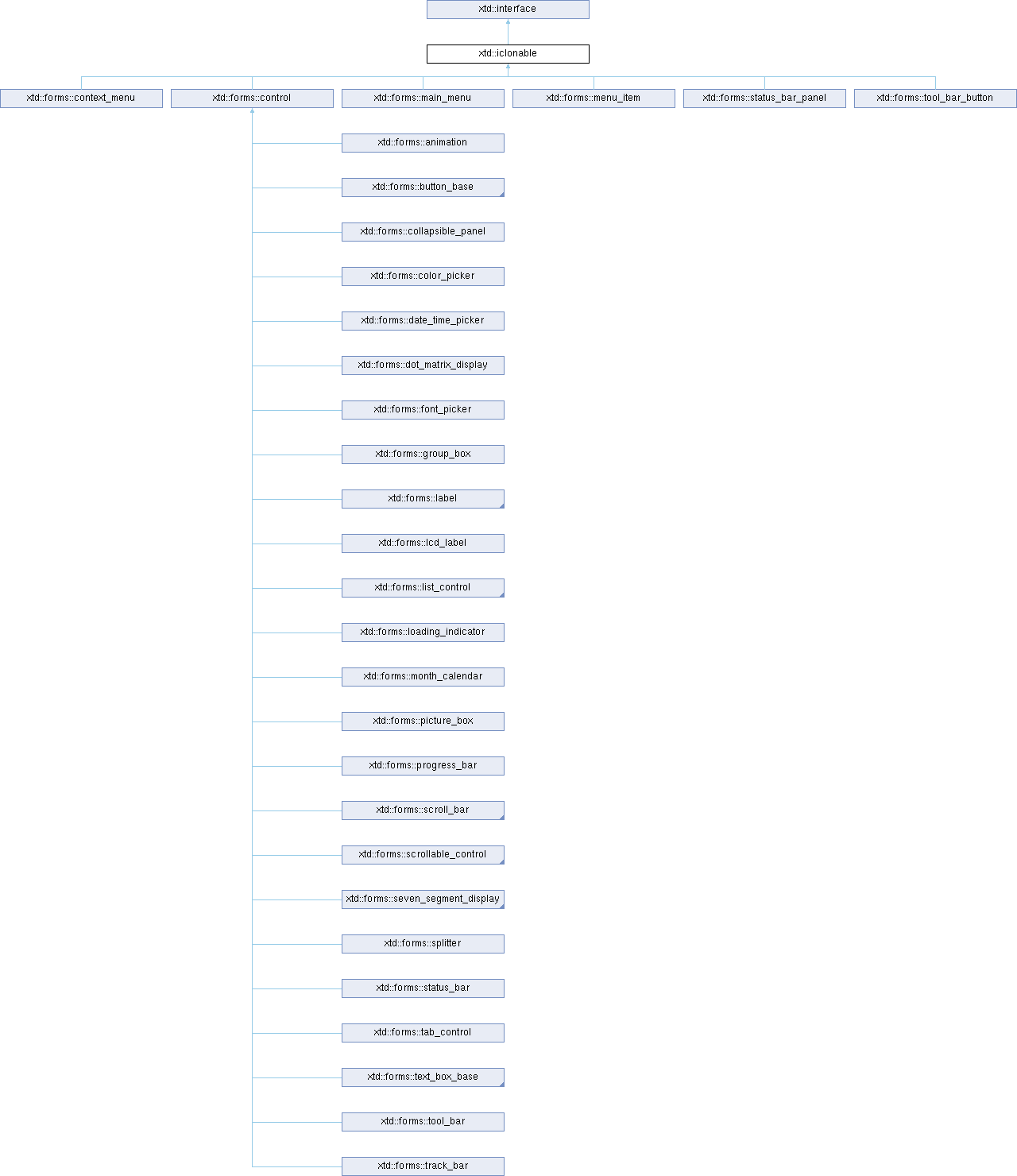
Inheritance diagram for xtd::iclonable:
Definition
Supports cloning, which creates a new instance of a class with the same value as an existing instance.
- Namespace
- xtd
- Library
- xtd.core
- Remarks
- The xtd::iclonable interface enables you to provide a customized implementation that creates a copy of an existing object. The xtd::iclonable interface contains one member, the xtd::iclonable::clone method, which is intended to provide cloning support beyond that supplied by xtd::object::memberwise_clone. For more information about cloning, deep versus shallow copies, and examples, see the xtd::object::memberwise_clone method.
- Notes to Implementers
- The xtd::iclonable interface simply requires that your implementation of the xtd::iclonable::clone() method return a copy of the current object instance. It does not specify whether the cloning operation performs a deep copy, a shallow copy, or something in between. Nor does it require all property values of the original instance to be copied to the new instance. For example, the xtd::iclonable::clone() method performs a shallow copy of all properties; it always sets this property value to false in the cloned object. Because callers of xtd::iclonable::clone() cannot depend on the method performing a predictable cloning operation, we recommend that xtd::iclonable not be implemented in public APIs. The following example demonstrates how to use xtd::iclonable interface. #include <xtd/xtd>public:explicit foo(int value) : value_ {value} {}private:int value_ = 0;};auto main() -> int {auto f1 = foo {42};console::write_line("f1 {{type = {}, value = {}}}", typeof_(f1), f1);console::write_line("f2 {{type = {}, value = {}}}", typeof_(f2), *f2);console::write_line("f3 {{type = {}, value = {}}}", typeof_(f3), *f3);}// This code produces the following output ://// f1 {type = foo, value = 42}// f2 {type = std::unique_ptr<xtd::object, std::default_delete<xtd::object>>, value = 42}// f3 {type = std::unique_ptr<foo, std::default_delete<foo>>, value = 42}Supports cloning, which creates a new instance of a class with the same value as an existing instance...Definition iclonable.hpp:21Supports all classes in the xtd class hierarchy and provides low-level services to derived classes....Definition object.hpp:40static auto format(const basic_string< char > &fmt, args_t &&... args) -> basic_string#define typeof_Used to obtain the type object of a specified type or object.Definition typeof.hpp:24xtd::unique_ptr_object< type_t > uptrThe xtd::uptr object is a unique pointer.Definition uptr.hpp:25auto new_uptr(args_t &&... args) -> xtd::uptr< type_t >xtd::new_uptr operator. This operator creates a xtd::uptr object.Definition new_uptr.hpp:24
Public Methods | |
| virtual auto | clone () const -> xtd::uptr< xtd::object >=0 |
| Creates a new object that is a copy of the current instance. | |
Member Function Documentation
◆ clone()
|
nodiscardpure virtual |
Creates a new object that is a copy of the current instance.
- Returns
- A new object that is a copy of this instance.
- Remarks
- The resulting clone must be of the same type as, or compatible with, the original instance.
- An implementation of xtd::iclonable::clone can perform either a deep copy or a shallow copy. In a deep copy, all objects are duplicated; in a shallow copy, only the top-level objects are duplicated and the lower levels contain references. Because callers of xtd::iclonable::clone cannot depend on the method performing a predictable cloning operation, we recommend that xtd::iclonable not be implemented in public APIs.
- See xtd::object::memberwise_clone for more information on cloning, deep versus shallow copies, and examples.
Implemented in xtd::collections::bit_array.
The documentation for this class was generated from the following file:
- xtd.core/include/xtd/iclonable.hpp
Generated on for xtd by Gammasoft. All rights reserved.