
|
xtd
1.0.0
|
Loading...
Searching...
No Matches
xtd::forms::screen Class Reference
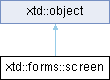
Inheritance diagram for xtd::forms::screen:
Definition
Represents a display device or multiple display devices on a single system.
- Header
- #include <xtd/forms/screen>
- Namespace
- xtd::forms
- Library
- xtd.forms
- Remarks
- The constructor for this object is not public, so you cannot explicitly create a screen object. The object is created when you call its public methods.
- Examples
- The following code example demonstrates the use of screen class. #include <xtd/xtd>auto main() -> int {xtd::drawing::rectangle area = screen::primary_screen().working_area();form form1;form1.text("screen 1/4");form1.visible(true);form form2;form2.text("screen 2/4");form2.visible(true);form form3;form3.start_position(form_start_position::manual);form3.text("screen 3/4");form3.visible(true);form form4;form4.start_position(form_start_position::manual);form4.location({area.location().x + area.size().width / 2, area.location().y + area.size().height / 2});form4.text("screen 4/4");form4.visible(true);application::run(form1);}virtual auto size() const noexcept -> xtd::drawing::sizeGets the height and width of the control.virtual auto text() const noexcept -> const xtd::string &Gets the text associated with this control.virtual auto location() const noexcept -> xtd::drawing::pointGets the coordinates of the upper-left corner of the control relative to the upper-left corner of its...Represents a window or dialog box that makes up an application's user interface.Definition form.hpp:54virtual auto start_position() const noexcept -> xtd::forms::form_start_positionGets the starting position of the form at run time.auto visible(bool visible) -> xtd::forms::control &overrideSets a value indicating whether the control and all its child controls are displayed.xtd::forms::style_sheets::control formThe form data allows you to specify the box of a form control.Definition form.hpp:23@ manualThe position of the form is determined by the Location property.Definition form_start_position.hpp:24Stores a set of four integers that represent the location and size of a rectangle.Definition rectangle.hpp:44auto size() const noexcept -> xtd::drawing::sizeGets the size of this xtd::drawing::rectangle.auto location() const noexcept -> xtd::drawing::pointGets the coordinates of the upper-left corner of this xtd::drawing::rectangle structure.
- Examples
- The following code example shows how to get screen informations of screen component. #include <xtd/xtd>public:main_form() {back_color(colors::dark_blue());client_size({450, 300});fore_color(colors::yellow());text("Screen informations example");screen_informations_text_box.dock(dock_style::fill);screen_informations_text_box.multiline(true);screen_informations_text_box.parent(*this);screen_informations_text_box.read_only(true);screen_informations_text_box.word_wrap(false);screen_informations_text_box.append_text(string::format("Number of screens: {}{}", screen::all_screens().length(), environment::new_line()));screen_informations_text_box.append_text(string::format("Standard pixels per inch: {}{}", screen::get_standard_pixels_per_inch(), environment::new_line()));auto index = 0;screen_informations_text_box.append_text(environment::new_line());screen_informations_text_box.append_text(string::format("Screen: {}\n", ++index, environment::new_line()));screen_informations_text_box.append_text(string::format(" Device name: {}{}", screen.device_name(), environment::new_line()));screen_informations_text_box.append_text(string::format(" Bounds: {}{}", screen.bounds(), environment::new_line()));screen_informations_text_box.append_text(string::format(" High resolution: {}{}", screen.high_resolution(), environment::new_line()));screen_informations_text_box.append_text(string::format(" working area: {}{}", screen.working_area(), environment::new_line()));screen_informations_text_box.append_text(string::format(" Primary: {}{}", screen.primary(), environment::new_line()));screen_informations_text_box.append_text(string::format(" Bits per pixels (Depth): {}{}", screen.bits_per_pixel(), environment::new_line()));screen_informations_text_box.append_text(string::format(" Pixels per Inch (PPI): {}{}", screen.pixels_per_inch(), environment::new_line()));screen_informations_text_box.append_text(string::format(" Scale factor: {}{}", screen.scale_factor()));}}private:text_box screen_informations_text_box;};auto main() -> int {xtd::forms::application::run(main_form());}static auto new_line() noexcept -> xtd::stringGets the newline string defined for this environment.static auto run() -> voidBegins running a standard application message loop on the current thread, without a form.Represents a display device or multiple display devices on a single system.Definition screen.hpp:32auto high_resolution() const noexcept -> boolGets a value indicating whether a particular display is high resolution.auto device_name() const -> const xtd::string &Gets the device name associated with a display.static auto get_standard_pixels_per_inch() -> xtd::int32Gets the the standard number of pixels per inch of the display.auto working_area() const noexcept -> const xtd::drawing::rectangle &Gets the working area of the display. The working area is the desktop area of the display,...auto scale_factor() const noexcept -> doubleGets the scale factor of the display.auto primary() const noexcept -> boolGets a value indicating whether a particular display is the primary device.auto bits_per_pixel() const noexcept -> xtd::int32Gets the number of bits of memory, associated with one pixel of data.auto bounds() const noexcept -> const xtd::drawing::rectangle &Gets the bounds of the display.static auto all_screens() -> xtd::array< screen >Gets an array of all displays on the system.auto pixels_per_inch() const noexcept -> xtd::int32Gets the number of pixels per inch of the display.static auto format(const basic_string< char > &fmt, args_t &&... args) -> basic_string@ fillAll the control's edges are docked to the all edges of its containing control and sized appropriately...Definition dock_style.hpp:35Contains classes that represent ASCII and Unicode character encodings; abstract base classes for conv...Definition basic_string_builder.hpp:14constexpr auto length() const noexcept -> size_typeReturns the length of the current read_only_span.Definition read_only_span.hpp:209Represents a type that can be used to index a collection either from the beginning or the end.Definition index.hpp:38
Public Properties | |
| auto | bits_per_pixel () const noexcept -> xtd::int32 |
| Gets the number of bits of memory, associated with one pixel of data. | |
| auto | bounds () const noexcept -> const xtd::drawing::rectangle & |
| Gets the bounds of the display. | |
| auto | device_name () const -> const xtd::string & |
| Gets the device name associated with a display. | |
| auto | high_resolution () const noexcept -> bool |
| Gets a value indicating whether a particular display is high resolution. | |
| auto | pixels_per_inch () const noexcept -> xtd::int32 |
| Gets the number of pixels per inch of the display. | |
| auto | primary () const noexcept -> bool |
| Gets a value indicating whether a particular display is the primary device. | |
| auto | scale_factor () const noexcept -> double |
| Gets the scale factor of the display. | |
| auto | working_area () const noexcept -> const xtd::drawing::rectangle & |
| Gets the working area of the display. The working area is the desktop area of the display, excluding taskbars, docked windows, and docked tool bars. | |
Public Methods | |
| auto | equals (const xtd::object &obj) const noexcept -> bool override |
| Determines whether the specified object is equal to the current object. | |
| auto | equals (const screen &other) const noexcept -> bool override |
| Determines whether the specified object is equal to the current object. | |
| auto | get_hash_code () const noexcept -> xtd::usize override |
| Serves as a hash function for a particular type. | |
Public Static Properties | |
| static auto | all_screens () -> xtd::array< screen > |
| Gets an array of all displays on the system. | |
| static auto | primary_screen () -> screen |
| Gets the primary display. | |
Public Static Methods | |
| static auto | create_graphics () -> xtd::drawing::graphics |
| Creates the xtd::drawing::graphics for the screen. | |
| static auto | from_control (const xtd::forms::control &control) -> screen |
| Retrieves a screen for the display that contains the largest portion of the specified control. | |
| static auto | from_handle (xtd::intptr handle) -> screen |
| Retrieves a screen for the display that contains the largest portion of the object referred to by the specified handle. | |
| static auto | from_point (const xtd::drawing::point &point) -> screen |
| Retrieves a screen for the display that contains the specified point. | |
| static auto | from_rectangle (const xtd::drawing::rectangle &rect) -> screen |
| Retrieves a screen for the display that contains the largest portion of the rectangle. | |
| static auto | get_bounds (const xtd::forms::control &control) -> xtd::drawing::rectangle |
| Retrieves the bounds of the display that contains the largest portion of the specified control. | |
| static auto | get_bounds (xtd::intptr handle) -> xtd::drawing::rectangle |
| Retrieves the bounds of the display that contains the largest portion of the specified handle. | |
| static auto | get_bounds (const xtd::drawing::point &point) -> xtd::drawing::rectangle |
| Retrieves the bounds of the display that contains the specified point. | |
| static auto | get_bounds (const xtd::drawing::rectangle &rect) -> xtd::drawing::rectangle |
| Retrieves the bounds of the display that contains the largest portion of the specified rectangle. | |
| static auto | get_standard_pixels_per_inch () -> xtd::int32 |
| Gets the the standard number of pixels per inch of the display. | |
| static auto | get_working_area (const xtd::forms::control &control) -> xtd::drawing::rectangle |
| Retrieves the working area for the display that contains the largest region of the specified control. The working area is the desktop area of the display, excluding taskbars, docked windows, and docked tool bars. | |
| static auto | get_working_area (xtd::intptr handle) -> xtd::drawing::rectangle |
| Retrieves the working area for the display that contains the largest region of the specified handle. The working area is the desktop area of the display, excluding taskbars, docked windows, and docked tool bars. | |
| static auto | get_working_area (const xtd::drawing::point &point) -> xtd::drawing::rectangle |
| Retrieves the working area closest to the specified point. The working area is the desktop area of the display, excluding taskbars, docked windows, and docked tool bars. | |
| static auto | get_working_area (const xtd::drawing::rectangle &rect) -> xtd::drawing::rectangle |
| Retrieves the working area for the display that contains the largest portion of the specified rectangle. The working area is the desktop area of the display, excluding taskbars, docked windows, and docked tool bars. | |
Additional Inherited Members | |
| object ()=default | |
| Create a new instance of the ultimate base class object. | |
| virtual auto | get_type () const noexcept -> type_object |
| Gets the type of the current instance. | |
| template<typename object_t> | |
| auto | memberwise_clone () const -> xtd::unique_ptr_object< object_t > |
| Creates a shallow copy of the current object. | |
| virtual auto | to_string () const -> xtd::string |
| Returns a xtd::string that represents the current object. | |
| virtual auto | equals (const screen &) const noexcept -> bool=0 |
| Indicates whether the current object is equal to another object of the same type. | |
| template<typename object_a_t, typename object_b_t> | |
| static auto | equals (const object_a_t &object_a, const object_b_t &object_b) noexcept -> bool |
| Determines whether the specified object instances are considered equal. | |
| template<typename object_a_t, typename object_b_t> | |
| static auto | reference_equals (const object_a_t &object_a, const object_b_t &object_b) noexcept -> bool |
| Determines whether the specified object instances are the same instance. | |
Member Function Documentation
◆ bits_per_pixel()
|
nodiscardnoexcept |
Gets the number of bits of memory, associated with one pixel of data.
- Returns
- The number of bits of memory, associated with one pixel of data.
- Remarks
- Typically, the number of bits per pixel for a screen is useful when working with bitmaps.
◆ bounds()
|
nodiscardnoexcept |
Gets the bounds of the display.
- Returns
- A xtd::drawing::rectangle, representing the bounds of the display.
◆ device_name()
|
nodiscard |
Gets the device name associated with a display.
- Returns
- The device name associated with a display.
- Remarks
- This string may contain non-printable characters.
◆ high_resolution()
|
nodiscardnoexcept |
Gets a value indicating whether a particular display is high resolution.
- Returns
- true if this display is high resolution; otherwise, false.
◆ pixels_per_inch()
|
nodiscardnoexcept |
Gets the number of pixels per inch of the display.
- Returns
- The number of pixels per inch of the display.
- Remarks
- See get_standard_pixels_per_inch() for more informations.
◆ primary()
|
nodiscardnoexcept |
Gets a value indicating whether a particular display is the primary device.
- Returns
- true if this display is primary; otherwise, false.
◆ scale_factor()
|
nodiscardnoexcept |
Gets the scale factor of the display.
- Returns
- The scale factor of the display.
- Remarks
- This value is computed from pixels_per_inch() for the display divided by get_standard_pixels_per_inch().
- If scale factor is equal to 1.0 is a standard display; greater than 1.0 is a high DPI display.
- See get_standard_pixels_per_inch() for more informations.
◆ working_area()
|
nodiscardnoexcept |
Gets the working area of the display. The working area is the desktop area of the display, excluding taskbars, docked windows, and docked tool bars.
- Returns
- A xtd::drawing::rectangle, representing the working area of the display.
- Remarks
- The working area is the desktop area of the display, excluding taskbars, docked windows, and docked tool bars.
- working_area will return the entire area of the screen if the Windows Taskbar is set to Auto-Hide, no matter whether the Taskbar is currently displayed or not.
◆ all_screens()
|
staticnodiscard |
Gets an array of all displays on the system.
- Returns
- An array of type screen, containing all displays on the system.
◆ primary_screen()
|
staticnodiscard |
Gets the primary display.
- Returns
- The primary display.
- Remarks
- For a single display system, the primary display is the only display.
◆ equals() [1/2]
|
nodiscardoverridevirtualnoexcept |
Determines whether the specified object is equal to the current object.
- Parameters
-
obj The object to compare with the current object.
- Returns
- true if the specified object is equal to the current object. otherwise, false.
Reimplemented from xtd::object.
◆ equals() [2/2]
|
nodiscardoverridenoexcept |
Determines whether the specified object is equal to the current object.
- Parameters
-
other The object to compare with the current object.
- Returns
- true if the specified object is equal to the current object. otherwise, false.
◆ get_hash_code()
|
nodiscardoverridevirtualnoexcept |
Serves as a hash function for a particular type.
- Returns
- A hash code for the current object.
Reimplemented from xtd::object.
◆ create_graphics()
|
staticnodiscard |
Creates the xtd::drawing::graphics for the screen.
- Returns
- A xtd::drawing::graphics for the screen.
◆ from_control()
|
staticnodiscard |
Retrieves a screen for the display that contains the largest portion of the specified control.
- Parameters
-
control A xtd::forms::control for which to retrieve a Screen.
- Returns
- A screen for the display that contains the largest region of the specified control. In multiple display environments where no display contains the control, the display closest to the specified control is returned.
◆ from_handle()
|
staticnodiscard |
Retrieves a screen for the display that contains the largest portion of the object referred to by the specified handle.
- Parameters
-
handle The window handle for which to retrieve the screen.
- Returns
- A screen for the display that contains the largest region of the object. In multiple display environments where no display contains any portion of the specified handle, the display closest to the object is returned.
◆ from_point()
|
staticnodiscard |
Retrieves a screen for the display that contains the specified point.
- Parameters
-
point A xtd::drawing::point that specifies the location for which to retrieve a screen.
- Returns
- A screen for the display that contains the point. In multiple display environments where no display contains the point, the display closest to the specified point is returned.
◆ from_rectangle()
|
staticnodiscard |
Retrieves a screen for the display that contains the largest portion of the rectangle.
- Parameters
-
A xtd::drawing::rectangle that specifies the area for which to retrieve the display.
- Returns
- A screen for the display that contains the largest region of the specified rectangle. In multiple display environments where no display contains the rectangle, the display closest to the rectangle is returned.
◆ get_bounds() [1/4]
|
staticnodiscard |
Retrieves the bounds of the display that contains the largest portion of the specified control.
- Parameters
-
control The control for which to retrieve the display bounds.
- Returns
- A xtd::drawing::rectangle that specifies the bounds of the display that contains the specified control. In multiple display environments where no display contains the specified control, the display closest to the control is returned.
◆ get_bounds() [2/4]
|
staticnodiscard |
Retrieves the bounds of the display that contains the largest portion of the specified handle.
- Parameters
-
handle The window handle for which to retrieve the display bounds.
- Returns
- A xtd::drawing::rectangle that specifies the bounds of the display that contains the specified handle. In multiple display environments where no display contains the specified handle, the display closest to the object is returned.
◆ get_bounds() [3/4]
|
staticnodiscard |
Retrieves the bounds of the display that contains the specified point.
- Parameters
-
point A xtd::drawing::point that specifies the coordinates for which to retrieve the display bounds.
- Returns
- A xtd::drawing::rectangle that specifies the bounds of the display that contains the specified point. In multiple display environments where no display contains the specified point, the display closest to the point is returned.
◆ get_bounds() [4/4]
|
staticnodiscard |
Retrieves the bounds of the display that contains the largest portion of the specified rectangle.
- Parameters
-
rect A xtd::drawing::rectangle that specifies the area for which to retrieve the display bounds.
- Returns
- A xtd::drawing::rectangle that specifies the bounds of the display that contains the specified rectangle. In multiple display environments where no monitor contains the specified rectangle, the monitor closest to the rectangle is returned.
◆ get_standard_pixels_per_inch()
|
staticnodiscard |
Gets the the standard number of pixels per inch of the display.
- Returns
- The standard number of pixels per inch of the display.
- Remarks
- In printing, DPI (dots per inch) refers to the output resolution of a printer, scanner or image setter, and PPI (pixels per inch) refers to the input resolution of a photograph, image or screen.
-
The following table shows the standard values by operating system :
Values and conversion Windows macOS linux Pixels per inch (PPI) 96 72 96 Pixels per centimeters (pixel/cm) 38 28 38 Pitch (µm) 265 353 265
◆ get_working_area() [1/4]
|
staticnodiscard |
Retrieves the working area for the display that contains the largest region of the specified control. The working area is the desktop area of the display, excluding taskbars, docked windows, and docked tool bars.
- Parameters
-
control The control for which to retrieve the working area.
- Returns
- A xtd::drawing::rectangle that specifies the working area. In multiple display environments where no display contains the specified control, the display closest to the control is returned.
◆ get_working_area() [2/4]
|
staticnodiscard |
Retrieves the working area for the display that contains the largest region of the specified handle. The working area is the desktop area of the display, excluding taskbars, docked windows, and docked tool bars.
- Parameters
-
handle The window handle for which to retrieve the working area.
- Returns
- A xtd::drawing::rectangle that specifies the working area. In multiple display environments where no display contains the specified handle, the display closest to the object is returned.
◆ get_working_area() [3/4]
|
staticnodiscard |
Retrieves the working area closest to the specified point. The working area is the desktop area of the display, excluding taskbars, docked windows, and docked tool bars.
- Parameters
-
point A xtd::drawing::point that specifies the coordinates for which to retrieve the working area.
- Returns
- A xtd::drawing::rectangle that specifies the working area. In multiple display environments where no display contains the specified point, the display closest to the point is returned.
◆ get_working_area() [4/4]
|
staticnodiscard |
Retrieves the working area for the display that contains the largest portion of the specified rectangle. The working area is the desktop area of the display, excluding taskbars, docked windows, and docked tool bars.
- Parameters
-
rect The xtd::drawing::rectangle that specifies the area for which to retrieve the working area.
- Returns
- A xtd::drawing::rectangle that specifies the working area. In multiple display environments where no display contains the specified rectangle, the display closest to the rectangle is returned.
The documentation for this class was generated from the following file:
- xtd.forms/include/xtd/forms/screen.hpp
Generated on for xtd by Gammasoft. All rights reserved.