
|
xtd
1.0.0
|
Loading...
Searching...
No Matches
xtd::io::binary_writer Class Reference
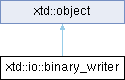
Inheritance diagram for xtd::io::binary_writer:
Definition
Writes primitive types in binary to a stream and supports writing strings.
binary_writer(const xtd::string &path)
Initializes a new instance of the binary_writer class for the specified file name.
Supports all classes in the xtd class hierarchy and provides low-level services to derived classes....
Definition object.hpp:40
- Inheritance
- xtd::object → xtd::io::binary_writer
- Header
- #include <xtd/io/binary_writer>
- Namespace
- xtd::io
- Library
- xtd.core
- Examples
- The following code example demonstrates how to store and retrieve application settings in a file. #include <xtd/xtd>class program {inline static const string file_name = "app_settings.dat";public:static auto main() {write_default_values();display_values();}static void write_default_values() {auto writer = binary_writer {fs};writer.write(1.250F);writer.write(R"(c:\Temp)");writer.write(10);writer.write(true);}}static void display_values() {auto aspect_ratio = .0f;auto temp_directory = string::empty_string;auto auto_save_time = 0;auto show_status_bar = false;if (file::exists(file_name)) {using_(auto fs = file::open(file_name, std::ios::in | std::ios::binary)) {auto reader = binary_reader {fs};aspect_ratio = reader.read_single();temp_directory = reader.read_string();auto_save_time = reader.read_int32();show_status_bar = reader.read_boolean();}console::write_line("Aspect ratio set to: {}", aspect_ratio);console::write_line("Temp directory is: {}", temp_directory);console::write_line("Auto save time set to: {}", auto_save_time);console::write_line("Show status bar: {}", show_status_bar);}}};startup_(program::main);// This code produces the following output ://// Aspect ratio set to: 1.25// Temp directory is: c:\Temp// Auto save time set to: 10// Show status bar: truestatic auto write_line() -> voidWrites the current line terminator to the standard output stream using the specified format informati...Writes primitive types in binary to a stream and supports writing strings.Definition binary_writer.hpp:47virtual auto write(bool value) -> voidWrites a one-byte boolean value to the current stream, with 0 representing false and 1 representing t...static auto open(const xtd::string &path, std::ios::openmode mode) -> std::fstreamOpens a FileStream on the specified path.#define using_(...)The specified expression is cleared automatically when the scope is ended.Definition using.hpp:36#define startup_(...)Defines the entry point to be called when the application loads. Generally this is set either to the ...Definition startup.hpp:152
- Examples
- The same example with stream operators. #include <xtd/xtd>class program {inline static const string file_name = "app_settings.dat";public:static auto main() {write_default_values();display_values();}static void write_default_values() {auto writer = binary_writer {fs};writer << 1.250F;writer << R"(c:\Temp)";writer << 10;writer << true;}}static void display_values() {auto aspect_ratio = .0f;auto temp_directory = string::empty_string;auto auto_save_time = 0;auto show_status_bar = false;if (file::exists(file_name)) {using_(auto fs = file::open(file_name, std::ios::in | std::ios::binary)) {auto reader = binary_reader {fs};reader >> aspect_ratio;reader >> temp_directory;reader >> auto_save_time;reader >> show_status_bar;}console::write_line("Aspect ratio set to: {}", aspect_ratio);console::write_line("Temp directory is: {}", temp_directory);console::write_line("Auto save time set to: {}", auto_save_time);console::write_line("Show status bar: {}", show_status_bar);}}};startup_(program::main);// This code produces the following output ://// Aspect ratio set to: 1.25// Temp directory is: c:\Temp// Auto save time set to: 10// Show status bar: true
- Remarks
- The xtd::io::binary_writer class provides methods that simplify writing primitive data types to a stream. For example, you can use the Write method to write a Boolean value to the stream as a one-byte value. The class includes write methods that support different data types.
- When you create a new instance of the xtd::io::binary_writer class, you provide the stream to write to.
- Note
- xtd xtd::io::binary_reader and xtd::io::binary_writer are fully compatible with .NET BinaryReader/BinaryWriter.
- Files written with xtd can be read directly in C# and vice versa, following the same binary format conventions (7-bit encoded string lengths, little-endian integers, etc.).
- Examples
- binary_reader3.cpp.
Public Constructors | |
| binary_writer (const xtd::string &path) | |
| Initializes a new instance of the binary_writer class for the specified file name. | |
| binary_writer (std::ostream &stream) | |
| Initializes a new instance of the binary_writer class for the specified stream. | |
Public Properties | |
| auto | base_stream () const -> std::optional< xtd::ref< std::ostream > > |
| Returns the underlying stream. | |
Public Methods | |
| virtual auto | close () -> void |
| Closes the xtd::io::binary_writer object and the underlying stream, and releases any system resources associated with the reader. | |
| virtual auto | flush () -> void |
| Clears all buffers for the current writer and causes any buffered data to be written to the underlying device. | |
| virtual auto | seek (xtd::usize offset, std::ios::seekdir origin) -> xtd::usize |
| Sets the position within the current stream. | |
| virtual auto | tell () -> std::streampos |
| Tell the current seek position of the readers stream;. | |
| virtual auto | write (bool value) -> void |
| Writes a one-byte boolean value to the current stream, with 0 representing false and 1 representing true. | |
| virtual auto | write (xtd::byte value) -> void |
| Writes an unsigned byte to the current stream and advances the stream position by one byte. | |
| virtual auto | write (char value) -> void |
| Writes a character to the current stream and advances the current position by one byte. | |
| template<xtd::usize size> | |
| auto | write (const std::array< xtd::byte, size > &buffer) -> void |
| Writes a byte array to the underlying stream. | |
| template<xtd::usize size> | |
| auto | write (const std::array< char, size > &buffer) -> void |
| Writes a character array to the underlying stream. | |
| virtual auto | write (const xtd::read_only_span< xtd::byte > &buffer) -> void |
| Writes a byte array to the underlying stream. | |
| virtual auto | write (const xtd::array< xtd::byte > &buffer, xtd::usize index, xtd::usize count) -> void |
| Writes a region of a byte array to the current stream. | |
| virtual auto | write (const xtd::read_only_span< char > &buffer) -> void |
| Writes a character array to the underlying stream. | |
| virtual auto | write (const xtd::array< char > &buffer, xtd::usize index, xtd::usize count) -> void |
| Writes a region of a character array to the current stream. | |
| virtual auto | write (double value) -> void |
| Writes an eight-byte floating-point value to the current stream and advances the stream position by eight bytes. | |
| virtual auto | write (int16 value) -> void |
| Writes a two-byte signed integer to the current stream and advances the stream position by two bytes. | |
| virtual auto | write (xtd::int32 value) -> void |
| Writes a four-byte signed integer to the current stream and advances the stream position by four bytes. | |
| virtual auto | write (xtd::int64 value) -> void |
| Writes a eight-byte signed integer to the current stream and advances the stream position by eight bytes. | |
| virtual auto | write (xtd::sbyte value) -> void |
| Writes an signed byte to the current stream and advances the stream position by one byte. | |
| virtual auto | write (float value) -> void |
| Writes an four-byte floating-point value to the current stream and advances the stream position by four bytes. | |
| virtual auto | write (const xtd::string &value) -> void |
| Writes a length-prefixed string to this stream, and advances the current position of the stream and the specific characters being written to the stream. | |
| virtual auto | write (xtd::uint16 value) -> void |
| Writes a two-byte unsigned integer to the current stream and advances the stream position by two bytes. | |
| virtual auto | write (xtd::uint32 value) -> void |
| Writes a four-byte unsigned integer to the current stream and advances the stream position by four bytes. | |
| virtual auto | write (xtd::uint64 value) -> void |
| Writes a eight-byte unsigned integer to the current stream and advances the stream position by eight bytes. | |
Additional Inherited Members | |
| object ()=default | |
| Create a new instance of the ultimate base class object. | |
| virtual auto | equals (const object &obj) const noexcept -> bool |
| Determines whether the specified object is equal to the current object. | |
| virtual auto | get_hash_code () const noexcept -> xtd::usize |
| Serves as a hash function for a particular type. | |
| virtual auto | get_type () const noexcept -> type_object |
| Gets the type of the current instance. | |
| template<typename object_t> | |
| auto | memberwise_clone () const -> xtd::unique_ptr_object< object_t > |
| Creates a shallow copy of the current object. | |
| virtual auto | to_string () const -> xtd::string |
| Returns a xtd::string that represents the current object. | |
| template<typename object_a_t, typename object_b_t> | |
| static auto | equals (const object_a_t &object_a, const object_b_t &object_b) noexcept -> bool |
| Determines whether the specified object instances are considered equal. | |
| template<typename object_a_t, typename object_b_t> | |
| static auto | reference_equals (const object_a_t &object_a, const object_b_t &object_b) noexcept -> bool |
| Determines whether the specified object instances are the same instance. | |
Constructor & Destructor Documentation
◆ binary_writer() [1/2]
|
explicit |
Initializes a new instance of the binary_writer class for the specified file name.
- Parameters
-
path The complete file path to be read.
- Exceptions
-
xtd::argument_exception path contains one or more of the invalid characters
-or-
The system could not retrieve the absolute path.xtd::io::io_exception the handle of the specified file cannot be opened
◆ binary_writer() [2/2]
|
explicit |
Initializes a new instance of the binary_writer class for the specified stream.
- Parameters
-
stream The stream to be read.
Member Function Documentation
◆ base_stream()
|
nodiscard |
Returns the underlying stream.
- Returns
- The underlying stream.
- Remarks
- For a list of common I/O tasks, see Common I/O Tasks.
◆ close()
|
virtual |
Closes the xtd::io::binary_writer object and the underlying stream, and releases any system resources associated with the reader.
◆ flush()
|
virtual |
Clears all buffers for the current writer and causes any buffered data to be written to the underlying device.
- Remarks
- This default method does nothing, but derived classes can virtual the method to provide the appropriate functionality
◆ seek()
|
virtual |
Sets the position within the current stream.
- Parameters
-
ofsset A byte offset relative to origin. origin A field of std::ios::seekdir indicating the reference point from which the new position is to be obtained.
- Returns
- The position with the current stream.
- Exceptions
-
xtd::io::io_exception The file pointer was moved to an invalid location.
- Remarks
- For a list of common I/O tasks, see Common I/O Tasks.
◆ tell()
|
nodiscardvirtual |
Tell the current seek position of the readers stream;.
- Returns
- The current seek position
◆ write() [1/19]
|
virtual |
Writes a one-byte boolean value to the current stream, with 0 representing false and 1 representing true.
- Parameters
-
value The boolean value to write (0 or 1).
- Exceptions
-
xtd::io::io_exception An I/O error occurs.
- Remarks
- For a list of common I/O tasks, see Common I/O Tasks.
◆ write() [2/19]
|
virtual |
Writes an unsigned byte to the current stream and advances the stream position by one byte.
- Parameters
-
value The unsigned byte to write.
- Exceptions
-
xtd::io::io_exception An I/O error occurs.
- Remarks
- For a list of common I/O tasks, see Common I/O Tasks.
◆ write() [3/19]
|
virtual |
Writes a character to the current stream and advances the current position by one byte.
- Parameters
-
value The character to write.
- Exceptions
-
xtd::io::io_exception An I/O error occurs.
- Remarks
- For a list of common I/O tasks, see Common I/O Tasks.
◆ write() [4/19]
template<xtd::usize size>
|
inline |
Writes a byte array to the underlying stream.
- Parameters
-
buffer A byte array containing the data to write.
- Exceptions
-
xtd::io::io_exception An I/O error occurs.
- Remarks
- For a list of common I/O tasks, see Common I/O Tasks.
◆ write() [5/19]
template<xtd::usize size>
|
inline |
Writes a character array to the underlying stream.
- Parameters
-
buffer A character array containing the data to write.
- Exceptions
-
xtd::io::io_exception An I/O error occurs.
- Remarks
- For a list of common I/O tasks, see Common I/O Tasks.
◆ write() [6/19]
|
virtual |
Writes a byte array to the underlying stream.
- Parameters
-
buffer A byte array containing the data to write.
- Exceptions
-
xtd::io::io_exception An I/O error occurs.
- Remarks
- For a list of common I/O tasks, see Common I/O Tasks.
◆ write() [7/19]
|
virtual |
Writes a region of a byte array to the current stream.
- Parameters
-
buffer A byte array containing the data to write. index The index of the first byte to read from buffer and to write to the stream. count The number of bytes to read from buffer and to write to the stream.
- Exceptions
-
xtd::argument_exception The buffer length minus index is less than count. xtd::io::io_exception An I/O error occurs.
- Remarks
- For a list of common I/O tasks, see Common I/O Tasks.
◆ write() [8/19]
|
virtual |
Writes a character array to the underlying stream.
- Parameters
-
buffer A character array containing the data to write.
- Exceptions
-
xtd::io::io_exception An I/O error occurs.
- Remarks
- For a list of common I/O tasks, see Common I/O Tasks.
◆ write() [9/19]
|
virtual |
Writes a region of a character array to the current stream.
- Parameters
-
buffer A character array containing the data to write. index The index of the first byte to read from buffer and to write to the stream. count The number of bytes to read from buffer and to write to the stream.
- Exceptions
-
xtd::argument_exception The buffer length minus index is less than count. xtd::io::io_exception An I/O error occurs.
- Remarks
- For a list of common I/O tasks, see Common I/O Tasks.
◆ write() [10/19]
|
virtual |
Writes an eight-byte floating-point value to the current stream and advances the stream position by eight bytes.
- Parameters
-
value The eight-byte floating-point value to write.
- Exceptions
-
xtd::io::io_exception An I/O error occurs.
- Remarks
- For a list of common I/O tasks, see Common I/O Tasks.
◆ write() [11/19]
|
virtual |
Writes a two-byte signed integer to the current stream and advances the stream position by two bytes.
- Parameters
-
value The two-byte signed integer to write.
- Exceptions
-
xtd::io::io_exception An I/O error occurs.
- Remarks
- For a list of common I/O tasks, see Common I/O Tasks.
◆ write() [12/19]
|
virtual |
Writes a four-byte signed integer to the current stream and advances the stream position by four bytes.
- Parameters
-
value The four-byte signed integer to write.
- Exceptions
-
xtd::io::io_exception An I/O error occurs.
- Remarks
- For a list of common I/O tasks, see Common I/O Tasks.
◆ write() [13/19]
|
virtual |
Writes a eight-byte signed integer to the current stream and advances the stream position by eight bytes.
- Parameters
-
value The eight-byte signed integer to write.
- Exceptions
-
xtd::io::io_exception An I/O error occurs.
- Remarks
- For a list of common I/O tasks, see Common I/O Tasks.
◆ write() [14/19]
|
virtual |
Writes an signed byte to the current stream and advances the stream position by one byte.
- Parameters
-
value The signed byte to write.
- Exceptions
-
xtd::io::io_exception An I/O error occurs.
- Remarks
- For a list of common I/O tasks, see Common I/O Tasks.
◆ write() [15/19]
|
virtual |
Writes an four-byte floating-point value to the current stream and advances the stream position by four bytes.
- Parameters
-
value The four-byte floating-point value to write.
- Exceptions
-
xtd::io::io_exception An I/O error occurs.
- Remarks
- For a list of common I/O tasks, see Common I/O Tasks.
◆ write() [16/19]
|
virtual |
Writes a length-prefixed string to this stream, and advances the current position of the stream and the specific characters being written to the stream.
- Parameters
-
value The value to write.
- Exceptions
-
xtd::io::io_exception An I/O error occurs.
- Remarks
- For a list of common I/O tasks, see Common I/O Tasks.
◆ write() [17/19]
|
virtual |
Writes a two-byte unsigned integer to the current stream and advances the stream position by two bytes.
- Parameters
-
value The two-byte unsigned integer to write.
- Exceptions
-
xtd::io::io_exception An I/O error occurs.
- Remarks
- For a list of common I/O tasks, see Common I/O Tasks.
◆ write() [18/19]
|
virtual |
Writes a four-byte unsigned integer to the current stream and advances the stream position by four bytes.
- Parameters
-
value The four-byte unsigned integer to write.
- Exceptions
-
xtd::io::io_exception An I/O error occurs.
- Remarks
- For a list of common I/O tasks, see Common I/O Tasks.
◆ write() [19/19]
|
virtual |
Writes a eight-byte unsigned integer to the current stream and advances the stream position by eight bytes.
- Parameters
-
value The eight-byte unsigned integer to write.
- Exceptions
-
xtd::io::io_exception An I/O error occurs.
- Remarks
- For a list of common I/O tasks, see Common I/O Tasks.
The documentation for this class was generated from the following file:
- xtd.core/include/xtd/io/binary_writer.hpp
Generated on for xtd by Gammasoft. All rights reserved.