
|
xtd
1.0.0
|
Loading...
Searching...
No Matches
xtd::io::path Class Reference
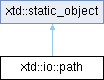
Inheritance diagram for xtd::io::path:
Definition
Performs operations on std::basic_string instances that contain file or directory path information. These operations are performed in a cross-platform manner.
Performs operations on std::basic_string instances that contain file or directory path information....
Definition path.hpp:33
#define static_
This keyword is use to represent a static object. A static object can't be instantiated (constructors...
Definition static.hpp:38
- Inheritance
- xtd::static_object → xtd::io::path
- Header
- #include <xtd/io/path>
- Namespace
- xtd::io
- Library
- xtd.core
Public Fields | |
| template<typename char_t> | |
| static auto | alt_directory_separator_char () noexcept -> char_t |
| Provides a platform-specific alternate character used to separate directory levels in a path string that reflects a hierarchical file system organization. | |
| static auto | alt_directory_separator_char () noexcept -> char |
| Provides a platform-specific alternate character used to separate directory levels in a path string that reflects a hierarchical file system organization. | |
| template<typename char_t> | |
| static auto | directory_separator_char () noexcept -> char_t |
| Provides a platform-specific character used to separate directory levels in a path string that reflects a hierarchical file system organization. | |
| static auto | directory_separator_char () noexcept -> char |
| Provides a platform-specific character used to separate directory levels in a path string that reflects a hierarchical file system organization. | |
| template<typename char_t> | |
| static auto | path_separator () noexcept -> char_t |
| A platform-specific separator character used to separate path strings in environment variables. | |
| static auto | path_separator () noexcept -> char |
| A platform-specific separator character used to separate path strings in environment variables. | |
| template<typename char_t> | |
| static auto | volume_separator_char () noexcept -> char_t |
| Provides a platform-specific volume separator character. | |
| static auto | volume_separator_char () noexcept -> char |
| Provides a platform-specific volume separator character. | |
Public Static Methods | |
| static auto | change_extension (const xtd::string &path, const xtd::string &extension) -> xtd::string |
| Changes the extension of a path string. | |
| static auto | combine (const xtd::string &path1, const xtd::string &path2) -> xtd::string |
| Combines two path strings. | |
| template<typename type1_t, typename type2_t, typename type3_t> | |
| static auto | combine (type1_t path1, type2_t path2, type3_t path3) noexcept |
| Combines three path strings. | |
| template<typename type1_t, typename type2_t, typename type3_t, typename type4_t> | |
| static auto | combine (type1_t path1, type2_t path2, type3_t path3, type4_t path4) noexcept |
| Combines four path strings. | |
| template<typename path_t> | |
| static auto | combine (path_t paths) noexcept -> xtd::string |
| Combines path strings array. | |
| static auto | combine (const std::initializer_list< xtd::string > &paths) noexcept -> xtd::string |
| Combines path strings array. | |
| static auto | get_directory_name (const xtd::string &path) -> xtd::string |
| Returns the directory information for the specified path string. | |
| static auto | get_extension (const xtd::string &path) -> xtd::string |
| Returns the extension of the specified path string. | |
| static auto | get_file_name (const xtd::string &path) -> xtd::string |
| Returns the file name and extension of the specified path string. | |
| static auto | get_file_name_without_extension (const xtd::string &path) -> xtd::string |
| Returns the file name of the specified path string without the extension. | |
| static auto | get_full_path (const xtd::string &path) -> xtd::string |
| Returns the absolute path for the specified path string. | |
| template<typename char_t> | |
| static auto | get_invalid_path_chars () noexcept -> xtd::array< char_t > |
| Gets an array containing the characters that are not allowed in path names. | |
| static auto | get_invalid_path_chars () noexcept -> xtd::array< char > |
| Gets an array containing the characters that are not allowed in path names. | |
| static auto | get_path_root (const xtd::string &path) -> xtd::string |
| Gets the root directory information of the specified path. | |
| static auto | get_random_file_name () -> xtd::string |
| Returns a random folder name or file name. | |
| static auto | get_random_file_name (xtd::usize name_length) -> xtd::string |
| Returns a random folder name or file name with specified name length. | |
| static auto | get_random_file_name (xtd::usize name_size, xtd::usize extension_size) -> xtd::string |
| Returns a random folder name or file name with specified name length, and extension length. | |
| static auto | get_temp_file_name () -> xtd::string |
| Creates a uniquely named, zero-byte temporary file on disk and returns the full path of that file. | |
| static auto | get_temp_path () noexcept -> xtd::string |
| Returns the path of the current user's temporary folder. | |
| static auto | has_extension (const xtd::string &path) -> bool |
| Determines whether a path includes a file name extension. | |
| static auto | is_path_rooted (const xtd::string &path) -> bool |
| Gets a value indicating whether the specified path string contains absolute or relative path information. | |
Member Function Documentation
◆ alt_directory_separator_char() [1/2]
template<typename char_t>
|
inlinestaticnodiscardnoexcept |
Provides a platform-specific alternate character used to separate directory levels in a path string that reflects a hierarchical file system organization.
- Returns
- char_t character used to separate directory levels.
- Remarks
- This method can have the same value as directory_separator_char. alt_directory_separator_char and directory_separator_char are both valid for separating directory levels in a path string.
- The value of this field is a slash ('/') on both Windows and Unix-based operating systems.
- Examples
- The following code example demonstrates the use of the alt_directory_separator_char() property.
◆ alt_directory_separator_char() [2/2]
|
staticnodiscardnoexcept |
Provides a platform-specific alternate character used to separate directory levels in a path string that reflects a hierarchical file system organization.
- Returns
- char character used to separate directory levels.
- Remarks
- This method can have the same value as directory_separator_char. alt_directory_separator_char and directory_separator_char are both valid for separating directory levels in a path string.
- The value of this field is a slash ('/') on both Windows and Unix-based operating systems.
- Examples
- The following code example demonstrates the use of the alt_directory_separator_char() property.
◆ directory_separator_char() [1/2]
template<typename char_t>
|
inlinestaticnodiscardnoexcept |
Provides a platform-specific character used to separate directory levels in a path string that reflects a hierarchical file system organization.
- Returns
- char_t Platform-specific character used to separate directory levels.
- Remarks
- alt_directory_separator_char and directory_separator_char are both valid for separating directory levels in a path string.
- Examples
- The following code example demonstrates the use of the directory_separator_char() property.
◆ directory_separator_char() [2/2]
|
staticnodiscardnoexcept |
Provides a platform-specific character used to separate directory levels in a path string that reflects a hierarchical file system organization.
- Returns
- char Platform-specific character used to separate directory levels.
- Remarks
- alt_directory_separator_char and directory_separator_char are both valid for separating directory levels in a path string.
- Examples
- The following code example demonstrates the use of the directory_separator_char() property.
◆ path_separator() [1/2]
template<typename char_t>
|
inlinestaticnodiscardnoexcept |
A platform-specific separator character used to separate path strings in environment variables.
- Examples
- The following code example demonstrates the use of the PathSeparator() property.
◆ path_separator() [2/2]
|
staticnodiscardnoexcept |
A platform-specific separator character used to separate path strings in environment variables.
- Examples
- The following code example demonstrates the use of the PathSeparator() property.
◆ volume_separator_char() [1/2]
template<typename char_t>
|
inlinestaticnodiscardnoexcept |
Provides a platform-specific volume separator character.
- Examples
- The following code example demonstrates the use of the volume_separator_char() property.
◆ volume_separator_char() [2/2]
|
staticnodiscardnoexcept |
Provides a platform-specific volume separator character.
- Examples
- The following code example demonstrates the use of the volume_separator_char() property.
◆ change_extension()
|
staticnodiscard |
Changes the extension of a path string.
- Parameters
-
path The path information to modify. The path cannot contain any of the characters defined in GetInvalidPathchar_ts. extension The new extension (with or without a leading period). Specify null to remove an existing extension from path.
- Returns
- string The modified path information.
- Note
- On Windows-based desktop platforms, if path is an empty string (""), the path information is returned unmodified. If extension is empty string (""), the returned string contains the specified path with its extension removed. If path has no extension, and extension is not empty, the returned path string contains extension appended to the end of path.
- Remarks
- If neither path nor extension contains a period (.), change_extension adds the period.
- The extension parameter can contain multiple periods and any valid path characters, and can be any length. If extension is empty (""), the returned string contains the contents of path with the last period and all characters following it removed.
- If extension is an empty string, the returned path string contains the contents of path with any characters following the last period removed.
- If extension does not contain a leading period, the period is added.
- If path contains a multiple extension separated by multiple periods, the returned string contains the contents of path with the last period and all characters following it replaced by extension. For example, if path is "\Dir1\examples\pathtests.csx.txt" and extension is "cs", the modified path is "\Dir1\examples\pathtests.csx.cs".
- It is not possible to verify that the returned results are valid in all scenarios. For example, if path is empty, extension is appended.
◆ combine() [1/5]
|
staticnodiscard |
Combines two path strings.
- Parameters
-
path1 The first path. path2 The second path.
- Returns
- A string containing the combined paths. If one of the specified paths is a zero-length string, this method returns the other path. If path2 contains an absolute path, this method returns path2.
- Remarks
- an empty string if path contains one or more of the invalid characters.
◆ combine() [2/5]
template<typename type1_t, typename type2_t, typename type3_t>
|
inlinestaticnodiscardnoexcept |
Combines three path strings.
- Parameters
-
path1 The first path. path2 The second path. path3 The third path.
- Returns
- A string containing the combined paths. If one of the specified paths is a zero-length string, this method returns the other path. If path2 contains an absolute path, this method returns path2.
- Remarks
- an empty string if path contains one or more of the invalid characters.
◆ combine() [3/5]
template<typename type1_t, typename type2_t, typename type3_t, typename type4_t>
|
inlinestaticnodiscardnoexcept |
Combines four path strings.
- Parameters
-
path1 The first path. path2 The second path. path3 The third path. path4 The fourth path.
- Returns
- A string containing the combined paths. If one of the specified paths is a zero-length string, this method returns the other path. If path2 contains an absolute path, this method returns path2.
- Remarks
- an empty string if path contains one or more of the invalid characters.
◆ combine() [4/5]
template<typename path_t>
|
inlinestaticnodiscardnoexcept |
Combines path strings array.
- Parameters
-
paths The path array.
- Returns
- A string containing the combined paths. If one of the specified paths is a zero-length string, this method returns the other path. If path2 contains an absolute path, this method returns path2.
- Remarks
- an empty string if path contains one or more of the invalid characters.
◆ combine() [5/5]
|
staticnodiscardnoexcept |
Combines path strings array.
- Parameters
-
paths The path array.
- Returns
- A string containing the combined paths. If one of the specified paths is a zero-length string, this method returns the other path. If path2 contains an absolute path, this method returns path2.
- Remarks
- an empty string if path contains one or more of the invalid characters.
◆ get_directory_name()
|
staticnodiscard |
Returns the directory information for the specified path string.
- Parameters
-
path the path of a file or directory.
- Returns
- A string containing directory information for path, or null if path denotes a root directory, is the empty string ("").
- Remarks
- Returns string empty if path does not contain directory information.
◆ get_extension()
|
staticnodiscard |
Returns the extension of the specified path string.
- Parameters
-
path The path string from which to get the extension.
- Returns
- An xtd::string containing the extension of the specified path (including the ".") or xtd::string::empty.
- Remarks
- If path is empty, GetExtension returns string empty. If path does not have extension information, GetExtension returns string empty ("").
◆ get_file_name()
|
staticnodiscard |
Returns the file name and extension of the specified path string.
- Parameters
-
path The path string from which to obtain the file name and extension.
- Returns
- The characters after the last directory separator character in path. If the last character of path is a directory or volume separator character, this method returns string empty ("").
- Remarks
- The separator characters used to determine the start of the file name are directory_separator_char and alt_directory_separator_char.
◆ get_file_name_without_extension()
|
staticnodiscard |
Returns the file name of the specified path string without the extension.
- Parameters
-
path The path of the file.
- Returns
- The string returned by xtd::io::path::get_file_name, minus the last period (.) and all characters following it.
- Remarks
- This method does not verify that the path or file name exists.
◆ get_full_path()
|
staticnodiscard |
Returns the absolute path for the specified path string.
- Parameters
-
path The file or directory for which to obtain absolute path information.
- Returns
- A string containing the fully qualified location of path, such as "C:\\MyFile.txt".
◆ get_invalid_path_chars() [1/2]
template<typename char_t>
|
inlinestaticnodiscardnoexcept |
Gets an array containing the characters that are not allowed in path names.
- Returns
- An array containing the characters that are not allowed in path names.
- Remarks
- The array returned from this method is not guaranteed to contain the complete set of characters that are invalid in file and directory names. The full set of invalid characters can vary by file system. For example, on Windows-based desktop platforms, invalid path characters might include ASCII/Unicode characters 1 through 31, as well as quote ("), less than (<), greater than (>), pipe (|), backspace (), null (\0) and tab (\t).
◆ get_invalid_path_chars() [2/2]
|
staticnodiscardnoexcept |
Gets an array containing the characters that are not allowed in path names.
- Returns
- An array containing the characters that are not allowed in path names.
- Remarks
- The array returned from this method is not guaranteed to contain the complete set of characters that are invalid in file and directory names. The full set of invalid characters can vary by file system. For example, on Windows-based desktop platforms, invalid path characters might include ASCII/Unicode characters 1 through 31, as well as quote ("), less than (<), greater than (>), pipe (|), backspace (), null (\0) and tab (\t).
◆ get_path_root()
|
staticnodiscard |
Gets the root directory information of the specified path.
- Parameters
-
path The path from which to obtain root directory information.
- Returns
- A string containing the root directory of path, such as "C:\", or null if
- path is null, or an empty string if path does not contain root directory
- information.
◆ get_random_file_name() [1/3]
|
staticnodiscard |
Returns a random folder name or file name.
- Returns
- A random folder name or file name.
- Remarks
- The get_random_file_name method returns a cryptographically strong, random string that can be used as either a folder name or a file name. Unlike GetTempFileName, get_random_file_name does not create a file. When the security of your file system is paramount, this method should be used instead of GetTempFileName.
- The default name length is 8 and the default extension length is 3.
- Examples
- file_assert.cpp, file_assume.cpp, and file_valid.cpp.
◆ get_random_file_name() [2/3]
|
staticnodiscard |
Returns a random folder name or file name with specified name length.
name_length The lname legnth.
- Returns
- A random folder name or file name.
- Remarks
- The get_random_file_name method returns a cryptographically strong, random string that can be used as either a folder name or a file name. Unlike GetTempFileName, get_random_file_name does not create a file. When the security of your file system is paramount, this method should be used instead of GetTempFileName.
- The default extension length is 0.
◆ get_random_file_name() [3/3]
|
staticnodiscard |
Returns a random folder name or file name with specified name length, and extension length.
name_length The name legnth.
extension_size The extension legnth.
- Returns
- A random folder name or file name.
- Remarks
- The get_random_file_name method returns a cryptographically strong, random string that can be used as either a folder name or a file name. Unlike GetTempFileName, get_random_file_name does not create a file. When the security of your file system is paramount, this method should be used instead of GetTempFileName.
◆ get_temp_file_name()
|
staticnodiscard |
Creates a uniquely named, zero-byte temporary file on disk and returns the full path of that file.
- Returns
- The full path of the temporary file.
- Remarks
- This method creates a temporary file with a .TMP file extension. The temporary file is created within the user’s temporary folder, which is the path returned by the GetTempPath method.
- The GetTempFileName method will raise an xtd::io_exception if it is used to create more than 65535 files without deleting previous temporary files.
- The GetTempFileName method will raise an xtd::io_exception if no unique temporary file name is available. To resolve this error, delete all unneeded temporary files.
◆ get_temp_path()
|
staticnodiscardnoexcept |
Returns the path of the current user's temporary folder.
- Returns
- string The path to the temporary folder, ending with a backslash.
- Remarks
- This method checks for the existence of environment variables in the following order and uses the first path found:
- The path specified by the TMP environment variable.
- The path specified by the TEMP environment variable.
- The path specified by the USERPROFILE environment variable.
- The Windows directory.
- Examples
- directory_assert.cpp, directory_assert_are_equal.cpp, directory_assert_are_not_equal.cpp, directory_assert_does_not_exist.cpp, directory_assert_exists.cpp, directory_assume.cpp, directory_assume_are_equal.cpp, directory_assume_are_not_equal.cpp, directory_assume_does_not_exist.cpp, directory_assume_exists.cpp, directory_valid.cpp, directory_valid_are_equal.cpp, directory_valid_are_not_equal.cpp, directory_valid_does_not_exist.cpp, and directory_valid_exists.cpp.
◆ has_extension()
|
staticnodiscard |
Determines whether a path includes a file name extension.
- Parameters
-
path The path to search for an extension.
- Returns
- true if the characters that follow the last directory separator (\ or /)
- or volume separator (:) in the path include a period (.) followed by one
- or more characters; otherwise, false.
◆ is_path_rooted()
|
staticnodiscard |
Gets a value indicating whether the specified path string contains absolute or relative path information.
- Parameters
-
path The path to test.
- Returns
- true if path contains an absolute path; otherwise, false.
- Remarks
- This method also returns false if path is empty or an invalid path.
- If the caller does not have sufficient permissions to read the specified file, no exception is thrown and the method returns false regardless of the existence of path.
The documentation for this class was generated from the following file:
- xtd.core/include/xtd/io/path.hpp
Generated on for xtd by Gammasoft. All rights reserved.