
|
xtd
1.0.0
|
Loading...
Searching...
No Matches
xtd::system_exception Class Reference
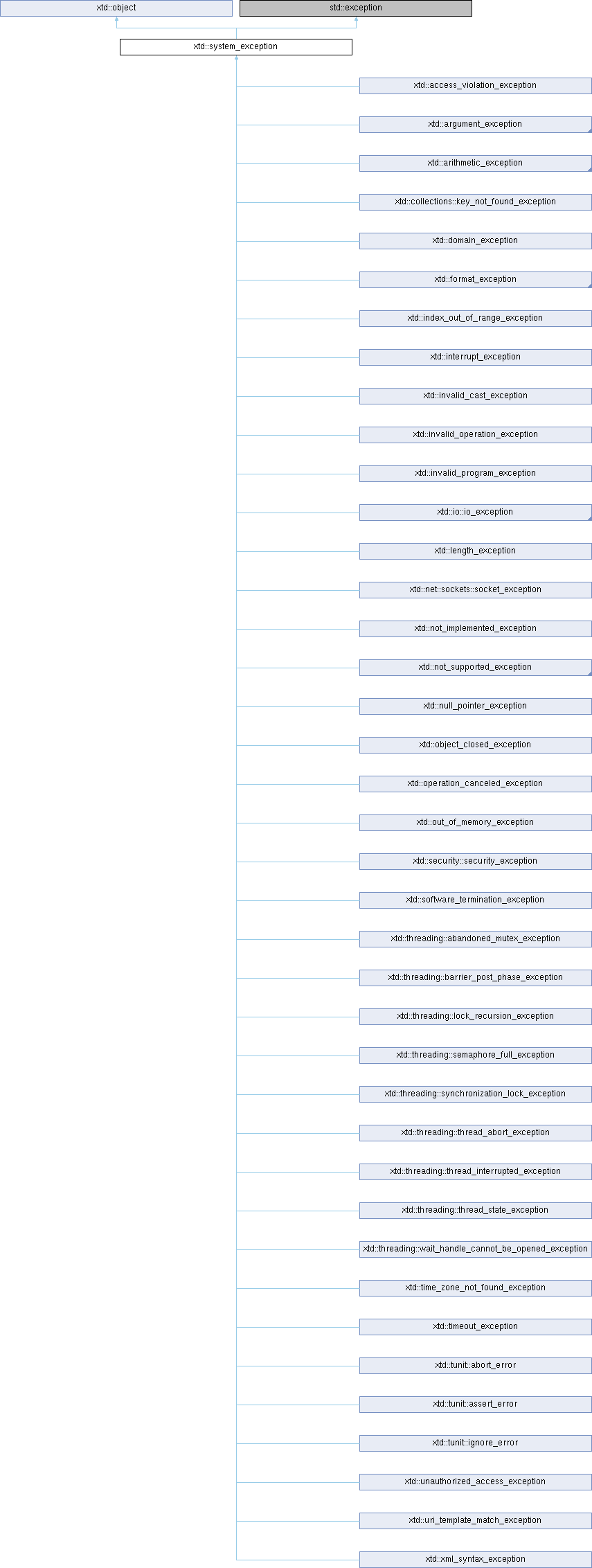
Inheritance diagram for xtd::system_exception:
Definition
The exception that is thrown when a method call is invalid for the object's current state.
- Namespace
- xtd
- Library
- xtd.core
- Examples
- The following example demonstrates how to throw and catch an system_exception. #include <xtd/xtd>auto create_handle() -> intptr {}delete reinterpret_cast<object*>(handle);}auto main() -> int {try {auto handle = 0l;// The following line is commented out so that the exception is generated.//handle = create_handle();destroy_handle(handle);} catch (const system_exception& e) {console::write_line("Exception occured :");console::write_line("-------------------");console::write_line(e);}}// This code can produce the following output ://// Exception occured :// -------------------// xtd::system_exception : The handle is null// at xtd::system_exception::system_exception(std::__1::optional<xtd::basic_string<char, std::__1::char_traits<char>, std::__1::allocator<char>>> const&, xtd::diagnostics::stack_frame const&) in system_exception.cpp:line 12// at destroy_handle(long) in system_exception.cpp:line 8// at main in system_exception.cpp:line 18Represents a globally unique identifier (GUID). A GUID is a 128-bit integer (16 bytes) that can be us...Definition guid.hpp:23The exception that is thrown when a method call is invalid for the object's current state.Definition system_exception.hpp:18
Public Constructors | |
| system_exception (const xtd::diagnostics::stack_frame &stack_frame=xtd::diagnostics::stack_frame::current()) | |
| Create a new instance of class xtd::system_exception. | |
| system_exception (const xtd::optional< xtd::string > &message, const xtd::diagnostics::stack_frame &stack_frame=xtd::diagnostics::stack_frame::current()) | |
| Create a new instance of class xtd::system_exception. | |
| template<typename exception_t> | |
| system_exception (const xtd::optional< xtd::string > &message, const exception_t &inner_exception, const xtd::diagnostics::stack_frame &stack_frame=xtd::diagnostics::stack_frame::current()) | |
| Create a new instance of class xtd::system_exception. | |
Public Deprecated Properties | |
| virtual auto | file_path () const noexcept -> const xtd::string & |
| Gets file path where exception occurred. | |
| virtual auto | line_number () const noexcept -> xtd::usize |
| Gets Line number where the exception occurred. | |
| virtual auto | member_name () const noexcept -> const xtd::string & |
| Gets file member where exception occurred. | |
| virtual auto | name () const noexcept -> const xtd::string & |
| Gets full class name the exception. | |
Public Deprecated Constructors | |
| system_exception (const xtd::string &message, const std::error_code &error, const xtd::diagnostics::stack_frame &stack_frame=xtd::diagnostics::stack_frame::current()) | |
| Create a new instance of class xtd::system_exception. | |
| system_exception (const xtd::string &message, const xtd::string &help_link, const xtd::diagnostics::stack_frame &stack_frame=xtd::diagnostics::stack_frame::current()) | |
| Create a new instance of class xtd::system_exception. | |
| system_exception (const xtd::string &message, const std::error_code &error, const xtd::string &help_link, const xtd::diagnostics::stack_frame &stack_frame=xtd::diagnostics::stack_frame::current()) | |
| Create a new instance of class xtd::system_exception. | |
| system_exception (const std::exception &inner_exception, const xtd::diagnostics::stack_frame &stack_frame=xtd::diagnostics::stack_frame::current()) | |
| Create a new instance of class xtd::system_exception. | |
| system_exception (const xtd::string &message, const std::exception &inner_exception, const xtd::diagnostics::stack_frame &stack_frame=xtd::diagnostics::stack_frame::current()) | |
| Create a new instance of class xtd::system_exception. | |
| system_exception (const xtd::string &message, const std::exception &inner_exception, const std::error_code &error, const xtd::diagnostics::stack_frame &stack_frame=xtd::diagnostics::stack_frame::current()) | |
| Create a new instance of class xtd::system_exception. | |
| system_exception (const xtd::string &message, const std::exception &inner_exception, const xtd::string &help_link, const xtd::diagnostics::stack_frame &stack_frame=xtd::diagnostics::stack_frame::current()) | |
| Create a new instance of class xtd::system_exception. | |
| system_exception (const xtd::string &message, const std::exception &inner_exception, const std::error_code &error, const xtd::string &help_link, const xtd::diagnostics::stack_frame &stack_frame=xtd::diagnostics::stack_frame::current()) | |
| Create a new instance of class xtd::system_exception. | |
Additional Inherited Members | |
| using | exception_ref |
| Optional reference wrapper on std::exception. | |
| exception (const xtd::diagnostics::stack_frame &stack_frame=xtd::diagnostics::stack_frame::current()) | |
| Create a new instance of class exception. | |
| exception (const xtd::optional< xtd::string > &message, const xtd::diagnostics::stack_frame &stack_frame=xtd::diagnostics::stack_frame::current()) | |
| Create a new instance of class exception. | |
| template<typename exception_t> | |
| exception (const xtd::optional< xtd::string > &message, const exception_t &inner_exception, const xtd::diagnostics::stack_frame &stack_frame=xtd::diagnostics::stack_frame::current()) | |
| Create a new instance of class exception. | |
| virtual auto | help_link () const noexcept -> const xtd::string & |
| Gets a link to the help file associated with this exception. | |
| virtual auto | help_link (const xtd::string &value) noexcept -> void |
| Sets a link to the help file associated with this exception. | |
| virtual auto | h_result () const noexcept -> xtd::int32 |
| Gets HRESULT, a coded numerical value that is assigned to a specific exception. | |
| virtual auto | h_result (xtd::int32 value) noexcept -> void |
| Sets HRESULT, a coded numerical value that is assigned to a specific exception. | |
| virtual auto | error_code () const noexcept -> const std::error_code & |
| Gets error associate to the exception. | |
| virtual auto | error_code (const std::error_code &value) noexcept -> void |
| Sets error associate to the exception. | |
| virtual auto | inner_exception () const noexcept -> exception_ref |
| Gets the exception instance that caused the current exception. | |
| virtual auto | message () const noexcept -> const xtd::string & |
| Gets message associate to the exception. | |
| virtual auto | source () const noexcept -> const xtd::string & |
| Gets the name of the application or the object that causes the error. | |
| virtual auto | source (const xtd::string &value) noexcept -> void |
| Sets the name of the application or the object that causes the error. | |
| virtual auto | stack_trace () const noexcept -> xtd::string |
| Gets a string representation of the immediate frames on the call stack. | |
| virtual auto | get_last_stack_frame () const noexcept -> const xtd::diagnostics::stack_frame & |
| Gets the last stack frame where the exception occurred. | |
| auto | to_string () const noexcept -> xtd::string override |
| Returns a string that represents the current exception. | |
| auto | what () const noexcept -> const char *override |
| Gets message associate to the exception. | |
| object ()=default | |
| Create a new instance of the ultimate base class object. | |
| virtual auto | equals (const object &obj) const noexcept -> bool |
| Determines whether the specified object is equal to the current object. | |
| virtual auto | get_hash_code () const noexcept -> xtd::usize |
| Serves as a hash function for a particular type. | |
| virtual auto | get_type () const noexcept -> type_object |
| Gets the type of the current instance. | |
| template<typename object_t> | |
| auto | memberwise_clone () const -> xtd::unique_ptr_object< object_t > |
| Creates a shallow copy of the current object. | |
| static auto | enable_stack_trace () noexcept -> bool |
| Gets if the generation of the stack trace is enabled. | |
| static auto | enable_stack_trace (bool enable) noexcept -> void |
| Sets if the generation of the stack trace is enabled. @paran enable triue if stack trace enabled; otherwise false. | |
| static auto | show_exception (const std::exception &e) -> xtd::int32 |
| Shows speciefied exception with xtd::forms::exception_dialog or xtd::console. | |
| static auto | show_exception () -> xtd::int32 |
| Shows unspecified exception with xtd::forms::exception_dialog or xtd::console. | |
| template<typename object_a_t, typename object_b_t> | |
| static auto | equals (const object_a_t &object_a, const object_b_t &object_b) noexcept -> bool |
| Determines whether the specified object instances are considered equal. | |
| template<typename object_a_t, typename object_b_t> | |
| static auto | reference_equals (const object_a_t &object_a, const object_b_t &object_b) noexcept -> bool |
| Determines whether the specified object instances are the same instance. | |
Constructor & Destructor Documentation
◆ system_exception() [1/11]
|
explicit |
Create a new instance of class xtd::system_exception.
- Parameters
-
stack_frame (optional) Contains current stack frame about member name, file path and line number in the file where the exception is occurred. Typically xtd::diagnostics::stack_frame::current().
- Remarks
- Message is set with the default message associate to the exception.
◆ system_exception() [2/11]
|
explicit |
Create a new instance of class xtd::system_exception.
- Parameters
-
message Message string associate to the exception. stack_frame (optional) Contains current stack frame about member name, file path and line number in the file where the exception is occurred. Typically xtd::diagnostics::stack_frame::current().
◆ system_exception() [3/11]
template<typename exception_t>
|
inline |
Create a new instance of class xtd::system_exception.
- Parameters
-
message Message string associate to the exception. inner_exception The exception that is the cause of the current exception. stack_frame (optional) Contains current stack frame about member name, file path and line number in the file where the exception is occurred. Typically xtd::diagnostics::stack_frame::current().
◆ system_exception() [4/11]
|
explicit |
Create a new instance of class xtd::system_exception.
- Parameters
-
message Message string associate to the exception. error Error code associate to the exception. stack_frame (optional) Contains current stack frame about member name, file path and line number in the file where the exception is occurred. Typically xtd::diagnostics::stack_frame::current().
- Deprecated
- Use xtd::system_exception (const xtd::string& message, const xtd::diagnostics::stack_frame& stack_frame) and manually set the property xtd::exception::error_code - Will be removed in version 1.2.0.
◆ system_exception() [5/11]
|
explicit |
Create a new instance of class xtd::system_exception.
- Parameters
-
message Message string associate to the exception. help_link Help link string associate to the exception. stack_frame (optional) Contains current stack frame about member name, file path and line number in the file where the exception is occurred. Typically xtd::diagnostics::stack_frame::current().
- Deprecated
- Use xtd::system_exception (const xtd::string& message, const xtd::diagnostics::stack_frame& stack_frame) and manually set the property xtd::exception::help_link - Will be removed in version 1.2.0.
◆ system_exception() [6/11]
|
explicit |
Create a new instance of class xtd::system_exception.
- Parameters
-
message Message string associate to the exception. error Error code associate to the exception. help_link Help link string associate to the exception. stack_frame (optional) Contains current stack frame about member name, file path and line number in the file where the exception is occurred. Typically xtd::diagnostics::stack_frame::current().
- Deprecated
- Use xtd::system_exception (const xtd::string& message, const xtd::diagnostics::stack_frame& stack_frame) and manually set the properties xtd::exception::error_code and xtd::exception::help_link - Will be removed in version 1.2.0.
◆ system_exception() [7/11]
|
explicit |
Create a new instance of class xtd::system_exception.
- Parameters
-
inner_exception The exception that is the cause of the current exception. stack_frame (optional) Contains current stack frame about member name, file path and line number in the file where the exception is occurred. Typically xtd::diagnostics::stack_frame::current().
- Remarks
- Message is set with the default message associate to the exception.
- Deprecated
- Use xtd::system_exception (const xtd::string& message, const exception_t& inner_exception, const xtd::diagnostics::stack_frame& stack_frame) - Will be removed in version 1.2.0.
◆ system_exception() [8/11]
|
explicit |
Create a new instance of class xtd::system_exception.
- Parameters
-
message Message string associate to the exception. inner_exception The exception that is the cause of the current exception. stack_frame (optional) Contains current stack frame about member name, file path and line number in the file where the exception is occurred. Typically xtd::diagnostics::stack_frame::current().
- Deprecated
- Use xtd::system_exception (const xtd::string& message, const exception_t& inner_exception, const xtd::diagnostics::stack_frame& stack_frame) - Will be removed in version 1.2.0.
◆ system_exception() [9/11]
|
explicit |
Create a new instance of class xtd::system_exception.
- Parameters
-
message Message string associate to the exception. inner_exception The exception that is the cause of the current exception. error Error code associate to the exception. stack_frame (optional) Contains current stack frame about member name, file path and line number in the file where the exception is occurred. Typically xtd::diagnostics::stack_frame::current().
- Deprecated
- Use xtd::system_exception (const xtd::string& message, const exception_t& inner_exception, const xtd::diagnostics::stack_frame& stack_frame) and manually set the property xtd::exception::error_code - Will be removed in version 1.2.0.
◆ system_exception() [10/11]
|
explicit |
Create a new instance of class xtd::system_exception.
- Parameters
-
message Message string associate to the exception. inner_exception The exception that is the cause of the current exception. help_link Help link string associate to the exception. stack_frame (optional) Contains current stack frame about member name, file path and line number in the file where the exception is occurred. Typically xtd::diagnostics::stack_frame::current().
- Deprecated
- Use xtd::system_exception (const xtd::string& message, const exception_t& inner_exception, const xtd::diagnostics::stack_frame& stack_frame) and manually set the property xtd::exception::help_link - Will be removed in version 1.2.0.
◆ system_exception() [11/11]
|
explicit |
Create a new instance of class xtd::system_exception.
- Parameters
-
message Message string associate to the exception. inner_exception The exception that is the cause of the current exception. error Error code associate to the exception. help_link Help link string associate to the exception. stack_frame (optional) Contains current stack frame about member name, file path and line number in the file where the exception is occurred. Typically xtd::diagnostics::stack_frame::current().
- Deprecated
- Use xtd::system_exception (const xtd::string& message, const exception_t& inner_exception, const xtd::diagnostics::stack_frame& stack_frame) and manually set the properties xtd::exception::error_code and xtd::exception::help_link - Will be removed in version 1.2.0.
Member Function Documentation
◆ file_path()
|
nodiscardvirtualnoexcept |
Gets file path where exception occurred.
- Returns
- A string represent file path where exception occurred
- Deprecated
- Replaced by xtd::exception::get_last_stack_frame().get_file_name - Will be removed in version 1.2.0.
- Deprecated
- Replaced by xtd::exception::get_last_stack_frame().get_file_name - Will be removed in version 1.2.0.
- Deprecated
- Replaced by xtd::exception::get_last_stack_frame().get_file_name - Will be removed in version 1.2.0.
◆ line_number()
|
nodiscardvirtualnoexcept |
Gets Line number where the exception occurred.
- Returns
- the line number where exception occurred
- Deprecated
- Replaced by xtd::exception::get_last_stack_frame().get_file_line_number - Will be removed in version 1.2.0.
- Deprecated
- Replaced by xtd::exception::get_last_stack_frame().get_file_line_number - Will be removed in version 1.2.0.
- Deprecated
- Replaced by xtd::exception::get_last_stack_frame().get_file_line_number - Will be removed in version 1.2.0.
◆ member_name()
|
nodiscardvirtualnoexcept |
Gets file member where exception occurred.
- Returns
- A string represent member name where exception occurred
- Deprecated
- Replaced by xtd::exception::get_last_stack_frame().get_method - Will be removed in version 1.2.0.
- Deprecated
- Replaced by xtd::exception::get_last_stack_frame().get_method - Will be removed in version 1.2.0.
- Deprecated
- Replaced by xtd::exception::get_last_stack_frame().get_method - Will be removed in version 1.2.0.
◆ name()
|
nodiscardvirtualnoexcept |
Gets full class name the exception.
- Returns
- A string represent a full class name of the exception
- Deprecated
- Replaced by xtd::exception::get_type().full_name() - Will be removed in version 1.2.0.
- Deprecated
- Replaced by xtd::exception::get_type().full_name() - Will be removed in version 1.2.0.
- Deprecated
- Replaced by xtd::exception::get_type().full_name() - Will be removed in version 1.2.0.
The documentation for this class was generated from the following file:
- xtd.core/include/xtd/system_exception.hpp
Generated on for xtd by Gammasoft. All rights reserved.