
|
xtd
1.0.0
|
Loading...
Searching...
No Matches
xtd::diagnostics::trace_switch Class Reference
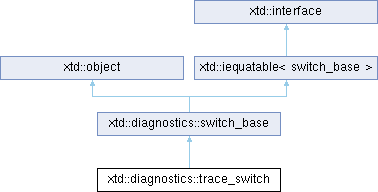
Inheritance diagram for xtd::diagnostics::trace_switch:
Definition
Provides a multilevel switch to control tracing and debug output without recompiling your code.
Provides an abstract base class to create new debugging and tracing switches.
Definition switch_object.hpp:35
trace_switch(const xtd::string &display_name, const xtd::string &description)
Initializes a new instance of the xtd::diagnostics::trace_switch class, using the specified display n...
- Header
- #include <xtd/diagnostics/trace_switch>
- Namespace
- xtd::diagnostics
- Library
- xtd.core
- Remarks
- You can use a trace switch to filter out messages based on their importance. The trace_switch class provides the trace_error, trace_warning, trace_info, and trace_verbose properties to test the level of the switch. The level property gets or sets the switch's trace_level.
- You can set the level of a trace_switch through the application configuration file and then use the configured trace_switch level in your application. Alternately, you can create a trace_switch in your code and set the level directly to instrument a specific section of code.
Public Constructors | |
| trace_switch (const xtd::string &display_name, const xtd::string &description) | |
| Initializes a new instance of the xtd::diagnostics::trace_switch class, using the specified display name and description. | |
| trace_switch (const xtd::string &display_name, const xtd::string &description, const xtd::string &default_switch_value) | |
| Initializes a new instance of the xtd::diagnostics::trace_switch class, using the specified display name, description, and default value for the switch. | |
Public Properties | |
| auto | level () const noexcept -> xtd::diagnostics::trace_level |
| Gets the trace level that determines the messages the switch allows. | |
| auto | level (xtd::diagnostics::trace_level level) noexcept -> void |
| Sets the trace level that determines the messages the switch allows. | |
| auto | trace_error () const noexcept -> bool |
| Gets a value indicating whether the switch allows error-handling messages. | |
| auto | trace_info () const noexcept -> bool |
| Gets a value indicating whether the switch allows informational messages. | |
| auto | trace_verbose () const noexcept -> bool |
| Gets a value indicating whether the switch allows all messages. | |
| auto | trace_warning () const noexcept -> bool |
| Gets a value indicating whether the switch allows warning messages. | |
Protected Methods | |
| auto | on_switch_setting_changed () -> void override |
| Invoked when the switch_setting property is changed. | |
| auto | on_value_changed () -> void override |
| Invoked when the value property is changed. | |
Additional Inherited Members | |
| using | attribute_collection |
| Represents the attributes collection. | |
| auto | attributes () const noexcept -> const attribute_collection & |
| Gets the custom switch attributes. | |
| auto | attributes () noexcept -> attribute_collection & |
| Gets the custom switch attributes. | |
| auto | attributes (const attribute_collection &attributes) noexcept -> void |
| Sets the custom switch attributes. | |
| auto | description () const noexcept -> const xtd::string & |
| Gets a description of the switch. | |
| auto | display_name () const noexcept -> const xtd::string & |
| Gets a name used to identify the switch. | |
| auto | value () const noexcept -> const xtd::string & |
| Gets the value of the switch. | |
| auto | value (const xtd::string &value) -> void |
| Sets the value of the switch. | |
| auto | equals (const xtd::object &obj) const noexcept -> bool override |
| Determines whether the specified object is equal to the current object. | |
| auto | equals (const switch_object &other) const noexcept -> bool override |
| Determines whether the specified object is equal to the current object. | |
| object ()=default | |
| Create a new instance of the ultimate base class object. | |
| virtual auto | get_hash_code () const noexcept -> xtd::usize |
| Serves as a hash function for a particular type. | |
| virtual auto | get_type () const noexcept -> type_object |
| Gets the type of the current instance. | |
| template<typename object_t> | |
| auto | memberwise_clone () const -> xtd::unique_ptr_object< object_t > |
| Creates a shallow copy of the current object. | |
| virtual auto | to_string () const -> xtd::string |
| Returns a xtd::string that represents the current object. | |
| template<typename object_a_t, typename object_b_t> | |
| static auto | equals (const object_a_t &object_a, const object_b_t &object_b) noexcept -> bool |
| Determines whether the specified object instances are considered equal. | |
| template<typename object_a_t, typename object_b_t> | |
| static auto | reference_equals (const object_a_t &object_a, const object_b_t &object_b) noexcept -> bool |
| Determines whether the specified object instances are the same instance. | |
| switch_object (const xtd::string &display_name, const xtd::string &description) | |
| Initializes a new instance of the switch_object class. | |
| auto | switch_setting () const noexcept -> xtd::int32 |
| Gets the current setting for this switch. | |
| auto | switch_setting (xtd::int32 switch_setting) -> void |
| Sets the current setting for this switch. | |
| virtual auto | get_supported_attributes () const noexcept -> xtd::array< xtd::string > |
| Gets the custom attributes supported by the switch. | |
Constructor & Destructor Documentation
◆ trace_switch() [1/2]
| xtd::diagnostics::trace_switch::trace_switch | ( | const xtd::string & | display_name, |
| const xtd::string & | description ) |
Initializes a new instance of the xtd::diagnostics::trace_switch class, using the specified display name and description.
- Parameters
-
display_name The name to display on a user interface. description The description of the switch.
- Remarks
- he xtd::diagnostics::trace_switch class provides the xtd::diagnostics::trace_switch::trace_error, xtd::diagnostics::trace_switch::trace_warning, xtd::diagnostics::trace_switch::trace_info, and xtd::diagnostics::trace_switch::trace_verbose properties to test the Level of the switch. The xtd::diagnostics::trace_switch::level property gets or sets the switch's xtd::diagnostics::trace_level.
- Note
- To improve performance, you can make xtd::diagnostics::trace_switch members static in your class.
◆ trace_switch() [2/2]
| xtd::diagnostics::trace_switch::trace_switch | ( | const xtd::string & | display_name, |
| const xtd::string & | description, | ||
| const xtd::string & | default_switch_value ) |
Initializes a new instance of the xtd::diagnostics::trace_switch class, using the specified display name, description, and default value for the switch.
- Parameters
-
display_name The name to display on a user interface. description The description of the switch. default_switch_value The default value of the switch.
- Remarks
- The display_name parameter is used to set the value of the xtd::diagnostics::trace_switch::display_name property, the description parameter is use to set the value of the xtd::diagnostics::trace_switch::description property, and the default_switch_value parameter is saved as a field and used to initialize the xtd::diagnostics::trace_switch::value property on first reference.
Member Function Documentation
◆ level() [1/2]
|
nodiscardnoexcept |
Gets the trace level that determines the messages the switch allows.
- Returns
- One of the xtd::diagnostics::trace_level values that specifies the level of messages that are allowed by the switch.
- Remarks
- Setting this property updates the xtd::diagnostics::trace_switch::trace_error, xtd::diagnostics::trace_switch::trace_warning, xtd::diagnostics::trace_switch::trace_info, and xtd::diagnostics::trace_switch::trace_verbose properties to reflect the new value.
◆ level() [2/2]
|
noexcept |
Sets the trace level that determines the messages the switch allows.
- Parameters
-
level One of the xtd::diagnostics::trace_level values that specifies the level of messages that are allowed by the switch.
- Remarks
- Setting this property updates the xtd::diagnostics::trace_switch::trace_error, xtd::diagnostics::trace_switch::trace_warning, xtd::diagnostics::trace_switch::trace_info, and xtd::diagnostics::trace_switch::trace_verbose properties to reflect the new value.
◆ trace_error()
|
nodiscardnoexcept |
Gets a value indicating whether the switch allows error-handling messages.
- Returns
- true if the xtd::diagnostics::trace_switch::level property is set to xtd::diagnostics::trace_level::error, xtd::diagnostics::trace_level::warning, xtd::diagnostics::trace_level::info, or xtd::diagnostics::trace_level::verbose; otherwise, false.
◆ trace_info()
|
nodiscardnoexcept |
Gets a value indicating whether the switch allows informational messages.
- Returns
- true if the xtd::diagnostics::trace_switch::level property is set to xtd::diagnostics::trace_level::info, or xtd::diagnostics::trace_level::verbose; otherwise, false.
◆ trace_verbose()
|
nodiscardnoexcept |
Gets a value indicating whether the switch allows all messages.
- Returns
- true if the xtd::diagnostics::trace_switch::level property is set to xtd::diagnostics::trace_level::verbose; otherwise, false.
◆ trace_warning()
|
nodiscardnoexcept |
Gets a value indicating whether the switch allows warning messages.
- Returns
- true if the xtd::diagnostics::trace_switch::level property is set to xtd::diagnostics::trace_level::warning, xtd::diagnostics::trace_level::info, or xtd::diagnostics::trace_level::verbose; otherwise, false.
◆ on_switch_setting_changed()
|
overrideprotectedvirtual |
Invoked when the switch_setting property is changed.
Reimplemented from xtd::diagnostics::switch_object.
◆ on_value_changed()
|
overrideprotectedvirtual |
Invoked when the value property is changed.
- Remarks
- The default implementation parses the new value of the value property to an integer value which it uses to set the switch_setting property.
- Not to Inheritors
- You should override this method and use a conversion that sets the appropriate switch_setting value for your switch.
Reimplemented from xtd::diagnostics::switch_object.
The documentation for this class was generated from the following file:
- xtd.core/include/xtd/diagnostics/trace_switch.hpp
Generated on for xtd by Gammasoft. All rights reserved.