
|
xtd
1.0.0
|
Loading...
Searching...
No Matches
xtd::operating_system Class Referencefinal
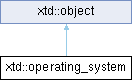
Inheritance diagram for xtd::operating_system:
Definition
Represents information about an operating system, such as the version and platform identifier. This class cannot be inherited.
- Namespace
- xtd
- Library
- xtd.core
- Remarks
- The operating_system class contains information about an operating system.
- For information about the current runtime operating system, retrieve the operating_system object returned by the xtd::environment::os_version method.
- By design, the operating_system class is not a general purpose means of describing an operating system, and you cannot derive a more inclusive type from the operating_system class. If you need a type to contain other information about an operating system, create your own type, then include a field of type operating_system and any additional fields or methods that you require.
Public Constructors | |
| operating_system (xtd::platform_id platform, const xtd::version &version) | |
| Initializes a new instance of the operating_system class, using the specified platform identifier value and version object. | |
| operating_system (xtd::platform_id platform, const xtd::version &version, const xtd::string &service_pack) | |
| Initializes a new instance of the operating_system class, using the specified platform identifier value and version object. | |
| operating_system (xtd::platform_id platform, const xtd::version &version, const xtd::string &service_pack, const xtd::string &desktop_environment) | |
| Initializes a new instance of the operating_system class, using the specified platform identifier value and version object. | |
| operating_system (xtd::platform_id platform, const xtd::version &version, const xtd::string &service_pack, const xtd::string &desktop_environment, const xtd::string &desktop_theme) | |
| Initializes a new instance of the operating_system class, using the specified platform identifier value and version object. | |
| operating_system (xtd::platform_id platform, const xtd::version &version, const xtd::string &service_pack, const xtd::string &desktop_environment, const xtd::string &desktop_theme, bool is_64_bit) | |
| Initializes a new instance of the operating_system class, using the specified platform identifier value and version object. | |
| operating_system (xtd::platform_id platform, const xtd::version &version, const xtd::string &service_pack, const xtd::string &desktop_environment, const xtd::string &desktop_theme, bool is_64_bit, const xtd::distribution &distribution) | |
| Initializes a new instance of the operating_system class, using the specified platform identifier value and version object. | |
Public Properties | |
| auto | desktop_environment () const noexcept -> xtd::string |
| Gets the desktop environment. | |
| auto | desktop_theme () const noexcept -> xtd::string |
| Gets the desktop theme. | |
| auto | distribution () const noexcept -> xtd::distribution |
| Gets the distribution. | |
| auto | name () const noexcept -> xtd::string |
| Gets the concatenated string representation of the platform identifier. | |
| auto | platform () const noexcept -> xtd::platform_id |
| Gets a xtd::platform_id enumeration value that identifies the operating system platform. | |
| auto | service_pack () const noexcept -> xtd::string |
| Gets the service pack version represented by this operating_system object. | |
| auto | version () const noexcept -> const xtd::version & |
| Gets a xtd::version object that identifies the operating system. | |
| auto | version_string () const noexcept -> xtd::string |
| Gets the concatenated string representation of the platform identifier, version, and service pack that are currently installed on the operating system. | |
Public Methods | |
| auto | is_64_bit () const noexcept -> bool |
| Determines whether the current operating system is a 64-bit operating system. | |
| auto | is_aix () const noexcept -> bool |
| Determines whether the current platform is AIX. | |
| auto | is_android () const noexcept -> bool |
| Determines whether the current platform is Android. | |
| auto | is_apple_platform () const noexcept -> bool |
| Determines whether the current platform belongs to the Apple ecosystem (macOS, iOS, tvOS, or watchOS). | |
| auto | is_bsd_platform () const noexcept -> bool |
| Determines whether the current platform is BSD (FreeBSD, or Darwin). | |
| auto | is_darwin () const noexcept -> bool |
| Determines whether the current platform is Darwin (macOS, iOS, tvOS, or watchOS). | |
| auto | is_free_bsd () const noexcept -> bool |
| Determines whether the current platform is FreeBSD. | |
| auto | is_haiku () const noexcept -> bool |
| Determines whether the current platform is Haiku. | |
| auto | is_serenityos () const noexcept -> bool |
| Determines whether the current platform is SerenityOS. | |
| auto | is_ios () const noexcept -> bool |
| Determines whether the current platform is iOS. | |
| auto | is_linux () const noexcept -> bool |
| Determines whether the current platform is Linux. | |
| auto | is_macos () const noexcept -> bool |
| Determines whether the current platform is macOS. | |
| auto | is_macos_platform () const noexcept -> bool |
| Determines whether the current platform is part of the macOS family (including macOS, iOS, tvOS, or watchOS). | |
| auto | is_mingw () const noexcept -> bool |
| Determines whether the current platform is MINGW. | |
| auto | is_msys () const noexcept -> bool |
| Determines whether the current platform is MSYS. | |
| auto | is_posix () const noexcept -> bool |
| Determines whether the current platform is Posix. | |
| auto | is_posix_platform () const noexcept -> bool |
| Determines whether the current platform is Posix family. | |
| auto | is_unix_platform () const noexcept -> bool |
| Determines whether the current platform is Unix family. | |
| auto | is_tvos () const noexcept -> bool |
| Determines whether the current platform is tvOS family. | |
| auto | is_watchos () const noexcept -> bool |
| Determines whether the current platform is watchOS. | |
| auto | is_windows () const noexcept -> bool |
| Determines whether the current platform is Windows. | |
| auto | is_windows_ce () const noexcept -> bool |
| Determines whether the current platform is Windows CE. | |
| auto | is_windows_platform () const noexcept -> bool |
| Determines whether the current platform is Windows family. | |
| auto | is_xbox () const noexcept -> bool |
| Determines whether the current platform is xbox. | |
| auto | get_hash_code () const noexcept -> xtd::usize override |
| Serves as a hash function for a particular type. | |
| auto | to_string () const noexcept -> xtd::string override |
| Converts the value of this operating_system object to its equivalent string representation. | |
Additional Inherited Members | |
| object ()=default | |
| Create a new instance of the ultimate base class object. | |
| virtual auto | equals (const object &obj) const noexcept -> bool |
| Determines whether the specified object is equal to the current object. | |
| virtual auto | get_type () const noexcept -> type_object |
| Gets the type of the current instance. | |
| template<typename object_t> | |
| auto | memberwise_clone () const -> xtd::unique_ptr_object< object_t > |
| Creates a shallow copy of the current object. | |
| template<typename object_a_t, typename object_b_t> | |
| static auto | equals (const object_a_t &object_a, const object_b_t &object_b) noexcept -> bool |
| Determines whether the specified object instances are considered equal. | |
| template<typename object_a_t, typename object_b_t> | |
| static auto | reference_equals (const object_a_t &object_a, const object_b_t &object_b) noexcept -> bool |
| Determines whether the specified object instances are the same instance. | |
Constructor & Destructor Documentation
◆ operating_system() [1/6]
| xtd::operating_system::operating_system | ( | xtd::platform_id | platform, |
| const xtd::version & | version ) |
Initializes a new instance of the operating_system class, using the specified platform identifier value and version object.
- Parameters
-
platform One of the xtd::platform_id values that indicates the operating system platform. version A Version object that indicates the version of the operating system.
- Exceptions
-
xtd::argument_exception platform is not a xtd::platform_id enumeration value.
◆ operating_system() [2/6]
| xtd::operating_system::operating_system | ( | xtd::platform_id | platform, |
| const xtd::version & | version, | ||
| const xtd::string & | service_pack ) |
Initializes a new instance of the operating_system class, using the specified platform identifier value and version object.
- Parameters
-
platform One of the xtd::platform_id values that indicates the operating system platform. version A Version object that indicates the version of the operating system. service_pack A string, such as "Service Pack 3", that represent the service pack. If no Service Pack has been installed, the string must be empty.
- Exceptions
-
xtd::argument_exception platform is not a xtd::platform_id enumeration value.
◆ operating_system() [3/6]
| xtd::operating_system::operating_system | ( | xtd::platform_id | platform, |
| const xtd::version & | version, | ||
| const xtd::string & | service_pack, | ||
| const xtd::string & | desktop_environment ) |
Initializes a new instance of the operating_system class, using the specified platform identifier value and version object.
- Parameters
-
platform One of the xtd::platform_id values that indicates the operating system platform. version A Version object that indicates the version of the operating system. service_pack A string, such as "Service Pack 3", that represent the service pack. If no Service Pack has been installed, the string must be empty. desktop_environment A string, such as "gnome", "kde", "windows", "macos".
- Exceptions
-
xtd::argument_exception platform is not a xtd::platform_id enumeration value.
◆ operating_system() [4/6]
| xtd::operating_system::operating_system | ( | xtd::platform_id | platform, |
| const xtd::version & | version, | ||
| const xtd::string & | service_pack, | ||
| const xtd::string & | desktop_environment, | ||
| const xtd::string & | desktop_theme ) |
Initializes a new instance of the operating_system class, using the specified platform identifier value and version object.
- Parameters
-
platform One of the xtd::platform_id values that indicates the operating system platform. version A Version object that indicates the version of the operating system. service_pack A string, such as "Service Pack 3", that represent the service pack. If no Service Pack has been installed, the string must be empty. desktop_environment A string, such as "gnome", "kde", "windows", "macos". desktop_theme A string, such as "Adwaita", "Breeze", "windows dark", "macos dark", ...
- Exceptions
-
xtd::argument_exception platform is not a xtd::platform_id enumeration value.
◆ operating_system() [5/6]
| xtd::operating_system::operating_system | ( | xtd::platform_id | platform, |
| const xtd::version & | version, | ||
| const xtd::string & | service_pack, | ||
| const xtd::string & | desktop_environment, | ||
| const xtd::string & | desktop_theme, | ||
| bool | is_64_bit ) |
Initializes a new instance of the operating_system class, using the specified platform identifier value and version object.
- Parameters
-
platform One of the xtd::platform_id values that indicates the operating system platform. version A Version object that indicates the version of the operating system. service_pack A string, such as "Service Pack 3", that represent the service pack. If no Service Pack has been installed, the string must be empty. desktop_environment A string, such as "gnome", "kde", "windows", "macos". desktop_theme A string, such as "Adwaita", "Breeze", "windows dark", "macos dark", ... is_64_bit True if Operating System is 64 bits; otherwise false.
- Exceptions
-
xtd::argument_exception platform is not a xtd::platform_id enumeration value.
◆ operating_system() [6/6]
| xtd::operating_system::operating_system | ( | xtd::platform_id | platform, |
| const xtd::version & | version, | ||
| const xtd::string & | service_pack, | ||
| const xtd::string & | desktop_environment, | ||
| const xtd::string & | desktop_theme, | ||
| bool | is_64_bit, | ||
| const xtd::distribution & | distribution ) |
Initializes a new instance of the operating_system class, using the specified platform identifier value and version object.
- Parameters
-
platform One of the xtd::platform_id values that indicates the operating system platform. version A Version object that indicates the version of the operating system. service_pack A string, such as "Service Pack 3", that represent the service pack. If no Service Pack has been installed, the string must be empty. desktop_environment A string, such as "gnome", "kde", "windows", "macos". desktop_theme A string, such as "Adwaita", "Breeze", "windows dark", "macos dark", ... is_64_bit True if Operating System is 64 bits; otherwise false. distribution An xtd::distribution that contains the operating system distribution informations.
- Exceptions
-
xtd::argument_exception platform is not a xtd::platform_id enumeration value.
Member Function Documentation
◆ desktop_environment()
|
nodiscardnoexcept |
Gets the desktop environment.
- Returns
- string The desktop environment for the operating system, if not found empty string ("").
- Remarks
- On Windows is always "windows".
- On macOS is always "macos".
- On linux it can be "budgie", "cinnamon", "deepin", "Enlightenment", "étoilé", "gnome", "kde", "lxqt", "mate", "pantheon", "razor-qt", "unity", "xfce".
◆ desktop_theme()
|
nodiscardnoexcept |
Gets the desktop theme.
- Returns
- string The desktop theme for the operating system, if not found empty string ("").
- Remarks
- On Windows is "windows" or "windows dark".
- On macOS is "macos" or 'macos dark'.
- On linux it can be "Adwaita", "Adwaita-dark", "Breeze", "Breeze-Dark", "Yaru", "Yaru-dark", "Yaru-light", ...
◆ distribution()
|
nodiscardnoexcept |
Gets the distribution.
- Returns
- An xtd::distribution that contains the operating system distribution informations.
◆ name()
|
nodiscardnoexcept |
Gets the concatenated string representation of the platform identifier.
- Returns
- The string representation of the values returned by the platform.
◆ platform()
|
nodiscardnoexcept |
Gets a xtd::platform_id enumeration value that identifies the operating system platform.
- Returns
- xtd::platform_id One of the xtd::platform_id values.
◆ service_pack()
|
nodiscardnoexcept |
Gets the service pack version represented by this operating_system object.
- Returns
- string The service pack version, if service packs are supported and at least one is installed; otherwise, an empty string ("").
- Remarks
- A service pack is used to distribute software updates for the operating system on which it is installed. However, not every operating system uses service packs.
- The service pack version, if available, is already correctly formatted for display.
◆ version()
|
nodiscardnoexcept |
Gets a xtd::version object that identifies the operating system.
- Returns
- Version A Version object that describes the major version, minor version, build, and revision numbers for the operating system.
- Remarks
- For Window system only: See http://msdn.microsoft.com/library/windows/desktop/ms724832.aspx on the Windows Dev Center for a list of Windows operating system versions and their corresponding version numbers.
◆ version_string()
|
nodiscardnoexcept |
Gets the concatenated string representation of the platform identifier, version, and service pack that are currently installed on the operating system.
- Returns
- The string representation of the values returned by the platform, version, and service_pack methods.
- Remarks
- By default, the value returned by version_string is the same as the value returned by the to_string method.
◆ is_64_bit()
|
nodiscardnoexcept |
Determines whether the current operating system is a 64-bit operating system.
- Returns
- true if the operating system is 64-bit; otherwise, false.
◆ is_aix()
|
nodiscardnoexcept |
Determines whether the current platform is AIX.
- Returns
- true if the current platform is AIX; otherwise, false.
◆ is_android()
|
nodiscardnoexcept |
Determines whether the current platform is Android.
- Returns
- true if the current platform is Android; otherwise, false.
◆ is_apple_platform()
|
nodiscardnoexcept |
Determines whether the current platform belongs to the Apple ecosystem (macOS, iOS, tvOS, or watchOS).
- Returns
- true if the current platform is macOS, iOS, tvOS, or watchOS; otherwise, false.
- Remarks
- This includes all Apple Darwin-based systems. Use this method when you need to target Apple-specific APIs or behaviors across multiple Apple platforms.
◆ is_bsd_platform()
|
nodiscardnoexcept |
Determines whether the current platform is BSD (FreeBSD, or Darwin).
- Returns
- true if the current platform is BSD; otherwise, false.
◆ is_darwin()
|
nodiscardnoexcept |
Determines whether the current platform is Darwin (macOS, iOS, tvOS, or watchOS).
- Returns
- true if the current platform is Darwin; otherwise, false.
◆ is_free_bsd()
|
nodiscardnoexcept |
Determines whether the current platform is FreeBSD.
- Returns
- true if the current platform is FreeBSD; otherwise, false.
◆ is_haiku()
|
nodiscardnoexcept |
Determines whether the current platform is Haiku.
- Returns
- true if the current platform is Haiku; otherwise, false.
◆ is_serenityos()
|
nodiscardnoexcept |
Determines whether the current platform is SerenityOS.
- Returns
- true if the current platform is SerenityOS; otherwise, false.
◆ is_ios()
|
nodiscardnoexcept |
Determines whether the current platform is iOS.
- Returns
- true if the current platform is iOS; otherwise, false.
◆ is_linux()
|
nodiscardnoexcept |
Determines whether the current platform is Linux.
- Returns
- true if the current platform is Linux; otherwise, false.
◆ is_macos()
|
nodiscardnoexcept |
Determines whether the current platform is macOS.
- Returns
- true if the current platform is macOS; otherwise, false.
◆ is_macos_platform()
|
nodiscardnoexcept |
Determines whether the current platform is part of the macOS family (including macOS, iOS, tvOS, or watchOS).
- Returns
- true if the current platform is macOS, iOS, tvOS, or watchOS; otherwise, false.
- Remarks
- This is an alias of is_apple_platform() and exists for naming consistency. Prefer is_apple_platform() for semantic clarity.
◆ is_mingw()
|
nodiscardnoexcept |
Determines whether the current platform is MINGW.
- Returns
- true if the current platform is MINGW; otherwise, false.
◆ is_msys()
|
nodiscardnoexcept |
Determines whether the current platform is MSYS.
- Returns
- true if the current platform is MSYS; otherwise, false.
◆ is_posix()
|
nodiscardnoexcept |
Determines whether the current platform is Posix.
- Returns
- true if the current platform is Posix; otherwise, false.
◆ is_posix_platform()
|
nodiscardnoexcept |
Determines whether the current platform is Posix family.
- Returns
- true if the current platform is Posix family; otherwise, false.
- Remarks
- Returns true if the current platform is Posix. This includes Linux, Android, macOS, iOS, tvOS, watchOS, BSD variants, Haiku, SerenityOS, Solaris, and AIX. It excludes platforms like Windows, and other non-posix environments.
- Note
- In this implementation, Unix and POSIX platforms overlap significantly but are semantically distinguished.
◆ is_unix_platform()
|
nodiscardnoexcept |
Determines whether the current platform is Unix family.
- Returns
- true if the current platform is Unix family; otherwise, false.
- Remarks
- Returns true if the current platform is a Unix or Unix-like operating system. This includes Linux, macOS, iOS, tvOS, watchOS, BSD variants, Haiku, SerenityOS, Solaris, and AIX. It excludes platforms like Windows, Android, and other non-Unix environments.
- Note
- In this implementation, Unix and POSIX platforms overlap significantly but are semantically distinguished.
◆ is_tvos()
|
nodiscardnoexcept |
Determines whether the current platform is tvOS family.
- Returns
- true if the current platform is macOS family; otherwise, false.
◆ is_watchos()
|
nodiscardnoexcept |
Determines whether the current platform is watchOS.
- Returns
- true if the current platform is watchOS; otherwise, false.
◆ is_windows()
|
nodiscardnoexcept |
Determines whether the current platform is Windows.
- Returns
- true if the current platform is Windows; otherwise, false.
◆ is_windows_ce()
|
nodiscardnoexcept |
Determines whether the current platform is Windows CE.
- Returns
- true if the current platform is Windows CE; otherwise, false.
◆ is_windows_platform()
|
nodiscardnoexcept |
Determines whether the current platform is Windows family.
- Returns
- true if the current platform is Windows family; otherwise, false.
◆ is_xbox()
|
nodiscardnoexcept |
Determines whether the current platform is xbox.
- Returns
- true if the current platform is xbox; otherwise, false.
◆ get_hash_code()
|
nodiscardoverridevirtualnoexcept |
Serves as a hash function for a particular type.
- Returns
- A hash code for the current object.
Reimplemented from xtd::object.
◆ to_string()
|
nodiscardoverridevirtualnoexcept |
Converts the value of this operating_system object to its equivalent string representation.
- Returns
- The string representation of the values returned by the platform, version, and service_pack methods.
Reimplemented from xtd::object.
The documentation for this class was generated from the following file:
- xtd.core/include/xtd/operating_system.hpp
Generated on for xtd by Gammasoft. All rights reserved.