
|
xtd
1.0.0
|
Loading...
Searching...
No Matches
xtd::box_integer< type_t > Class Template Reference
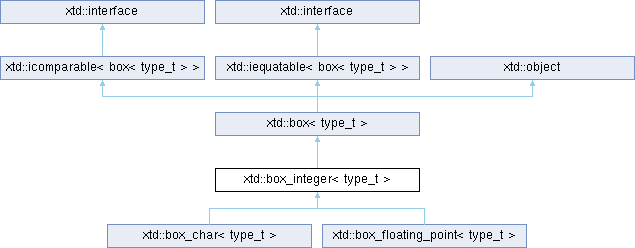
Inheritance diagram for xtd::box_integer< type_t >:
Definition
template<typename type_t>
class xtd::box_integer< type_t >
class xtd::box_integer< type_t >
Represents a boxed integer object.
- Inheritance
- xtd::object → xtd::box <type_t> → xtd::box_integer <type_t> ///
- Namespace
- Header
- #include <xtd/box_integer>
- Namespace
- xtd
- Library
- xtd.core
- Remarks
- You can use xtd::box to represent a class or structure that does not inherit from xtd::object. Typically used for integral types.
- Use xtd::boxing to box an object.
- Use xtd::unboxing to unbox an object.
- For more information about types, see Native types, boxing and unboxing.
- Examples
- The following example shows how to create and use xtd::box_integer<int32>. int32 unboxed_object = 42;box_integer<int32> boxed_object = unboxed_object;auto result = stringer(boxed_object);static auto write_line() -> voidWrites the current line terminator to the standard output stream using the specified format informati...
Public Fields | |
| static constexpr type_t | max_value |
| Represents the largest possible value of type_t. This field is constant. | |
| static constexpr type_t | min_value |
| Represents the smallest possible value of type_t. This field is constant. | |
Public Static Methods | |
| static auto | is_valid (type_t value) noexcept -> bool |
| Determines whether the specified signed integral value is within the range of type_t. | |
| static auto | parse (const xtd::string &value, xtd::number_styles styles) -> type_t |
| Converts the string to its type_t equivalent. | |
| static auto | try_parse (const xtd::string &value, type_t &result, xtd::number_styles styles) -> bool |
| Converts the string to its type_t equivalent. | |
Additional Inherited Members | |
| using | value_type |
| Represents the value type. | |
| using | reference |
| Represents the reference type. | |
| using | const_reference |
| Represents the cont reference type. | |
| using | pointer |
| Represents the reference type. | |
| using | const_pointer |
| Represents the cont reference type. | |
| value_type | value |
| Gets or sets the underlying value. | |
| box ()=default | |
| Initialize a new xtd::box object. | |
| box (const_reference value) | |
| Initialize a new xtd::box object with specified value. | |
| template<typename ... args_t> | |
| box (args_t &&...args) | |
| Initialize a new xtd::box object with specified value. | |
| operator value_type () const noexcept | |
| Cast operator to the value type. | |
| auto | compare_to (const box &value) const noexcept -> xtd::int32 override |
| Compares the current instance with another object of the same type. | |
| auto | equals (const object &obj) const noexcept -> bool override |
| Determines whether the specified object is equal to the current object. | |
| auto | equals (const box &value) const noexcept -> bool override |
| Indicates whether the current object is equal to another object of the same type. | |
| auto | get_hash_code () const noexcept -> xtd::usize override |
| Serves as a hash function for a particular type. | |
| auto | to_string () const noexcept -> xtd::string override |
| Returns a xtd::string that represents the current object. | |
| auto | to_string (const xtd::string &format) const -> xtd::string |
| Converts the value of this instance to its equivalent string representation, using the specified format. | |
| auto | to_string (const xtd::string &format, const globalization::culture_info &culture) const -> xtd::string override |
| Converts the value of this instance to its equivalent string representation, using the specified format, and locale. | |
| object ()=default | |
| Create a new instance of the ultimate base class object. | |
| virtual auto | get_type () const noexcept -> type_object |
| Gets the type of the current instance. | |
| template<typename object_t> | |
| auto | memberwise_clone () const -> xtd::unique_ptr_object< object_t > |
| Creates a shallow copy of the current object. | |
| virtual auto | compare_to (const type_t &obj) const noexcept -> xtd::int32=0 |
| Compares the current instance with another object of the same type. | |
| virtual auto | equals (const type_t &) const noexcept -> bool=0 |
| Indicates whether the current object is equal to another object of the same type. | |
| static auto | parse (const xtd::string &value) -> value_type |
| Converts the string to its value_type equivalent. | |
| static auto | try_parse (const xtd::string &value, reference result) noexcept -> bool |
| Converts the string to its value_type equivalent. A return value indicates whether the conversion succeeded or failed. | |
| template<typename object_a_t, typename object_b_t> | |
| static auto | equals (const object_a_t &object_a, const object_b_t &object_b) noexcept -> bool |
| Determines whether the specified object instances are considered equal. | |
| template<typename object_a_t, typename object_b_t> | |
| static auto | reference_equals (const object_a_t &object_a, const object_b_t &object_b) noexcept -> bool |
| Determines whether the specified object instances are the same instance. | |
Member Function Documentation
◆ is_valid()
template<typename type_t>
|
inlinestaticnodiscardnoexcept |
Determines whether the specified signed integral value is within the range of type_t.
- Parameters
-
value The signed integral value to validate.
- Returns
- true if value is greater than or equal to min_value and less than or equal to max_value; otherwise, false.
- Remarks
- This method checks whether a signed integral value can be safely represented by type_t without overflow.
- If the value is outside the valid range defined by min_value and max_value, the method returns false.
◆ parse()
template<typename type_t>
|
inlinestaticnodiscard |
Converts the string to its type_t equivalent.
- Parameters
-
value A string containing a type_t to convert.
- Returns
- A type_t equivalent to the number contained in value.
◆ try_parse()
template<typename type_t>
|
inlinestaticnodiscard |
Converts the string to its type_t equivalent.
- Parameters
-
value A string containing a type_t to convert.
- Returns
- A type_t equivalent to the number contained in value.
Member Data Documentation
◆ max_value
template<typename type_t>
|
staticconstexpr |
Represents the largest possible value of type_t. This field is constant.
- Remarks
- The value of this field is std::numeric_limits<type_t>::max().
◆ min_value
template<typename type_t>
|
staticconstexpr |
Represents the smallest possible value of type_t. This field is constant.
- Remarks
- The value of this field is std::numeric_limits<type_t>::lowest().
The documentation for this class was generated from the following file:
- xtd.core/include/xtd/box_integer.hpp
Generated on for xtd by Gammasoft. All rights reserved.