
|
xtd
1.0.0
|
Loading...
Searching...
No Matches
xtd::iprogress< type_t > Class Template Referenceabstract
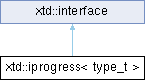
Inheritance diagram for xtd::iprogress< type_t >:
Definition
template<typename type_t>
class xtd::iprogress< type_t >
class xtd::iprogress< type_t >
Defines a provider for progress updates.
- Namespace
- xtd
- Library
- xtd.core
- Template Parameters
-
type_t The type of progress update value. This type parameter is contravariant. That is, you can use either the type you specified or any type that is less derived The following example demonstrates how to use xtd::iprogress interface. #include <xtd/xtd>class generic_progress {public:generic_progress() = default;generic_progress(int val, int min = 0, int max = 100, const string& msg = "") : message_(msg) {minimum(min);maximum(max);value(val);}auto maximum() const noexcept -> int {return maximum_;}generic_progress& maximum(int maximum) noexcept {maximum_ = maximum;minimum_ = math::min(minimum(), maximum);value_ = math::min(value(), maximum);return *this;}auto minimum() const noexcept -> int {return minimum_;}generic_progress& minimum(int minimum) noexcept {minimum_ = minimum;maximum_ = math::max(maximum(), minimum);value_ = math::max(value(), minimum);return *this;}auto message() const noexcept -> const string& {return message_;}generic_progress& message(const string& message) noexcept {message_ = message;return *this;}auto percent() const noexcept -> float {return maximum_ - minimum_ ? as<float>(value() - minimum()) / (maximum() - minimum()) : 1;}auto increment(int increment) noexcept -> generic_progress& {return *this;}auto perform_step() noexcept -> generic_progress& {return increment(step());}auto perform_step(const string& message) noexcept -> generic_progress& {message_ = message;return perform_step();}value_ = math::clamp(value, minimum(), maximum());return *this;}auto step() const noexcept -> int {return step_;}generic_progress& step(int step) noexcept {step_ = step;return *this;}private:int minimum_ = 0;int maximum_ = 100;int step_ = 1;int value_ = 0;string message_;};class print_generic_progress : public iprogress<generic_progress> {public:print_generic_progress() = default;auto report(const generic_progress& value) noexcept -> void override {console::write_line("completion={,3}%, message=\"{}\"", as<int>(value.percent() * 100), value.message());}};auto main() -> int {console::write_line("Started");auto print_progress = print_generic_progress {};auto progress = generic_progress {0, 0, 5, "Initialized"};print_progress.report(progress);// Open device....print_progress.report(progress.perform_step("Device opened"));// Update 1 device....print_progress.report(progress.perform_step("Device updated 1"));// Update 2 device....print_progress.report(progress.perform_step("Device updated 2"));// Update 3 device....print_progress.report(progress.perform_step("Device updated 3"));// Close device....print_progress.report(progress.perform_step("Device closed"));console::write_line("Ended");}// The example displays output similar to the following://// Started// completion= 0%, message="Initialized"// completion= 20%, message="Device opened"// completion= 40%, message="Device updated 1"// completion= 60%, message="Device updated 2"// completion= 80%, message="Device updated 3"// completion=100%, message="Device closed"// Ended@ valueRepresnets the constant operator precedence (42).Definition operator_precedence.hpp:30@ percentThe control should be sized as a percentage of the parent container.Definition size_type.hpp:28
Public Methods | |
| virtual auto | report (const type_t &value) noexcept -> void=0 |
| Reports a progress update. | |
Member Function Documentation
◆ report()
template<typename type_t>
|
pure virtualnoexcept |
Reports a progress update.
- Parameters
-
value The value of the updated progress.
The documentation for this class was generated from the following file:
- xtd.core/include/xtd/iprogress.hpp
Generated on for xtd by Gammasoft. All rights reserved.