
|
xtd
1.0.0
|
Loading...
Searching...
No Matches
xtd::globalization::date_time_format_info Class Reference
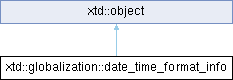
Inheritance diagram for xtd::globalization::date_time_format_info:
Definition
Provides culture-specific information about the format of date and time values.
date_time_format_info()
Initializes a new instance of the xtd::globalization::date_time_format_info class.
Supports all classes in the xtd class hierarchy and provides low-level services to derived classes....
Definition object.hpp:40
- Inheritance
- xtd::object → xtd::globalization::date_time_format_info
- Header
- #include <xtd/globalization/date_time_format_info>
- Namespace
- xtd::globalization
- Library
- xtd.core
- Examples
- The following example uses reflection to get the properties of the xtd::globalization::date_time_format_info object for the English (United States) culture. It displays the value of those properties that contain custom format strings and uses those strings to display formatted dates. #include <xtd/xtd>using namespace xtd::globalization;auto main() -> int {// Get the properties of an en-US date_time_format_info object.auto props = array<property_info> {{"full_date_time_pattern", {dtfi, &date_time_format_info::full_date_time_pattern}}, {"long_date_pattern", {dtfi, &date_time_format_info::long_date_pattern}}, {"long_time_pattern", {dtfi, &date_time_format_info::long_time_pattern}}, {"month_day_pattern", {dtfi, &date_time_format_info::month_day_pattern}}, {"rfc_1123_pattern", {dtfi, &date_time_format_info::rfc_1123_pattern}}, {"short_date_pattern", {dtfi, &date_time_format_info::short_date_pattern}}, {"short_time_pattern", {dtfi, &date_time_format_info::short_time_pattern}}, {"sortable_date_time_pattern", {dtfi, &date_time_format_info::sortable_date_time_pattern}}, {"universal_sortable_date_time_pattern", {dtfi, &date_time_format_info::universal_sortable_date_time_pattern}}, {"year_month_pattern", {dtfi, &date_time_format_info::year_month_pattern}}};for (const auto& [name, pattern] : props)console::write_line("{,-37} {} \n{,-41}Example: {}\n", name, pattern(), "", value.to_string(pattern()));}// This code produces the following output ://// full_date_time_pattern dddd, MMMM d, yyyy h:mm:ss tt// Example: Monday, May 28, 2012 11:35:00 AM//// long_date_pattern dddd, MMMM d, yyyy// Example: Monday, May 28, 2012//// long_time_pattern h:mm:ss tt// Example: 11:35:00 AM//// month_day_pattern MMMM d// Example: May 28//// rfc_1123_pattern ddd, dd MMM yyyy HH':'mm':'ss 'GMT'// Example: Mon, 28 May 2012 11:35:00 GMT//// short_date_pattern M/d/yyyy// Example: 5/28/2012//// short_time_pattern h:mm tt// Example: 11:35 AM//// sortable_date_time_pattern yyyy'-'MM'-'dd'T'HH':'mm':'ss// Example: 2012-05-28T11:35:00//// universal_sortable_date_time_pattern yyyy'-'MM'-'dd HH':'mm':'ss'Z'// Example: 2012-05-28 11:35:00Z//// year_month_pattern MMMM yyyy// Example: May 2012//Provides methods for creating, manipulating, searching, and sorting arrays, thereby serving as the ba...Definition array.hpp:64static auto write_line() -> voidWrites the current line terminator to the standard output stream using the specified format informati...Represents an instant in time, typically expressed as a date and time of day.Definition date_time.hpp:83static auto get_culture_info(const xtd::string &name) -> xtd::globalization::culture_infoRetrieves a cached, read-only instance of a culture using the specified culture name.@ valueRepresnets the constant operator precedence (42).Definition operator_precedence.hpp:30xtd::basic_string< char > stringRepresents text as a sequence of UTF-8 code units.Definition __string_definitions.hpp:43Contains classes that define culture-related information, including language, country/region,...Definition culture_info.hpp:19
Public Constructors | |
| date_time_format_info () | |
| Initializes a new instance of the xtd::globalization::date_time_format_info class. | |
| date_time_format_info (xtd::globalization::date_time_format_info &&info)=default | |
| Initializes a new instance of the xtd::globalization::date_time_format_info class with specified info. | |
| date_time_format_info (const xtd::globalization::date_time_format_info &info) | |
| Initializes a new instance of the xtd::globalization::date_time_format_info class with specified infp. | |
Public Properties | |
| auto | abreviated_day_names () const noexcept -> const xtd::array< xtd::string > & |
| Gets a one-dimensional array of type String containing the culture-specific abbreviated names of the days of the week. | |
| auto | abreviated_day_names (const xtd::array< xtd::string > &value) -> xtd::globalization::date_time_format_info & |
| Sets a one-dimensional array of type String containing the culture-specific abbreviated names of the days of the week. | |
| auto | abreviated_month_genitive_names () const noexcept -> const xtd::array< xtd::string > & |
| Gets a string array of abbreviated month names associated with the current xtd::globalization::date_time_format_info object. | |
| auto | abreviated_month_genitive_names (const xtd::array< xtd::string > &value) -> xtd::globalization::date_time_format_info & |
| Sets a string array of abbreviated month names associated with the current xtd::globalization::date_time_format_info object. | |
| auto | abreviated_month_names () const noexcept -> const xtd::array< xtd::string > & |
| Gets or a one-dimensional string array that contains the culture-specific abbreviated names of the months. | |
| auto | abreviated_month_names (const xtd::array< xtd::string > &value) -> xtd::globalization::date_time_format_info & |
| Sets or a one-dimensional string array that contains the culture-specific abbreviated names of the months. @oaram value A one-dimensional string array with 13 elements that contains the culture-specific abbreviated names of the months. For 12-month calendars, the 13th element of the array is an empty string. The array for InvariantInfo contains "Jan", "Feb", "Mar", "Apr", "May", "Jun", "Jul", "Aug", "Sep", "Oct", "Nov", "Dec", and "". | |
| auto | am_designator () const noexcept -> const xtd::string & |
| Gets the string designator for hours that are "ante meridiem" (before noon). | |
| auto | am_designator (const xtd::string &value) noexcept -> xtd::globalization::date_time_format_info & |
| Sets the string designator for hours that are "ante meridiem" (before noon). | |
| auto | date_separator () const noexcept -> const xtd::string & |
| auto | date_separator (const xtd::string &value) noexcept -> xtd::globalization::date_time_format_info & |
| auto | day_names () const noexcept -> const xtd::array< xtd::string > & |
| auto | day_names (const xtd::array< xtd::string > &value) noexcept -> xtd::globalization::date_time_format_info & |
| auto | first_day_of_week () const noexcept -> xtd::day_of_week |
| auto | first_day_of_week (xtd::day_of_week value) noexcept -> xtd::globalization::date_time_format_info & |
| auto | full_date_time_pattern () const noexcept -> const xtd::string & |
| auto | full_date_time_pattern (const xtd::string &value) noexcept -> xtd::globalization::date_time_format_info & |
| auto | long_date_pattern () const noexcept -> const xtd::string & |
| auto | long_date_pattern (const xtd::string &value) noexcept -> xtd::globalization::date_time_format_info & |
| auto | long_time_pattern () const noexcept -> const xtd::string & |
| auto | long_time_pattern (const xtd::string &value) noexcept -> xtd::globalization::date_time_format_info & |
| auto | month_day_pattern () const noexcept -> const xtd::string & |
| auto | month_day_pattern (const xtd::string &value) noexcept -> xtd::globalization::date_time_format_info & |
| auto | month_genitive_names () const noexcept -> const xtd::array< xtd::string > & |
| auto | month_genitive_names (const xtd::array< xtd::string > &value) noexcept -> xtd::globalization::date_time_format_info & |
| auto | month_names () const noexcept -> const xtd::array< xtd::string > & |
| auto | month_names (const xtd::array< xtd::string > &value) noexcept -> xtd::globalization::date_time_format_info & |
| auto | native_calendar_name () const noexcept -> const xtd::string & |
| auto | native_calendar_name (const xtd::string &value) noexcept -> xtd::globalization::date_time_format_info & |
| auto | pm_designator () const noexcept -> const xtd::string & |
| auto | pm_designator (const xtd::string &value) noexcept -> xtd::globalization::date_time_format_info & |
| auto | rfc_1123_pattern () const noexcept -> const xtd::string & |
| auto | rfc_1123_pattern (const xtd::string &value) noexcept -> xtd::globalization::date_time_format_info & |
| auto | short_date_pattern () const noexcept -> const xtd::string & |
| auto | short_date_pattern (const xtd::string &value) noexcept -> xtd::globalization::date_time_format_info & |
| auto | short_time_pattern () const noexcept -> const xtd::string & |
| auto | short_time_pattern (const xtd::string &value) noexcept -> xtd::globalization::date_time_format_info & |
| auto | shortest_day_names () const noexcept -> const xtd::array< xtd::string > & |
| auto | shortest_day_names (const xtd::array< xtd::string > &value) noexcept -> xtd::globalization::date_time_format_info & |
| auto | sortable_date_time_pattern () const noexcept -> const xtd::string & |
| auto | sortable_date_time_pattern (const xtd::string &value) noexcept -> xtd::globalization::date_time_format_info & |
| auto | time_separator () const noexcept -> const xtd::string & |
| auto | time_separator (const xtd::string &value) noexcept -> xtd::globalization::date_time_format_info & |
| auto | universal_sortable_date_time_pattern () const noexcept -> const xtd::string & |
| auto | universal_sortable_date_time_pattern (const xtd::string &value) noexcept -> xtd::globalization::date_time_format_info & |
| auto | year_month_pattern () const noexcept -> const xtd::string & |
| auto | year_month_pattern (const xtd::string &value) noexcept -> xtd::globalization::date_time_format_info & |
Public Static Properties | |
| static auto | current_info () noexcept -> const xtd::globalization::date_time_format_info & |
| Gets a read-only xtd::globalization::date_time_format_info object that formats values based on the current culture. | |
| static auto | invariant_info () noexcept -> const xtd::globalization::date_time_format_info & |
| Gets the default read-only xtd::globalization::date_time_format_info object that is culture-independent (invariant). | |
Additional Inherited Members | |
| object ()=default | |
| Create a new instance of the ultimate base class object. | |
| virtual auto | equals (const object &obj) const noexcept -> bool |
| Determines whether the specified object is equal to the current object. | |
| virtual auto | get_hash_code () const noexcept -> xtd::usize |
| Serves as a hash function for a particular type. | |
| virtual auto | get_type () const noexcept -> type_object |
| Gets the type of the current instance. | |
| template<typename object_t> | |
| auto | memberwise_clone () const -> xtd::unique_ptr_object< object_t > |
| Creates a shallow copy of the current object. | |
| virtual auto | to_string () const -> xtd::string |
| Returns a xtd::string that represents the current object. | |
| template<typename object_a_t, typename object_b_t> | |
| static auto | equals (const object_a_t &object_a, const object_b_t &object_b) noexcept -> bool |
| Determines whether the specified object instances are considered equal. | |
| template<typename object_a_t, typename object_b_t> | |
| static auto | reference_equals (const object_a_t &object_a, const object_b_t &object_b) noexcept -> bool |
| Determines whether the specified object instances are the same instance. | |
Constructor & Destructor Documentation
◆ date_time_format_info() [1/3]
| xtd::globalization::date_time_format_info::date_time_format_info | ( | ) |
Initializes a new instance of the xtd::globalization::date_time_format_info class.
- Remarks
- This constructor creates a xtd::globalization::date_time_format_info object that represents the date and time information of the invariant culture. To create a xtd::globalization::date_time_format_info object for a specific culture, create a xtd::globalization::culture_info object for that culture and retrieve the xtd::globalization::date_time_format_info object returned by its xtd::globalization::culture_info::date_time_format property.
- The properties of the xtd::globalization::date_time_format_info object created by this constructor can be modified. However, you cannot modify the xtd::globalization::date_time_format_info::calendar property, because the invariant culture supports only a localized version of the Gregorian calendar. To create a xtd::globalization::date_time_format_info object that uses a specific calendar, you must instantiate a xtd::globalization::culture_info object that supports that calendar and assign the calendar to the xtd::globalization::date_time_format_info::calendar property of the xtd::globalization::date_time_format_info object returned by the xtd::globalization::culture_info::date_time_format property.
◆ date_time_format_info() [2/3]
|
default |
Initializes a new instance of the xtd::globalization::date_time_format_info class with specified info.
- Parameters
-
info The xtd::globalization::date_time_format_info to inititalise this instance.
◆ date_time_format_info() [3/3]
| xtd::globalization::date_time_format_info::date_time_format_info | ( | const xtd::globalization::date_time_format_info & | info | ) |
Initializes a new instance of the xtd::globalization::date_time_format_info class with specified infp.
- Parameters
-
info The xtd::globalization::date_time_format_info to inititalise this instance.
Member Function Documentation
◆ abreviated_day_names() [1/2]
|
nodiscardnoexcept |
Gets a one-dimensional array of type String containing the culture-specific abbreviated names of the days of the week.
- Returns
- A one-dimensional array of type xtd::string containing the culture-specific abbreviated names of the days of the week. The array for xtd::globalization::date_time_format_info::invariant_info contains "Sun", "Mon", "Tue", "Wed", "Thu", "Fri", and "Sat".
◆ abreviated_day_names() [2/2]
| auto xtd::globalization::date_time_format_info::abreviated_day_names | ( | const xtd::array< xtd::string > & | value | ) | -> xtd::globalization::date_time_format_info & |
Sets a one-dimensional array of type String containing the culture-specific abbreviated names of the days of the week.
- Parameters
-
value A one-dimensional array of type xtd::string containing the culture-specific abbreviated names of the days of the week. The array for xtd::globalization::date_time_format_info::invariant_info contains "Sun", "Mon", "Tue", "Wed", "Thu", "Fri", and "Sat".
- Exceptions
-
xtd::argument_exception The property is being set to an array that has a length that is not exactly 7.
◆ abreviated_month_genitive_names() [1/2]
|
nodiscardnoexcept |
Gets a string array of abbreviated month names associated with the current xtd::globalization::date_time_format_info object.
- Returns
- An array of abbreviated month names.
◆ abreviated_month_genitive_names() [2/2]
| auto xtd::globalization::date_time_format_info::abreviated_month_genitive_names | ( | const xtd::array< xtd::string > & | value | ) | -> xtd::globalization::date_time_format_info & |
Sets a string array of abbreviated month names associated with the current xtd::globalization::date_time_format_info object.
- Parameters
-
value An array of abbreviated month names.
- Exceptions
-
xtd::argument_exception The property is being set to an array that has a length that is not exactly 13.
◆ abreviated_month_names() [1/2]
|
nodiscardnoexcept |
Gets or a one-dimensional string array that contains the culture-specific abbreviated names of the months.
- Returns
- A one-dimensional string array with 13 elements that contains the culture-specific abbreviated names of the months. For 12-month calendars, the 13th element of the array is an empty string. The array for InvariantInfo contains "Jan", "Feb", "Mar", "Apr", "May", "Jun", "Jul", "Aug", "Sep", "Oct", "Nov", "Dec", and "".
◆ abreviated_month_names() [2/2]
| auto xtd::globalization::date_time_format_info::abreviated_month_names | ( | const xtd::array< xtd::string > & | value | ) | -> xtd::globalization::date_time_format_info & |
Sets or a one-dimensional string array that contains the culture-specific abbreviated names of the months. @oaram value A one-dimensional string array with 13 elements that contains the culture-specific abbreviated names of the months. For 12-month calendars, the 13th element of the array is an empty string. The array for InvariantInfo contains "Jan", "Feb", "Mar", "Apr", "May", "Jun", "Jul", "Aug", "Sep", "Oct", "Nov", "Dec", and "".
- Exceptions
-
xtd::argument_exception The property is being set to an array that has a length that is not exactly 13.
◆ am_designator() [1/2]
|
nodiscardnoexcept |
Gets the string designator for hours that are "ante meridiem" (before noon).
- Returns
- The string designator for hours that are ante meridiem. The default for InvariantInfo is "AM".
- Remarks
- The xtd::globalization::date_time_format_info::am_designator property is used for all times from 0:00:00 (midnight) to 11:59:59.999.
- If a custom format string includes the "tt" format specifier and the time is before noon, the xtd::date_time::to_string method includes the value of the xtd::globalization::date_time_format_info::am_designator property in place of "tt" in the result string. If the custom format string includes the "t" custom format specifier, only the first character of the xtd::globalization::date_time_format_info::am_designator property value is included. You should use "tt" for languages for which it is necessary to maintain the distinction between A.M. and P.M. An example is Japanese, in which the A.M. and P.M. designators differ in the second character instead of the first character.
- For cultures that do not use an A.M. designator, this property returns an empty string.
◆ am_designator() [2/2]
|
noexcept |
Sets the string designator for hours that are "ante meridiem" (before noon).
- Parameters
-
value The string designator for hours that are ante meridiem. The default for InvariantInfo is "AM".
- Remarks
- If a custom format string includes the "tt" format specifier and the time is before noon, the xtd::date_time::to_string method includes the value of the xtd::globalization::date_time_format_info::am_designator property in place of "tt" in the result string. If the custom format string includes the "t" custom format specifier, only the first character of the xtd::globalization::date_time_format_info::am_designator property value is included. You should use "tt" for languages for which it is necessary to maintain the distinction between A.M. and P.M. An example is Japanese, in which the A.M. and P.M. designators differ in the second character instead of the first character.
- For cultures that do not use an A.M. designator, this property returns an empty string.
◆ current_info()
|
staticnodiscardnoexcept |
Gets a read-only xtd::globalization::date_time_format_info object that formats values based on the current culture.
- Returns
- A read-only xtd::globalization::date_time_format_info object based on the xtd::globalization::culture_info object for the current thread.
- Remarks
- The xtd::globalization::date_time_format_info object returned by the xtd::globalization::date_time_format_info::current_info property reflects user overrides.
◆ invariant_info()
|
staticnodiscardnoexcept |
Gets the default read-only xtd::globalization::date_time_format_info object that is culture-independent (invariant).
- Returns
- A read-only object that is culture-independent (invariant).
- Remarks
- This property does not change, regardless of the current culture. Because of this, the invariant culture's xtd::globalization::date_time_format_info object can be used to produce consistent, culture-independent results in parsing and formatting operations on data that is multi-cultural. For example, if date and time data from multiple cultures is to be persisted in string form, it can be formatted by using the xtd::globalization::date_time_format_info object of the invariant culture and saved. It can then be parsed by using the invariant culture's xtd::globalization::date_time_format_info object.
The documentation for this class was generated from the following file:
- xtd.core/include/xtd/globalization/date_time_format_info.hpp
Generated on for xtd by Gammasoft. All rights reserved.