
|
xtd
1.0.0
|
Loading...
Searching...
No Matches
xtd::expressions::expression Struct Reference
Inheritance diagram for xtd::expressions::expression:
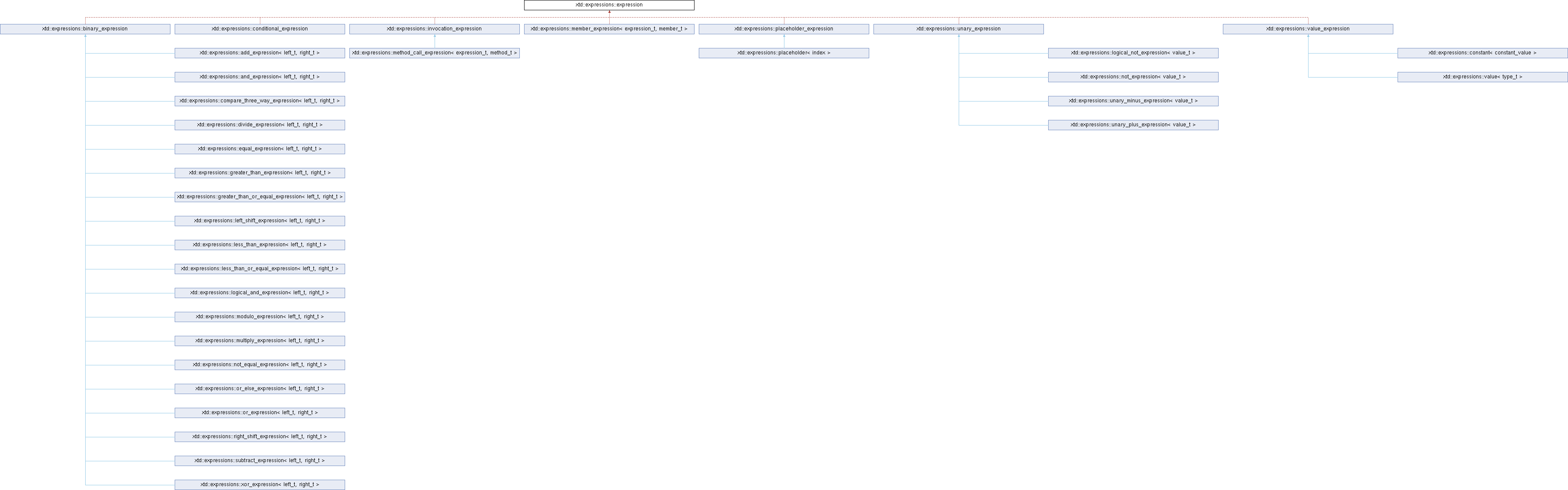
Definition
Provides the base class from which the classes that represent expression tree nodes are derived. It also contains static factory methods to create the various node types. This is an abstract class.
- Namespace
- xtd::expressions
- Header
- #include <xtd/expressions/expression>
- Library
- xtd.core
- Remarks
- The following tables show the expressions by type :
-
Member and pointer operator xtd::expressions::expression::member xtd::expressions::expression::method -
Conditional operator xtd::expressions::expression::if_then_else a ? b : c -
Others operator xtd::expressions::expression::constant xtd::expressions::expression::value xtd::expressions::expression::arg
- Examples
- The following example demonstrates how to use xtd::expressions::expression class. #include <xtd/xtd>auto main() -> int {auto value = 30;// auto expr1 = [value](auto&& _1, auto&& _2) {return (_1 + _2);};println("expr1 = {}", expr1(10, 20));println("expr1 => {}", expr1);println("type_of(expr1) => {}", type_of(expr1));println();// auto expr2 = [value](auto&& _1, auto&& _2) {return (_1 + _2) * value;};println("expr2 = {}", expr2(10, 20));println("expr2 => {}", expr2);println("type_of(expr2) => {}", type_of(expr2));}// This code produces the following output ://// expr1 = 900// expr1 => (_1 + _2) * 30// type_of(expr1) => xtd::expressions::multiply<xtd::expressions::add<xtd::expressions::argument<1ul>, xtd::expressions::argument<2ul>>, xtd::expressions::value<int>>//// expr2 = 900// expr2 => (_1 + _2) * 30// type_of(expr2) => xtd::expressions::multiply<xtd::expressions::add<xtd::expressions::argument<1ul>, xtd::expressions::argument<2ul>>, xtd::expressions::value<int>>constexpr auto _2The xtd::expressions::_2 arg instance is second argument used by expression.Definition args.hpp:119constexpr auto _1The xtd::expressions::_1 arg instance is first argument used by expression.Definition args.hpp:94auto println(FILE *file) -> voidWrites the current line terminator to the file output stream using the specified format information.Definition println.hpp:15static constexpr auto add(left_t left, right_t right)Add the specified left and right operands.static constexpr auto multiply(left_t left, right_t right)Multiply the specified left and right operands.
Public Static Fields | |
| template<size_t index> | |
| static const xtd::expressions::argument< index > | arg |
| Gets the index argument used by expression. | |
Public Static Methods | |
| template<typename left_t, typename right_t> requires std::is_base_of_v<expression, std::decay_t<left_t>> || std::is_base_of_v<expression, std::decay_t<right_t>> | |
| static constexpr auto | add (left_t left, right_t right) |
| Add the specified left and right operands. | |
| template<typename left_t, typename right_t> requires std::is_base_of_v<expression, std::decay_t<left_t>> || std::is_base_of_v<expression, std::decay_t<right_t>> | |
| static constexpr auto | and_ (left_t left, right_t right) |
| Bitwise and the specified left and right operands. | |
| template<typename left_t, typename right_t> requires std::is_base_of_v<expression, std::decay_t<left_t>> || std::is_base_of_v<expression, std::decay_t<right_t>> | |
| static constexpr auto | and_also (left_t left, right_t right) |
| Logical and the specified left and right operands. | |
| template<typename left_t, typename right_t> requires std::is_base_of_v<expression, std::decay_t<left_t>> || std::is_base_of_v<expression, std::decay_t<right_t>> | |
| static constexpr auto | compare_three_way (left_t left, right_t right) |
| Compare three way the specified left and right operands. | |
| template<auto constant_value> | |
| static constexpr auto | constant () |
| Gets the constant value. | |
| template<typename left_t, typename right_t> requires std::is_base_of_v<expression, std::decay_t<left_t>> || std::is_base_of_v<expression, std::decay_t<right_t>> | |
| static constexpr auto | divide (left_t left, right_t right) |
| Divide the specified left and right operands. | |
| template<typename left_t, typename right_t> requires std::is_base_of_v<expression, std::decay_t<left_t>> || std::is_base_of_v<expression, std::decay_t<right_t>> | |
| static constexpr auto | equal (left_t left, right_t right) |
| Equal the specified left and right operands. | |
| template<typename left_t, typename right_t> requires std::is_base_of_v<expression, std::decay_t<left_t>> || std::is_base_of_v<expression, std::decay_t<right_t>> | |
| static constexpr auto | exclusive_or (left_t left, right_t right) |
| Bitwise xor the specified left and right operands. | |
| template<typename left_t, typename right_t> requires std::is_base_of_v<expression, std::decay_t<left_t>> || std::is_base_of_v<expression, std::decay_t<right_t>> | |
| static constexpr auto | greater_than (left_t left, right_t right) |
| Greater than the specified left and right operands. | |
| template<typename left_t, typename right_t> requires std::is_base_of_v<expression, std::decay_t<left_t>> || std::is_base_of_v<expression, std::decay_t<right_t>> | |
| static constexpr auto | greater_than_or_equal (left_t left, right_t right) |
| Greater than or equzl the specified left and right operands. | |
| template<typename left_t, typename right_t> requires std::is_base_of_v<expression, std::decay_t<left_t>> || std::is_base_of_v<expression, std::decay_t<right_t>> | |
| static constexpr auto | left_shift (left_t left, right_t right) |
| Left shift the specified left and right operands. | |
| template<typename left_t, typename right_t> requires std::is_base_of_v<expression, std::decay_t<left_t>> || std::is_base_of_v<expression, std::decay_t<right_t>> | |
| static constexpr auto | less_than (left_t left, right_t right) |
| Less than the specified left and right operands. | |
| template<typename left_t, typename right_t> requires std::is_base_of_v<expression, std::decay_t<left_t>> || std::is_base_of_v<expression, std::decay_t<right_t>> | |
| static constexpr auto | less_than_or_equal (left_t left, right_t right) |
| Less than or equal the specified left and right operands. | |
| template<typename left_t, typename right_t> requires std::is_base_of_v<expression, std::decay_t<left_t>> || std::is_base_of_v<expression, std::decay_t<right_t>> | |
| static constexpr auto | logical_and (left_t left, right_t right) |
| Logical and the specified left and right operands. | |
| template<typename value_t> requires std::is_base_of_v<expression, std::decay_t<value_t>> | |
| static constexpr auto | logical_not (value_t value) |
| Logical not the specified left and right operands. | |
| template<typename left_t, typename right_t> requires std::is_base_of_v<expression, std::decay_t<left_t>> || std::is_base_of_v<expression, std::decay_t<right_t>> | |
| static constexpr auto | logical_or (left_t left, right_t right) |
| Logical or the specified left and right operands. | |
| template<typename left_t, typename right_t> requires std::is_base_of_v<expression, std::decay_t<left_t>> || std::is_base_of_v<expression, std::decay_t<right_t>> | |
| static constexpr auto | modulo (left_t left, right_t right) |
| Modulo the specified left and right operands. | |
| template<typename left_t, typename right_t> requires std::is_base_of_v<expression, std::decay_t<left_t>> || std::is_base_of_v<expression, std::decay_t<right_t>> | |
| static constexpr auto | multiply (left_t left, right_t right) |
| Multiply the specified left and right operands. | |
| template<typename value_t> requires std::is_base_of_v<expression, std::decay_t<value_t>> | |
| static constexpr auto | negate (value_t value) |
| Unary minus the specified left and right operands. | |
| template<typename value_t> requires std::is_base_of_v<expression, std::decay_t<value_t>> | |
| static constexpr auto | not_ (value_t value) |
| Bitwise not the specified left and right operands. | |
| template<typename left_t, typename right_t> requires std::is_base_of_v<expression, std::decay_t<left_t>> || std::is_base_of_v<expression, std::decay_t<right_t>> | |
| static constexpr auto | not_equal (left_t left, right_t right) |
| Not equal the specified left and right operands. | |
| template<typename left_t, typename right_t> requires std::is_base_of_v<expression, std::decay_t<left_t>> || std::is_base_of_v<expression, std::decay_t<right_t>> | |
| static constexpr auto | or_ (left_t left, right_t right) |
| Bitwise or the specified left and right operands. | |
| template<typename left_t, typename right_t> requires std::is_base_of_v<expression, std::decay_t<left_t>> || std::is_base_of_v<expression, std::decay_t<right_t>> | |
| static constexpr auto | or_else (left_t left, right_t right) |
| Logical or the specified left and right operands. | |
| template<typename left_t, typename right_t> requires std::is_base_of_v<expression, std::decay_t<left_t>> || std::is_base_of_v<expression, std::decay_t<right_t>> | |
| static constexpr auto | right_shift (left_t left, right_t right) |
| Right shift the specified left and right operands. | |
| template<typename left_t, typename right_t> requires std::is_base_of_v<expression, std::decay_t<left_t>> || std::is_base_of_v<expression, std::decay_t<right_t>> | |
| static constexpr auto | spaceship (left_t left, right_t right) |
| Compare three way the specified left and right operands. | |
| template<typename left_t, typename right_t> requires std::is_base_of_v<expression, std::decay_t<left_t>> || std::is_base_of_v<expression, std::decay_t<right_t>> | |
| static constexpr auto | subtract (left_t left, right_t right) |
| Subtract the specified left and right operands. | |
| template<typename value_t> requires std::is_base_of_v<expression, std::decay_t<value_t>> | |
| static constexpr auto | unary_minus (value_t value) |
| Unary minus the specified left and right operands. | |
| template<typename value_t> requires std::is_base_of_v<expression, std::decay_t<value_t>> | |
| static constexpr auto | unary_plus (value_t value) |
| Unary plus the specified left and right operands. | |
| template<typename type_t> | |
| static constexpr auto | value (type_t value) |
| Gets the value value. | |
| template<typename left_t, typename right_t> requires std::is_base_of_v<expression, std::decay_t<left_t>> || std::is_base_of_v<expression, std::decay_t<right_t>> | |
| static constexpr auto | xor_ (left_t left, right_t right) |
| Bitwise xor the specified left and right operands. | |
Member Function Documentation
◆ add()
template<typename left_t, typename right_t>
requires std::is_base_of_v<expression, std::decay_t<left_t>> || std::is_base_of_v<expression, std::decay_t<right_t>>
requires std::is_base_of_v<expression, std::decay_t<left_t>> || std::is_base_of_v<expression, std::decay_t<right_t>>
|
staticconstexpr |
Add the specified left and right operands.
- Parameters
-
left The left operand. right The right operand.
- Returns
- The result of add.
- Examples
- The following example demonstrates how to use xtd::expressions::expression::add. #include <xtd/xtd>auto main() -> int {// auto expr1 = [](auto&& _) {return _ + 10;};auto expr1 = _ + 10;println("expr1 = {}", expr1(40));println("expr2 = {}", expr2(40));println();// auto expr3 = [](auto&& _1, auto&& _2) {return _1 + _2;};println("expr3 = {}", expr3(40, 20));println("expr4 = {}", expr4(40, 20));}// This code produces the following output ://// expr1 = 50// expr2 = 50//// expr3 = 60// expr4 = 60constexpr auto _The xtd::expressions::_ arg instance is used by expression that have only one argument.Definition args.hpp:68
◆ and_()
template<typename left_t, typename right_t>
requires std::is_base_of_v<expression, std::decay_t<left_t>> || std::is_base_of_v<expression, std::decay_t<right_t>>
requires std::is_base_of_v<expression, std::decay_t<left_t>> || std::is_base_of_v<expression, std::decay_t<right_t>>
|
staticconstexpr |
Bitwise and the specified left and right operands.
- Parameters
-
left The left operand. right The right operand.
- Returns
- The result of bitwise and.
- Examples
- The following example demonstrates how to use xtd::expressions::expression::and_. #include <xtd/xtd>auto main() -> int {// auto expr1 = [](auto&& _) {return _ & 0x0F;};auto expr1 = _ & 0x0F;println("expr1 = {:B}", expr1(42));println("expr2 = {:B}", expr2(42));println();// auto expr3 = [](auto&& _1, auto&& _2) {return _1 & _2;};println("expr3 = {:B}", expr3(42, 0xF0));println("expr4 = {:B}", expr4(42, 0xF0));}// This code produces the following output ://// expr1 = 1010// expr2 = 1010//// expr3 = 100000// expr4 = 100000static constexpr auto and_(left_t left, right_t right)Bitwise and the specified left and right operands.
◆ and_also()
template<typename left_t, typename right_t>
requires std::is_base_of_v<expression, std::decay_t<left_t>> || std::is_base_of_v<expression, std::decay_t<right_t>>
requires std::is_base_of_v<expression, std::decay_t<left_t>> || std::is_base_of_v<expression, std::decay_t<right_t>>
|
staticconstexpr |
Logical and the specified left and right operands.
- Parameters
-
left The left operand. right The right operand.
- Returns
- The result of logical and.
- Remarks
- xtd::expressions::expression::and_also is an alias on xtd::expressions::expression::logical_and
- Examples
- The following example demonstrates how to use xtd::expressions::expression::and_also. #include <xtd/xtd>auto main() -> int {// auto expr1 = [value](auto&& _) {return _ && value;};println("expr1 = {}", expr1(42 % 2 == 0));println("expr2 = {}", expr2(42 % 2 == 0));println();// auto expr3 = [](auto&& _1, auto&& _2) {return _1 && _2;};println("expr3 = {}", expr3(42 % 2 == 0, 42 % 8 == 0));println("expr4 = {}", expr4(42 % 2 == 0, 42 % 8 == 0));}// This code produces the following output ://// expr1 = true// expr2 = true//// expr3 = false// expr4 = falsestatic constexpr auto and_also(left_t left, right_t right)Logical and the specified left and right operands.
◆ compare_three_way()
template<typename left_t, typename right_t>
requires std::is_base_of_v<expression, std::decay_t<left_t>> || std::is_base_of_v<expression, std::decay_t<right_t>>
requires std::is_base_of_v<expression, std::decay_t<left_t>> || std::is_base_of_v<expression, std::decay_t<right_t>>
|
staticconstexpr |
Compare three way the specified left and right operands.
- Parameters
-
left The left operand. right The right operand.
- Returns
- The result of compare three way.
- Examples
- The following example demonstrates how to use xtd::expressions::expression::compare_three_way. #include <xtd/xtd>auto main() -> int {// auto expr1 = [](auto&& _) {return _ <=> 10;};auto expr1 = _ <=> 10;println("expr1 = {}", expr1(42));println("expr2 = {}", expr2(42));println();// auto expr3 = [](auto&& _1, auto&& _2) {return _1 <=> _2;};auto expr3 = _1 <=> _2;println("expr3 = {}", expr3(42, 42));println("expr4 = {}", expr4(42, 42));}// This code produces the following output ://// expr1 = greater// expr2 = greater//// expr3 = equivalent// expr4 = equivalentstatic constexpr auto compare_three_way(left_t left, right_t right)Compare three way the specified left and right operands.
◆ constant()
template<auto constant_value>
|
staticconstexpr |
Gets the constant value.
- Parameters
-
value The constnt value.
- Returns
- The constant value expression.
- Examples
- The following example demonstrates how to use xtd::expressions::expression::constant. #include <xtd/xtd>auto main() -> int {// auto constant1 = [] {return 10;};auto constant1 = constant<10> {};println("constant1 = {}", constant1());auto constant2 = expression::constant<10>();println("constant2 = {}", constant2());//auto constant3 = [value] {return value;};auto constant3 = constant<value> {};println("constant3 = {}", constant3());auto constant4 = expression::constant<value>();println("constant4 = {}", constant4());println();//auto expr1 = [value] {return 20 + value;};auto expr1 = constant<20> {} + expression::constant<value>();println("expr1 = {}", expr1());}// This code produces the following output ://// constant1 = 10// constant2 = 10// constant3 = 30// constant4 = 30//// expr1 = 50The xtd::expressions::constant is the constant wrapper.Definition constant.hpp:55
◆ divide()
template<typename left_t, typename right_t>
requires std::is_base_of_v<expression, std::decay_t<left_t>> || std::is_base_of_v<expression, std::decay_t<right_t>>
requires std::is_base_of_v<expression, std::decay_t<left_t>> || std::is_base_of_v<expression, std::decay_t<right_t>>
|
staticconstexpr |
Divide the specified left and right operands.
- Parameters
-
left The left operand. right The right operand.
- Returns
- The result of devide.
- Examples
- The following example demonstrates how to use xtd::expressions::expression::divide. #include <xtd/xtd>auto main() -> int {// auto expr1 = [](auto&& _) {return _ / 10;};auto expr1 = _ / 10;println("expr1 = {}", expr1(50));println("expr2 = {}", expr2(50));println();// auto expr3 = [](auto&& _1, auto&& _2) {return _1 / _2;};println("expr3 = {}", expr3(60, 15));println("expr4 = {}", expr4(60, 15));}// This code produces the following output ://// expr1 = 5// expr2 = 5//// expr3 = 4// expr4 = 4static constexpr auto divide(left_t left, right_t right)Divide the specified left and right operands.
◆ equal()
template<typename left_t, typename right_t>
requires std::is_base_of_v<expression, std::decay_t<left_t>> || std::is_base_of_v<expression, std::decay_t<right_t>>
requires std::is_base_of_v<expression, std::decay_t<left_t>> || std::is_base_of_v<expression, std::decay_t<right_t>>
|
staticconstexpr |
Equal the specified left and right operands.
- Parameters
-
left The left operand. right The right operand.
- Returns
- The result of equal.
- Examples
- The following example demonstrates how to use xtd::expressions::expression::equal. #include <xtd/xtd>auto main() -> int {// auto equal1 = [](auto&& _) {return _ == 10;};auto equal1 = _ == 10;println("equal1 result => {}", equal1(42));println("equal2 result => {}", equal2(42));println();// auto equal3 = [](auto&& _1, auto&& _2) {return _1 == _2;};println("equal3 result => {}", equal3(42, 42));println("equal4 result => {}", equal4(42, 42));}// This code produces the following output ://// equal1 result => false// equal2 result => false//// equal3 result => true// equal4 result => truestatic constexpr auto equal(left_t left, right_t right)Equal the specified left and right operands.
◆ exclusive_or()
template<typename left_t, typename right_t>
requires std::is_base_of_v<expression, std::decay_t<left_t>> || std::is_base_of_v<expression, std::decay_t<right_t>>
requires std::is_base_of_v<expression, std::decay_t<left_t>> || std::is_base_of_v<expression, std::decay_t<right_t>>
|
staticconstexpr |
Bitwise xor the specified left and right operands.
- Parameters
-
left The left operand. right The right operand.
- Returns
- The result of bitwise xor.
- Examples
- The following example demonstrates how to use xtd::expressions::expression::xor_. #include <xtd/xtd>auto main() -> int {// auto or1 = [](auto&& _) {return _ ^ 0x0F;};auto xor1 = _ ^ 0x0F;println("xor1 result => {:B}", xor1(42));println("xor2 result => {:B}", xor2(42));println();// auto xor3 = [](auto&& _1, auto&& _2) {return _1 ^ _2;};println("xor3 result => {:B}", xor3(42, 0xF0));println("xor4 result => {:B}", xor4(42, 0xF0));}// This code produces the following output ://// xor1 result => 100101// xor2 result => 100101//// xor3 result => 11010010// xor4 result => 11010010static constexpr auto exclusive_or(left_t left, right_t right)Bitwise xor the specified left and right operands.
◆ greater_than()
template<typename left_t, typename right_t>
requires std::is_base_of_v<expression, std::decay_t<left_t>> || std::is_base_of_v<expression, std::decay_t<right_t>>
requires std::is_base_of_v<expression, std::decay_t<left_t>> || std::is_base_of_v<expression, std::decay_t<right_t>>
|
staticconstexpr |
Greater than the specified left and right operands.
- Parameters
-
left The left operand. right The right operand.
- Returns
- The result of greater than.
- Examples
- The following example demonstrates how to use xtd::expressions::expression::greater_than. #include <xtd/xtd>auto main() -> int {// auto greater_than1 = [](auto&& _) {return _ > 10;};auto greater_than1 = _ > 10;println("greater_than1 result => {}", greater_than1(42));println("greater_than2 result => {}", greater_than2(42));println();// auto greater_than3 = [](auto&& _1, auto&& _2) {return _1 > _2;};println("greater_than3 result => {}", greater_than3(42, 42));println("greater_than4 result => {}", greater_than4(42, 42));}// This code produces the following output ://// greater_than1 result => true// greater_than2 result => true//// greater_than3 result => false// greater_than4 result => falsestatic constexpr auto greater_than(left_t left, right_t right)Greater than the specified left and right operands.
◆ greater_than_or_equal()
template<typename left_t, typename right_t>
requires std::is_base_of_v<expression, std::decay_t<left_t>> || std::is_base_of_v<expression, std::decay_t<right_t>>
requires std::is_base_of_v<expression, std::decay_t<left_t>> || std::is_base_of_v<expression, std::decay_t<right_t>>
|
staticconstexpr |
Greater than or equzl the specified left and right operands.
- Parameters
-
left The left operand. right The right operand.
- Returns
- The result of greater than or equal.
- Examples
- The following example demonstrates how to use xtd::expressions::expression::greater_than_or_equal. #include <xtd/xtd>auto main() -> int {// auto greater_than_or_equal1 = [](auto&& _) {return _ >= 10;};auto greater_than_or_equal1 = _ > 10;println("greater_than_or_equal1 result => {}", greater_than_or_equal1(42));println("greater_than_or_equal2 result => {}", greater_than2(42));println();// auto greater_than_or_equal3 = [](auto&& _1, auto&& _2) {return _1 >= _2;};println("greater_than_or_equal3 result => {}", greater_than_or_equal2(32, 42));println("greater_than_or_equal4 result => {}", greater_than_or_equal4(32, 42));}// This code produces the following output ://// greater_than_or_equal1 result => true// greater_than_or_equal2 result => true//// greater_than_or_equal3 result => false// greater_than_or_equal4 result => falsestatic constexpr auto greater_than_or_equal(left_t left, right_t right)Greater than or equzl the specified left and right operands.
◆ left_shift()
template<typename left_t, typename right_t>
requires std::is_base_of_v<expression, std::decay_t<left_t>> || std::is_base_of_v<expression, std::decay_t<right_t>>
requires std::is_base_of_v<expression, std::decay_t<left_t>> || std::is_base_of_v<expression, std::decay_t<right_t>>
|
staticconstexpr |
Left shift the specified left and right operands.
- Parameters
-
left The left operand. right The right operand.
- Returns
- The result of left shift.
- Examples
- The following example demonstrates how to use xtd::expressions::expression::left_shift. #include <xtd/xtd>auto main() -> int {// auto left_shift1 = [](auto&& _) {return _ << 2;};auto left_shift1 = _ << 2;println("left_shift1 result => {}", left_shift1(42));println("left_shift2 result => {}", left_shift2(42));println();// auto left_shift3 = [](auto&& _1, auto&& _2) {return _1 << _2;};println("left_shift3 result => {}", left_shift3(42, 4));println("left_shift4 result => {}", left_shift4(42, 4));}// This code produces the following output ://// left_shift1 result => 168// left_shift2 result => 168//// left_shift3 result => 672// left_shift4 result => 672static constexpr auto left_shift(left_t left, right_t right)Left shift the specified left and right operands.
◆ less_than()
template<typename left_t, typename right_t>
requires std::is_base_of_v<expression, std::decay_t<left_t>> || std::is_base_of_v<expression, std::decay_t<right_t>>
requires std::is_base_of_v<expression, std::decay_t<left_t>> || std::is_base_of_v<expression, std::decay_t<right_t>>
|
staticconstexpr |
Less than the specified left and right operands.
- Parameters
-
left The left operand. right The right operand.
- Returns
- The result of less than.
- Examples
- The following example demonstrates how to use xtd::expressions::expression::less_than. #include <xtd/xtd>auto main() -> int {// auto less_than1 = [](auto&& _) {return _ < 10;};auto less_than1 = _ < 10;println("less_than1 result => {}", less_than1(42));println("less_than2 result => {}", less_than2(42));println();// auto less_than3 = [](auto&& _1, auto&& _2) {return _1 < _2;};println("less_than3 result => {}", less_than3(42, 52));println("less_than4 result => {}", less_than4(42, (52)));}// This code produces the following output ://// greater_than1 result => false// greater_than2 result => false//// greater_than3 result => true// greater_than4 result => truestatic constexpr auto less_than(left_t left, right_t right)Less than the specified left and right operands.
◆ less_than_or_equal()
template<typename left_t, typename right_t>
requires std::is_base_of_v<expression, std::decay_t<left_t>> || std::is_base_of_v<expression, std::decay_t<right_t>>
requires std::is_base_of_v<expression, std::decay_t<left_t>> || std::is_base_of_v<expression, std::decay_t<right_t>>
|
staticconstexpr |
Less than or equal the specified left and right operands.
- Parameters
-
left The left operand. right The right operand.
- Returns
- The result of less than or equal.
- Examples
- The following example demonstrates how to use xtd::expressions::expression::less_than_or_equal. #include <xtd/xtd>auto main() -> int {// auto less_than_or_equal1 = [](auto&& _) {return _ <= 10;};auto less_than_or_equal1 = _ <= 10;println("less_than_or_equal1 result => {}", less_than_or_equal1(42));println("less_than_or_equal2 result => {}", less_than_or_equal2(42));println();// auto less_than_or_equal3 = [](auto&& _1, auto&& _2) {return _1 <= _2;};println("less_than_or_equal3 result => {}", less_than_or_equal3(42, 52));println("less_than_or_equal4 result => {}", less_than_or_equal4(42, (52)));}// This code produces the following output ://// greater_than1 result => false// greater_than2 result => false//// greater_than3 result => true// greater_than4 result => truestatic constexpr auto less_than_or_equal(left_t left, right_t right)Less than or equal the specified left and right operands.
◆ logical_and()
template<typename left_t, typename right_t>
requires std::is_base_of_v<expression, std::decay_t<left_t>> || std::is_base_of_v<expression, std::decay_t<right_t>>
requires std::is_base_of_v<expression, std::decay_t<left_t>> || std::is_base_of_v<expression, std::decay_t<right_t>>
|
staticconstexpr |
Logical and the specified left and right operands.
- Parameters
-
left The left operand. right The right operand.
- Returns
- The result of logical and.
- Remarks
- xtd::expressions::expression::and_also is an alias on xtd::expressions::expression::logical_and
- Examples
- The following example demonstrates how to use xtd::expressions::expression::logical_and. #include <xtd/xtd>auto main() -> int {// auto logical_and1 = [value](auto&& _) {return _ && value;};println("logical_and1 result => {}", logical_and1(42 % 2 == 0));println("logical_and2 result => {}", logical_and2(42 % 2 == 0));println();// auto logical_and3 = [](auto&& _1, auto&& _2) {return _1 && _2;};println("and_also3 result => {}", logical_and3(42 % 2 == 0, 42 % 8 == 0));println("logical_and4 result => {}", logical_and4(42 % 2 == 0, 42 % 8 == 0));}// This code produces the following output ://// logical_and1 result => true// logical_and2 result => true//// logical_and3 result => false// logical_and4 result => falsestatic constexpr auto logical_and(left_t left, right_t right)Logical and the specified left and right operands.
◆ logical_not()
template<typename value_t>
requires std::is_base_of_v<expression, std::decay_t<value_t>>
requires std::is_base_of_v<expression, std::decay_t<value_t>>
|
staticconstexpr |
Logical not the specified left and right operands.
- Parameters
-
left The left operand. right The right operand.
- Returns
- The result of logical not.
- Remarks
- xtd::expressions::expression::and_also is an alias on xtd::expressions::expression::logical_not
- Examples
- The following example demonstrates how to use xtd::expressions::expression::logical_not. #include <xtd/xtd>auto main() -> int {// auto logical_not1 = [value](auto&& _) {return !_;};auto logical_not1 = !_;}// This code produces the following output ://// logical_not1 result => true// logical_not2 result => truestatic constexpr auto logical_not(value_t value)Logical not the specified left and right operands.
◆ logical_or()
template<typename left_t, typename right_t>
requires std::is_base_of_v<expression, std::decay_t<left_t>> || std::is_base_of_v<expression, std::decay_t<right_t>>
requires std::is_base_of_v<expression, std::decay_t<left_t>> || std::is_base_of_v<expression, std::decay_t<right_t>>
|
staticconstexpr |
Logical or the specified left and right operands.
- Parameters
-
left The left operand. right The right operand.
- Returns
- The result of logical or.
- Remarks
- xtd::expressions::expression::and_also is an alias on xtd::expressions::expression::logical_or
- Examples
- The following example demonstrates how to use xtd::expressions::expression::logical_or. #include <xtd/xtd>auto main() -> int {// auto logical_or1 = [value](auto&& _) {return _ || value;};println("logical_or1 result => {}", logical_or1(42 % 2 == 0));println("logical_or2 result => {}", logical_or2(42 % 2 == 0));println();// auto logical_or3 = [](auto&& _1, auto&& _2) {return _1 || _2;};println("and_also3 result => {}", logical_or3(42 % 2 != 0, 42 % 8 == 0));println("logical_or4 result => {}", logical_or4(42 % 2 != 0, 42 % 8 == 0));}// This code produces the following output ://// logical_or1 result => true// logical_or2 result => true//// logical_or3 result => false// logical_or4 result => falsestatic constexpr auto logical_or(left_t left, right_t right)Logical or the specified left and right operands.
◆ modulo()
template<typename left_t, typename right_t>
requires std::is_base_of_v<expression, std::decay_t<left_t>> || std::is_base_of_v<expression, std::decay_t<right_t>>
requires std::is_base_of_v<expression, std::decay_t<left_t>> || std::is_base_of_v<expression, std::decay_t<right_t>>
|
staticconstexpr |
Modulo the specified left and right operands.
- Parameters
-
left The left operand. right The right operand.
- Returns
- The result of modulo.
- Examples
- The following example demonstrates how to use xtd::expressions::expression::modulo. #include <xtd/xtd>auto main() -> int {// auto modulo1 = [](auto&& _) {return _ % 10;};auto modulo1 = _ % 10;println("modulo1 result => {}", modulo1(27));println("modulo2 result => {}", modulo2(27));println();// auto modulo3 = [](auto&& _1, auto&& _2) {return _1 % _2;};println("modulo3 result => {}", modulo3(64, 6));println("modulo4 result => {}", modulo4(64, 6));}// This code produces the following output ://// mul1 result => 7// mul2 result => 7//// mul3 result => 4// mul4 result => 4static constexpr auto modulo(left_t left, right_t right)Modulo the specified left and right operands.
◆ multiply()
template<typename left_t, typename right_t>
requires std::is_base_of_v<expression, std::decay_t<left_t>> || std::is_base_of_v<expression, std::decay_t<right_t>>
requires std::is_base_of_v<expression, std::decay_t<left_t>> || std::is_base_of_v<expression, std::decay_t<right_t>>
|
staticconstexpr |
Multiply the specified left and right operands.
- Parameters
-
left The left operand. right The right operand.
- Returns
- The result of multiply.
- Examples
- The following example demonstrates how to use xtd::expressions::expression::multiply. #include <xtd/xtd>auto main() -> int {// auto multiply1 = [](auto&& _) {return _ * 10;};auto multiply1 = _ * 10;println("multiply1 result => {}", multiply1(5));println("multiply2 result => {}", multiply2(5));println();// auto multiply3 = [](auto&& _1, auto&& _2) {return _1 * _2;};println("multiply3 result => {}", multiply3(4, 15));println("multiply4 result => {}", multiply4(4, 15));}// This code produces the following output ://// mul1 result => 50// mul2 result => 50//// mul3 result => 60// mul4 result => 60
◆ negate()
template<typename value_t>
requires std::is_base_of_v<expression, std::decay_t<value_t>>
requires std::is_base_of_v<expression, std::decay_t<value_t>>
|
staticconstexpr |
Unary minus the specified left and right operands.
- Parameters
-
left The left operand. right The right operand.
- Returns
- The result of unary minus.
- Remarks
- xtd::expressions::expression::and_also is an alias on xtd::expressions::expression::negate
- Examples
- The following example demonstrates how to use xtd::expressions::expression::negate. #include <xtd/xtd>auto main() -> int {// auto negate1 = [value](auto&& _) {return -_;};auto negate1 = -_;println("negate1 result => {}", negate1(42));println("negate2 result => {}", negate2(42));}// This code produces the following output ://// negate1 result => -42// negate2 result => -42static constexpr auto negate(value_t value)Unary minus the specified left and right operands.
◆ not_()
template<typename value_t>
requires std::is_base_of_v<expression, std::decay_t<value_t>>
requires std::is_base_of_v<expression, std::decay_t<value_t>>
|
staticconstexpr |
Bitwise not the specified left and right operands.
- Parameters
-
left The left operand. right The right operand.
- Returns
- The result of bistwise not.
- Remarks
- xtd::expressions::expression::and_also is an alias on xtd::expressions::expression::not_
- Examples
- The following example demonstrates how to use xtd::expressions::expression::not_. #include <xtd/xtd>auto main() -> int {//auto not1 = [](auto _) {return static_cast<decltype(_)>(~_);};auto not1 = ~_;println("not1 result => {:B}", not1(42_u8));println("unary_plus2 result => {:B}", not2(42));}// This code produces the following output ://// not1 result => 11010101// not2 result => 11010101static constexpr auto not_(value_t value)Bitwise not the specified left and right operands.
◆ not_equal()
template<typename left_t, typename right_t>
requires std::is_base_of_v<expression, std::decay_t<left_t>> || std::is_base_of_v<expression, std::decay_t<right_t>>
requires std::is_base_of_v<expression, std::decay_t<left_t>> || std::is_base_of_v<expression, std::decay_t<right_t>>
|
staticconstexpr |
Not equal the specified left and right operands.
- Parameters
-
left The left operand. right The right operand.
- Returns
- The result of not equal.
- Examples
- The following example demonstrates how to use xtd::expressions::expression::not_equal. #include <xtd/xtd>auto main() -> int {// auto not_equal1 = [](auto&& _) {return _ != 10;};auto not_equal1 = _ != 10;println("not_equal1 result => {}", not_equal1(42));println("not_equal2 result => {}", not_equal2(42));println();// auto not_equal3 = [](auto&& _1, auto&& _2) {return _1 != _2;};println("not_equal3 result => {}", not_equal3(42, 42));println("not_equal4 result => {}", not_equal4(42, 42));}// This code produces the following output ://// not_equal1 result => true// not_equal2 result => true//// not_equal3 result => false// not_equal4 result => falsestatic constexpr auto not_equal(left_t left, right_t right)Not equal the specified left and right operands.
◆ or_()
template<typename left_t, typename right_t>
requires std::is_base_of_v<expression, std::decay_t<left_t>> || std::is_base_of_v<expression, std::decay_t<right_t>>
requires std::is_base_of_v<expression, std::decay_t<left_t>> || std::is_base_of_v<expression, std::decay_t<right_t>>
|
staticconstexpr |
Bitwise or the specified left and right operands.
- Parameters
-
left The left operand. right The right operand.
- Returns
- The result of bitwise or.
- Examples
- The following example demonstrates how to use xtd::expressions::expression::or_. #include <xtd/xtd>auto main() -> int {// auto or1 = [](auto&& _) {return _ | 0x0F;};auto or1 = _ | 0x0F;println("or1 result => {:B}", or1(42));println("or2 result => {:B}", or2(42));println();// auto or3 = [](auto&& _1, auto&& _2) {return _1 | _2;};println("or3 result => {:B}", or3(42, 0xF0));println("or4 result => {:B}", or4(42, 0xF0));}// This code produces the following output ://// or1 result => 101111// or2 result => 101111//// or3 result => 11111010// or4 result => 11111010static constexpr auto or_(left_t left, right_t right)Bitwise or the specified left and right operands.
◆ or_else()
template<typename left_t, typename right_t>
requires std::is_base_of_v<expression, std::decay_t<left_t>> || std::is_base_of_v<expression, std::decay_t<right_t>>
requires std::is_base_of_v<expression, std::decay_t<left_t>> || std::is_base_of_v<expression, std::decay_t<right_t>>
|
staticconstexpr |
Logical or the specified left and right operands.
- Parameters
-
left The left operand. right The right operand.
- Returns
- The result of logical or.
- Remarks
- xtd::expressions::expression::and_also is an alias on xtd::expressions::expression::or_else
- Examples
- The following example demonstrates how to use xtd::expressions::expression::or_else. #include <xtd/xtd>auto main() -> int {// auto or_else1 = [value](auto&& _) {return _ || value;};println("or_else1 result => {}", or_else1(42 % 2 == 0));println("or_else2 result => {}", or_else2(42 % 2 == 0));println();// auto or_else3 = [](auto&& _1, auto&& _2) {return _1 || _2;};println("and_also3 result => {}", or_else3(42 % 2 != 0, 42 % 8 == 0));println("or_else4 result => {}", or_else4(42 % 2 != 0, 42 % 8 == 0));}// This code produces the following output ://// or_else1 result => true// or_else2 result => true//// or_else3 result => false// or_else4 result => falsestatic constexpr auto or_else(left_t left, right_t right)Logical or the specified left and right operands.
◆ right_shift()
template<typename left_t, typename right_t>
requires std::is_base_of_v<expression, std::decay_t<left_t>> || std::is_base_of_v<expression, std::decay_t<right_t>>
requires std::is_base_of_v<expression, std::decay_t<left_t>> || std::is_base_of_v<expression, std::decay_t<right_t>>
|
staticconstexpr |
Right shift the specified left and right operands.
- Parameters
-
left The left operand. right The right operand.
- Returns
- The result of right shift.
- Examples
- The following example demonstrates how to use xtd::expressions::expression::right_shift. #include <xtd/xtd>auto main() -> int {// auto right_shift1 = [](auto&& _) {return _ >> 2;};auto right_shift1 = _ >> 2;println("right_shift1 result => {}", right_shift1(42));println("right_shift2 result => {}", right_shift2(42));println();// auto right_shift3 = [](auto&& _1, auto&& _2) {return _1 >> _2;};println("right_shift3 result => {}", right_shift3(42, 4));println("right_shift4 result => {}", right_shift4(42, 4));}// This code produces the following output ://// right_shift1 result => 10// right_shift2 result => 10//// right_shift3 result => 2// right_shift4 result => 2static constexpr auto right_shift(left_t left, right_t right)Right shift the specified left and right operands.
◆ spaceship()
template<typename left_t, typename right_t>
requires std::is_base_of_v<expression, std::decay_t<left_t>> || std::is_base_of_v<expression, std::decay_t<right_t>>
requires std::is_base_of_v<expression, std::decay_t<left_t>> || std::is_base_of_v<expression, std::decay_t<right_t>>
|
staticconstexpr |
Compare three way the specified left and right operands.
- Parameters
-
left The left operand. right The right operand.
- Returns
- The result of compare three way.
- Examples
- The following example demonstrates how to use xtd::expressions::expression::spaceship. #include <xtd/xtd>auto main() -> int {// auto cspaceship1 = [value](auto&& _) {return _ <=> 10;};auto cspaceship1 = _ <=> 10;println("spaceship1 result => {}", spaceship1(42));println();//auto spaceship3 = [](auto&& _1, auto&& _2) {return _1 <=> _2;};println("spaceship3 result => {}", spaceship3(42, 42));println("spaceship4 result => {}", spaceship4(42, 42));}// This code produces the following output ://// spaceship1 result => greater// spaceship2 result => greater//// spaceship3 result => equivalent// spaceship4 result => equivalentstatic constexpr auto spaceship(left_t left, right_t right)Compare three way the specified left and right operands.
◆ subtract()
template<typename left_t, typename right_t>
requires std::is_base_of_v<expression, std::decay_t<left_t>> || std::is_base_of_v<expression, std::decay_t<right_t>>
requires std::is_base_of_v<expression, std::decay_t<left_t>> || std::is_base_of_v<expression, std::decay_t<right_t>>
|
staticconstexpr |
Subtract the specified left and right operands.
- Parameters
-
left The left operand. right The right operand.
- Returns
- The result of subtract.
- Examples
- The following example demonstrates how to use xtd::expressions::expression::subtract. #include <xtd/xtd>auto main() -> int {// auto subtract1 = [](auto&& _) {return _ - 10;};auto subtract1 = _ - 10;println("subtract1 result => {}", subtract1(40));println("subtract2 result => {}", subtract2(40));println();// auto subtract3 = [](auto&& _1, auto&& _2) {return _1 - _2;};println("subtract3 result => {}", subtract3(40, 20));println("subtract4 result => {}", subtract4(40, 20));}// This code produces the following output ://// subtract1 result => 30// subtract2 result => 30//// subtract3 result => 20// subtract4 result => 20static constexpr auto subtract(left_t left, right_t right)Subtract the specified left and right operands.
◆ unary_minus()
template<typename value_t>
requires std::is_base_of_v<expression, std::decay_t<value_t>>
requires std::is_base_of_v<expression, std::decay_t<value_t>>
|
staticconstexpr |
Unary minus the specified left and right operands.
- Parameters
-
left The left operand. right The right operand.
- Returns
- The result of unary minus.
- Remarks
- xtd::expressions::expression::and_also is an alias on xtd::expressions::expression::unary_minus
- Examples
- The following example demonstrates how to use xtd::expressions::expression::unary_minus. #include <xtd/xtd>auto main() -> int {// auto unary_minus1 = [value](auto&& _) {return -_;};auto unary_minus1 = -_;println("unary_minus1 result => {}", unary_minus1(42));println("unary_minus2 result => {}", unary_minus2(42));}// This code produces the following output ://// unary_minus1 result => -42// unary_minus2 result => -42static constexpr auto unary_minus(value_t value)Unary minus the specified left and right operands.
◆ unary_plus()
template<typename value_t>
requires std::is_base_of_v<expression, std::decay_t<value_t>>
requires std::is_base_of_v<expression, std::decay_t<value_t>>
|
staticconstexpr |
Unary plus the specified left and right operands.
- Parameters
-
left The left operand. right The right operand.
- Returns
- The result of unary plus.
- Remarks
- xtd::expressions::expression::and_also is an alias on xtd::expressions::expression::unary_plus
- Examples
- The following example demonstrates how to use xtd::expressions::expression::unary_plus. #include <xtd/xtd>auto main() -> int {// auto unary_plus1 = [value](auto&& _) {return +_;};auto unary_plus1 = +_;println("unary_plus1 result => {}", unary_plus1(42));println("unary_plus2 result => {}", unary_plus2(42));}// This code produces the following output ://// unary_plus1 result => 42// unary_plus2 result => 42static constexpr auto unary_plus(value_t value)Unary plus the specified left and right operands.
◆ value()
template<typename type_t>
|
staticconstexpr |
Gets the value value.
- Parameters
-
value The value value.
- Returns
- The value value expression.
- Examples
- The following example demonstrates how to use xtd::expressions::expression::value. #include <xtd/xtd>auto main() -> int {// auto value1 = [] {return 10;};auto value1 = value {10};println("value1 result => {}", value1());auto value2 = expression::value(10);println("value2 result => {}", value2());auto value = 30;//auto value3 = [value] {return value;};println("value3 result => {}", value3());println("value4 result => {}", value4());println();//auto expr1 = [value] {return 20 + value;};println("expr1 result => {}", expr1());}// This code produces the following output ://// value1 result => 10// value2 result => 10// value3 result => 30// value4 result => 30//// expr1 result => 50
◆ xor_()
template<typename left_t, typename right_t>
requires std::is_base_of_v<expression, std::decay_t<left_t>> || std::is_base_of_v<expression, std::decay_t<right_t>>
requires std::is_base_of_v<expression, std::decay_t<left_t>> || std::is_base_of_v<expression, std::decay_t<right_t>>
|
staticconstexpr |
Bitwise xor the specified left and right operands.
- Parameters
-
left The left operand. right The right operand.
- Returns
- The result of bitwise xor.
- Examples
- The following example demonstrates how to use xtd::expressions::expression::xor_. #include <xtd/xtd>auto main() -> int {// auto or1 = [](auto&& _) {return _ ^ 0x0F;};auto xor1 = _ ^ 0x0F;println("xor1 result => {:B}", xor1(42));println("xor2 result => {:B}", xor2(42));println();// auto xor3 = [](auto&& _1, auto&& _2) {return _1 ^ _2;};println("xor3 result => {:B}", xor3(42, 0xF0));println("xor4 result => {:B}", xor4(42, 0xF0));}// This code produces the following output ://// xor1 result => 100101// xor2 result => 100101//// xor3 result => 11010010// xor4 result => 11010010static constexpr auto xor_(left_t left, right_t right)Bitwise xor the specified left and right operands.
Member Data Documentation
◆ arg
template<size_t index>
|
static |
Gets the index argument used by expression.
- Remarks
- The index start from 1 to N.
- Prefer the xtd::expressions::expression::arg <N> or xtd::expressions::_, xtd::expressions::_1 ... xtd::expressions::_10 instead xtd::expressions::expression::arg.
- Examples
- The following example demonstrates how to use xtd::expressions::expression::arg. #include <xtd/xtd>auto main() -> int {// auto arg1 = [](auto&& _1) {return _1;};auto arg1_1 = expression::arg<1>;println("arg1_1 = {}", arg1_1(10));// For argument 1 to 10, a second method is possible because the _N are aliases on xtd::expressionq::expression::arg<N>.println("arg1_2 = {}", arg1_2(10));// For argument 1, a third method is possible because the _ is an alias on xtd::expressionq::expression::arg<1>.println("arg1_3 = {}", arg1_3(10));println();// auto expr = [](auto&& arg1, auto&& arg2, auto&& arg3) {return arg1 + arg2 + arg3;};println("expr1 = {}", expr1(10, 20, 30));println("expr2 = {}", expr2(10, 20, 30));println("expr3 = {}", expr3(10, 20, 30));}// This code produces the following output ://// arg1_1 = 10// arg1_2 = 10// arg1_3 = 10//// expr1 = 60// expr2 = 60// expr3 = 60constexpr auto _3The xtd::expressions::_3 arg instance is third argument used by expression.Definition args.hpp:144static const xtd::expressions::argument< index > argGets the index argument used by expression.Definition expression.hpp:95
The documentation for this struct was generated from the following file:
- xtd.core/include/xtd/expressions/expression.hpp
Generated on for xtd by Gammasoft. All rights reserved.