
|
xtd
1.0.0
|
Loading...
Searching...
No Matches
xtd::tunit::constraints::does_value< actual_t > Class Template Reference
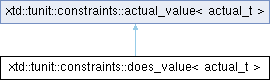
Inheritance diagram for xtd::tunit::constraints::does_value< actual_t >:
Public Methods | |
| auto | not_ () |
| template<typename item_t> | |
| auto | end_with (const item_t &item, const xtd::diagnostics::stack_frame &stack_frame=xtd::diagnostics::stack_frame::current()) const |
| Asserts that string ends with specified item. | |
| template<typename item_t> | |
| auto | end_with (const item_t &item, const xtd::string &message, const xtd::diagnostics::stack_frame &stack_frame=xtd::diagnostics::stack_frame::current()) const |
| Asserts that string ends with specified item and specified user message. | |
| template<typename item_t> | |
| auto | start_with (const item_t &item, const xtd::diagnostics::stack_frame &stack_frame=xtd::diagnostics::stack_frame::current()) const |
| Asserts that string starts with specified item. | |
| template<typename item_t> | |
| auto | start_with (const item_t &item, const xtd::string &message, const xtd::diagnostics::stack_frame &stack_frame=xtd::diagnostics::stack_frame::current()) const |
| Asserts that string starts with specified item and specified user message. | |
Protected Construtors | |
| does_value (actual_value< actual_t > &&v) | |
| does_value (const actual_value< actual_t > &v) | |
Member Function Documentation
◆ end_with() [1/2]
template<typename actual_t>
template<typename item_t>
|
inline |
Asserts that string ends with specified item.
- Parameters
-
item object to verify. stack_frame Contains information about current file and current line.
- Exceptions
-
xtd::tunit::assert_error If bad assertion.
- Examples
- xtd::tunit::constraints::assert_that(s).does().end_with("val"); // test ok.xtd::tunit::constraints::assert_that(s).does().end_with("law"); // test throws an assert_error exception.
◆ end_with() [2/2]
template<typename actual_t>
template<typename item_t>
|
inline |
Asserts that string ends with specified item and specified user message.
- Parameters
-
item object to verify. message A user message to display if the assertion fails. This message can be seen in the unit test results. stack_frame Contains information about current file and current line.
- Exceptions
-
xtd::tunit::assert_error If bad assertion.
- Examples
- xtd::tunit::constraints::assert_that(s).does().end_with("val", "User message..."); // test ok.xtd::tunit::constraints::assert_that(s).does().end_with("law", "User message..."); // test throws an assert_error exception.
◆ start_with() [1/2]
template<typename actual_t>
template<typename item_t>
|
inline |
Asserts that string starts with specified item.
- Parameters
-
item object to verify. stack_frame Contains information about current file and current line.
- Exceptions
-
xtd::tunit::assert_error If bad assertion.
- Examples
- xtd::tunit::constraints::assert_that(s).does().start_with("val"); // test ok.xtd::tunit::constraints::assert_that(s).does().start_with("zoe"); // test throws an assert_error exception.xtd::basic_string< char > stringRepresents text as a sequence of UTF-8 code units.Definition __string_definitions.hpp:43
◆ start_with() [2/2]
template<typename actual_t>
template<typename item_t>
|
inline |
Asserts that string starts with specified item and specified user message.
- Parameters
-
item object to verify. message A user message to display if the assertion fails. This message can be seen in the unit test results. stack_frame Contains information about current file and current line.
- Exceptions
-
xtd::tunit::assert_error If bad assertion.
- Examples
- xtd::tunit::constraints::assert_that(s).does().start_with("val", "User message..."); // test ok.xtd::tunit::constraints::assert_that(s).does().start_with("zoe", "User message..."); // test throws an assert_error exception.
The documentation for this class was generated from the following file:
- xtd.tunit/include/xtd/tunit/constraints/does_value.hpp
Generated on for xtd by Gammasoft. All rights reserved.