
|
xtd
1.0.0
|
Loading...
Searching...
No Matches
xtd::tunit::assert Class Referencefinal
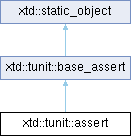
Inheritance diagram for xtd::tunit::assert:
Definition
The assert class contains a collection of static methods that implement the most common assertions used in xtd::tUnit.
- Namespace
- xtd::tunit
- Library
- xtd.tunit
- Remarks
- Assertions are central to unit testing in any of the xUnit frameworks, and xtd.tunit is no exception. xtd.tunit provides a rich set of assertions as static methods of the Assert class.
- If an assertion fails, the method call does not return and an error is reported. If a test contains multiple assertions, any that follow the one that failed will not be executed. For this reason, it's usually best to try for one assertion per test.
- Each method may be called without a message, with a simple text message or with a message and arguments. In the last case the message is formatted using the provided text and arguments.
- Examples
- This example show how to used some methods : #include <xtd/xtd.tunit>namespace unit_tests {class test_class_(test) {void test_method_(test_case1) {assert::is_true(true);}void test_method_(test_case2) {assert::is_false(true);}void test_method_(test_case3) {}};}auto main() -> int {return console_unit_test().run();}// This code can produce the following output ://// Start 3 tests from 1 test case// Run tests:// SUCCEED unit_tests::test.test_case1 [< 1 ms]// FAILED unit_tests::test.test_case2 [< 1 ms]// Expected: false// But was: true// Stack Trace: in |---OMITTED---|/assert.cpp:10// FAILED unit_tests::test.test_case3 [< 1 ms]// Expected: No Exception to be thrown// But was: <xtd::index_out_of_range_exception>// Stack Trace: in |---OMITTED---|/assert.cpp:14//// Test results:// SUCCEED 1 test.// FAILED 2 tests.// End 3 tests from 1 test case ran. [0.0006 seconds]The exception that is thrown when an attempt is made to access an element of an array with an index t...Definition index_out_of_range_exception.hpp:19static auto is_false(bool condition, const xtd::diagnostics::stack_frame &stack_frame=xtd::diagnostics::stack_frame::current()) -> voidAsserts that a condition is false.static auto is_true(bool condition, const xtd::diagnostics::stack_frame &stack_frame=xtd::diagnostics::stack_frame::current()) -> voidAsserts that a condition is true.#define test_method_(method_name)Add test method to class test.Definition test_method_attribute.hpp:72
Public Static Methods | |
| template<typename expected_t, typename actual_t> | |
| static auto | are_equal (const expected_t &expected, const actual_t &actual, const xtd::diagnostics::stack_frame &stack_frame=xtd::diagnostics::stack_frame::current()) -> void |
| Asserts that two type are equal. | |
| template<typename expected_t, typename actual_t> | |
| static auto | are_equal (const expected_t &expected, const actual_t &actual, const xtd::string &message, const xtd::diagnostics::stack_frame &stack_frame=xtd::diagnostics::stack_frame::current()) -> void |
| Asserts that two type are equal. | |
| static auto | are_equal (float expected, float actual, float tolerance, const xtd::diagnostics::stack_frame &stack_frame=xtd::diagnostics::stack_frame::current()) -> void |
| Asserts that two type are equal. | |
| static auto | are_equal (float expected, float actual, float tolerance, const xtd::string &message, const xtd::diagnostics::stack_frame &stack_frame=xtd::diagnostics::stack_frame::current()) -> void |
| Asserts that two type are equal. | |
| static auto | are_equal (double expected, double actual, double tolerance, const xtd::diagnostics::stack_frame &stack_frame=xtd::diagnostics::stack_frame::current()) -> void |
| Asserts that two type are equal. | |
| static auto | are_equal (double expected, double actual, double tolerance, const xtd::string &message, const xtd::diagnostics::stack_frame &stack_frame=xtd::diagnostics::stack_frame::current()) -> void |
| Asserts that two type are equal. | |
| static auto | are_equal (long double expected, long double actual, long double tolerance, const xtd::diagnostics::stack_frame &stack_frame=xtd::diagnostics::stack_frame::current()) -> void |
| Asserts that two type are equal. | |
| static auto | are_equal (long double expected, long double actual, long double tolerance, const xtd::string &message, const xtd::diagnostics::stack_frame &stack_frame=xtd::diagnostics::stack_frame::current()) -> void |
| Asserts that two type are equal. | |
| template<typename expected_t, typename actual_t> | |
| static auto | are_not_equal (const expected_t &expected, const actual_t &actual, const xtd::diagnostics::stack_frame &stack_frame=xtd::diagnostics::stack_frame::current()) -> void |
| Asserts that two type are not equal. | |
| template<typename expected_t, typename actual_t> | |
| static auto | are_not_equal (const expected_t &expected, const actual_t &actual, const xtd::string &message, const xtd::diagnostics::stack_frame &stack_frame=xtd::diagnostics::stack_frame::current()) -> void |
| Asserts that two type are not equal. | |
| template<typename expected_t, typename actual_t> | |
| static auto | are_not_same (const expected_t &expected, const actual_t &actual, const xtd::diagnostics::stack_frame &stack_frame=xtd::diagnostics::stack_frame::current()) -> void |
| Asserts that two objects do refer to differents objects. | |
| template<typename expected_t, typename actual_t> | |
| static auto | are_not_same (const expected_t &expected, const actual_t &actual, const xtd::string &message, const xtd::diagnostics::stack_frame &stack_frame=xtd::diagnostics::stack_frame::current()) -> void |
| Asserts that two objects do refer to differents objects. | |
| template<typename expected_t, typename actual_t> | |
| static auto | are_same (const expected_t &expected, const actual_t &actual, const xtd::diagnostics::stack_frame &stack_frame=xtd::diagnostics::stack_frame::current()) -> void |
| Asserts that two objects do refer to differents objects. | |
| template<typename expected_t, typename actual_t> | |
| static auto | are_same (const expected_t &expected, const actual_t &actual, const xtd::string &message, const xtd::diagnostics::stack_frame &stack_frame=xtd::diagnostics::stack_frame::current()) -> void |
| Asserts that two objects do refer to differents objects. | |
| template<typename item_t, typename collection_t> | |
| static auto | contains (const item_t &item, const collection_t &collection, const xtd::diagnostics::stack_frame &stack_frame=xtd::diagnostics::stack_frame::current()) -> void |
| Asserts that collection contains an item. | |
| template<typename item_t, typename collection_t> | |
| static auto | contains (const item_t &item, const collection_t &collection, const xtd::string &message, const xtd::diagnostics::stack_frame &stack_frame=xtd::diagnostics::stack_frame::current()) -> void |
| Asserts that collection contains an item. | |
| static auto | does_not_throw (const std::function< void()> &statement, const xtd::diagnostics::stack_frame &stack_frame=xtd::diagnostics::stack_frame::current()) -> void |
| Asserts that the staement does not throw an exception. | |
| static auto | does_not_throw (const std::function< void()> &statement, const xtd::string &message, const xtd::diagnostics::stack_frame &stack_frame=xtd::diagnostics::stack_frame::current()) -> void |
| Asserts that the staement does not throw an exception. | |
| template<typename value_t> | |
| static auto | is_empty (const value_t &value, const xtd::diagnostics::stack_frame &stack_frame=xtd::diagnostics::stack_frame::current()) -> void |
| Asserts that collection contains an item. | |
| template<typename value_t> | |
| static auto | is_empty (const value_t &value, const xtd::string &message, const xtd::diagnostics::stack_frame &stack_frame=xtd::diagnostics::stack_frame::current()) -> void |
| Asserts that collection contains an item. | |
| static auto | is_false (bool condition, const xtd::diagnostics::stack_frame &stack_frame=xtd::diagnostics::stack_frame::current()) -> void |
| Asserts that a condition is false. | |
| static auto | is_false (bool condition, const xtd::string &message, const xtd::diagnostics::stack_frame &stack_frame=xtd::diagnostics::stack_frame::current()) -> void |
| Asserts that a condition is false. | |
| template<typename value1_t, typename value2_t> | |
| static auto | is_greater (const value1_t &val1, const value2_t &val2, const xtd::diagnostics::stack_frame &stack_frame=xtd::diagnostics::stack_frame::current()) -> void |
| Asserts that the first value is greater than the second value. | |
| template<typename value1_t, typename value2_t> | |
| static auto | is_greater (const value1_t &val1, const value2_t &val2, const xtd::string &message, const xtd::diagnostics::stack_frame &stack_frame=xtd::diagnostics::stack_frame::current()) -> void |
| Asserts that the first value is greater than the second value. | |
| template<typename value1_t, typename value2_t> | |
| static auto | is_greater_or_equal (const value1_t &val1, const value2_t &val2, const xtd::diagnostics::stack_frame &stack_frame=xtd::diagnostics::stack_frame::current()) -> void |
| Asserts that the first value is greater than or equal to the second value. | |
| template<typename value1_t, typename value2_t> | |
| static auto | is_greater_or_equal (const value1_t &val1, const value2_t &val2, const xtd::string &message, const xtd::diagnostics::stack_frame &stack_frame=xtd::diagnostics::stack_frame::current()) -> void |
| Asserts that the first value is greater than or equal to the second value. | |
| template<typename type_t, typename value_t> | |
| static auto | is_instance_of (const value_t &value, const xtd::diagnostics::stack_frame &stack_frame=xtd::diagnostics::stack_frame::current()) -> void |
| Asserts that an object is of the type supplied or a derived type. | |
| template<typename type_t, typename value_t> | |
| static auto | is_instance_of (const value_t &value, const xtd::string &message, const xtd::diagnostics::stack_frame &stack_frame=xtd::diagnostics::stack_frame::current()) -> void |
| Asserts that an object is of the type supplied or a derived type. | |
| template<typename value1_t, typename value2_t> | |
| static auto | is_less (const value1_t &val1, const value2_t &val2, const xtd::diagnostics::stack_frame &stack_frame=xtd::diagnostics::stack_frame::current()) -> void |
| Asserts that the first value is is_less than the second value. | |
| template<typename value1_t, typename value2_t> | |
| static auto | is_less (const value1_t &val1, const value2_t &val2, const xtd::string &message, const xtd::diagnostics::stack_frame &stack_frame=xtd::diagnostics::stack_frame::current()) -> void |
| Asserts that the first value is is_less than the second value. | |
| template<typename value1_t, typename value2_t> | |
| static auto | is_less_or_equal (const value1_t &val1, const value2_t &val2, const xtd::diagnostics::stack_frame &stack_frame=xtd::diagnostics::stack_frame::current()) -> void |
| Asserts that the first value is is_less than or equal to the second value. | |
| template<typename value1_t, typename value2_t> | |
| static auto | is_less_or_equal (const value1_t &val1, const value2_t &val2, const xtd::string &message, const xtd::diagnostics::stack_frame &stack_frame=xtd::diagnostics::stack_frame::current()) -> void |
| Asserts that the first value is is_less than or equal to the second value. | |
| static auto | is_NaN (double value, const xtd::diagnostics::stack_frame &stack_frame=xtd::diagnostics::stack_frame::current()) -> void |
| that a value is NaN. | |
| static auto | is_NaN (double value, const xtd::string &message, const xtd::diagnostics::stack_frame &stack_frame=xtd::diagnostics::stack_frame::current()) -> void |
| Asserts that a value is NaN. | |
| static auto | is_NaN (long double value, const xtd::diagnostics::stack_frame &stack_frame=xtd::diagnostics::stack_frame::current()) -> void |
| that a value is NaN. | |
| static auto | is_NaN (long double value, const xtd::string &message, const xtd::diagnostics::stack_frame &stack_frame=xtd::diagnostics::stack_frame::current()) -> void |
| Asserts that a value is NaN. | |
| static auto | is_NaN (float value, const xtd::diagnostics::stack_frame &stack_frame=xtd::diagnostics::stack_frame::current()) -> void |
| that a value is NaN. | |
| static auto | is_NaN (float value, const xtd::string &message, const xtd::diagnostics::stack_frame &stack_frame=xtd::diagnostics::stack_frame::current()) -> void |
| Asserts that a value is NaN. | |
| template<typename value_t> | |
| static auto | is_negative (const value_t &value, const xtd::diagnostics::stack_frame &stack_frame=xtd::diagnostics::stack_frame::current()) -> void |
| Asserts that ta condition is negative. | |
| template<typename value_t> | |
| static auto | is_negative (const value_t &value, const xtd::string &message, const xtd::diagnostics::stack_frame &stack_frame=xtd::diagnostics::stack_frame::current()) -> void |
| Asserts that ta condition is negative. | |
| template<typename value_t> | |
| static auto | is_not_empty (const value_t &value, const xtd::diagnostics::stack_frame &stack_frame=xtd::diagnostics::stack_frame::current()) -> void |
| Asserts that collection does not contain any item. | |
| template<typename value_t> | |
| static auto | is_not_empty (const value_t &value, const xtd::string &message, const xtd::diagnostics::stack_frame &stack_frame=xtd::diagnostics::stack_frame::current()) -> void |
| Asserts that collection does not contain any item. | |
| template<typename type_t, typename value_t> | |
| static auto | is_not_instance_of (const value_t &value, const xtd::diagnostics::stack_frame &stack_frame=xtd::diagnostics::stack_frame::current()) -> void |
| Asserts that an object is not of the type supplied or a derived type. | |
| template<typename type_t, typename value_t> | |
| static auto | is_not_instance_of (const value_t &value, const xtd::string &message, const xtd::diagnostics::stack_frame &stack_frame=xtd::diagnostics::stack_frame::current()) -> void |
| Asserts that an object is not of the type supplied or a derived type. | |
| template<typename pointer_t> | |
| static auto | is_not_null (const pointer_t *pointerpointer, const xtd::diagnostics::stack_frame &stack_frame=xtd::diagnostics::stack_frame::current()) -> void |
| Asserts that the pointer is not null. | |
| template<typename pointer_t> | |
| static auto | is_not_null (const pointer_t *pointerpointer, const xtd::string &message, const xtd::diagnostics::stack_frame &stack_frame=xtd::diagnostics::stack_frame::current()) -> void |
| Asserts that the pointer is not null. | |
| template<typename optional_t> | |
| static auto | is_not_null (const std::optional< optional_t > &opt, const xtd::diagnostics::stack_frame &stack_frame=xtd::diagnostics::stack_frame::current()) -> void |
| Asserts that the optional is not std::nullopt. | |
| template<typename optional_t> | |
| static auto | is_not_null (const std::optional< optional_t > &opt, const xtd::string &message, const xtd::diagnostics::stack_frame &stack_frame=xtd::diagnostics::stack_frame::current()) -> void |
| Asserts that the optional is not std::nullopt. | |
| template<typename pointer_t> | |
| static auto | is_not_null (const xtd::uptr< pointer_t > &pointerpointer, const xtd::diagnostics::stack_frame &stack_frame=xtd::diagnostics::stack_frame::current()) -> void |
| Asserts that the pointer is not null. | |
| template<typename pointer_t> | |
| static auto | is_not_null (const xtd::uptr< pointer_t > &pointerpointer, const xtd::string &message, const xtd::diagnostics::stack_frame &stack_frame=xtd::diagnostics::stack_frame::current()) -> void |
| Asserts that the pointer is not null. | |
| template<typename pointer_t> | |
| static auto | is_not_null (const xtd::sptr< pointer_t > &pointerpointer, const xtd::diagnostics::stack_frame &stack_frame=xtd::diagnostics::stack_frame::current()) -> void |
| Asserts that the pointer is not null. | |
| template<typename pointer_t> | |
| static auto | is_not_null (const xtd::sptr< pointer_t > &pointerpointer, const xtd::string &message, const xtd::diagnostics::stack_frame &stack_frame=xtd::diagnostics::stack_frame::current()) -> void |
| Asserts that the pointer is not null. | |
| template<typename pointer_t> | |
| static auto | is_not_null (const xtd::wptr< pointer_t > &pointerpointer, const xtd::diagnostics::stack_frame &stack_frame=xtd::diagnostics::stack_frame::current()) -> void |
| Asserts that the pointer is not null. | |
| template<typename pointer_t> | |
| static auto | is_not_null (const xtd::wptr< pointer_t > &pointerpointer, const xtd::string &message, const xtd::diagnostics::stack_frame &stack_frame=xtd::diagnostics::stack_frame::current()) -> void |
| Asserts that the pointer is not null. | |
| static auto | is_not_null (std::nullptr_t pointerpointer, const xtd::diagnostics::stack_frame &stack_frame=xtd::diagnostics::stack_frame::current()) -> void |
| Asserts that the pointer is not null. | |
| static auto | is_not_null (std::nullptr_t pointerpointer, const xtd::string &message, const xtd::diagnostics::stack_frame &stack_frame=xtd::diagnostics::stack_frame::current()) -> void |
| Asserts that the pointer is not null. | |
| template<typename value_t> | |
| static auto | is_not_zero (const value_t &value, const xtd::diagnostics::stack_frame &stack_frame=xtd::diagnostics::stack_frame::current()) -> void |
| Asserts that ta condition is not zero. | |
| template<typename value_t> | |
| static auto | is_not_zero (const value_t &value, const xtd::string &message, const xtd::diagnostics::stack_frame &stack_frame=xtd::diagnostics::stack_frame::current()) -> void |
| Asserts that ta condition is not zero. | |
| template<typename pointer_t> | |
| static auto | is_null (const pointer_t *pointerpointer, const xtd::diagnostics::stack_frame &stack_frame=xtd::diagnostics::stack_frame::current()) -> void |
| Asserts that the pointer is null. | |
| template<typename pointer_t> | |
| static auto | is_null (const pointer_t *pointerpointer, const xtd::string &message, const xtd::diagnostics::stack_frame &stack_frame=xtd::diagnostics::stack_frame::current()) -> void |
| Asserts that the pointer is null. | |
| template<typename optional_t> | |
| static auto | is_null (const std::optional< optional_t > &opt, const xtd::diagnostics::stack_frame &stack_frame=xtd::diagnostics::stack_frame::current()) -> void |
| Asserts that the optional is std::nullopt. | |
| template<typename optional_t> | |
| static auto | is_null (const std::optional< optional_t > &opt, const xtd::string &message, const xtd::diagnostics::stack_frame &stack_frame=xtd::diagnostics::stack_frame::current()) -> void |
| Asserts that the optional is std::nullopt. | |
| template<typename pointer_t> | |
| static auto | is_null (const xtd::uptr< pointer_t > &pointerpointer, const xtd::diagnostics::stack_frame &stack_frame=xtd::diagnostics::stack_frame::current()) -> void |
| Asserts that the pointer is null. | |
| template<typename pointer_t> | |
| static auto | is_null (const xtd::uptr< pointer_t > &pointerpointer, const xtd::string &message, const xtd::diagnostics::stack_frame &stack_frame=xtd::diagnostics::stack_frame::current()) -> void |
| Asserts that the pointer is null. | |
| template<typename pointer_t> | |
| static auto | is_null (const xtd::sptr< pointer_t > &pointerpointer, const xtd::diagnostics::stack_frame &stack_frame=xtd::diagnostics::stack_frame::current()) -> void |
| Asserts that the pointer is null. | |
| template<typename pointer_t> | |
| static auto | is_null (const xtd::sptr< pointer_t > &pointerpointer, const xtd::string &message, const xtd::diagnostics::stack_frame &stack_frame=xtd::diagnostics::stack_frame::current()) -> void |
| Asserts that the pointer is null. | |
| template<typename pointer_t> | |
| static auto | is_null (const xtd::wptr< pointer_t > &pointerpointer, const xtd::diagnostics::stack_frame &stack_frame=xtd::diagnostics::stack_frame::current()) -> void |
| Asserts that the pointer is null. | |
| template<typename pointer_t> | |
| static auto | is_null (const xtd::wptr< pointer_t > &pointerpointer, const xtd::string &message, const xtd::diagnostics::stack_frame &stack_frame=xtd::diagnostics::stack_frame::current()) -> void |
| Asserts that the pointer is null. | |
| static auto | is_null (std::nullptr_t pointerpointer, const xtd::diagnostics::stack_frame &stack_frame=xtd::diagnostics::stack_frame::current()) -> void |
| Asserts that the pointer is null. | |
| static auto | is_null (std::nullptr_t pointerpointer, const xtd::string &message, const xtd::diagnostics::stack_frame &stack_frame=xtd::diagnostics::stack_frame::current()) -> void |
| Asserts that the pointer is null. | |
| template<typename value_t> | |
| static auto | is_positive (const value_t &value, const xtd::diagnostics::stack_frame &stack_frame=xtd::diagnostics::stack_frame::current()) -> void |
| Asserts that ta condition is positive. | |
| template<typename value_t> | |
| static auto | is_positive (const value_t &value, const xtd::string &message, const xtd::diagnostics::stack_frame &stack_frame=xtd::diagnostics::stack_frame::current()) -> void |
| Asserts that ta condition is positive. | |
| static auto | is_true (bool condition, const xtd::diagnostics::stack_frame &stack_frame=xtd::diagnostics::stack_frame::current()) -> void |
| Asserts that a condition is true. | |
| static auto | is_true (bool condition, const xtd::string &message, const xtd::diagnostics::stack_frame &stack_frame=xtd::diagnostics::stack_frame::current()) -> void |
| Asserts that a condition is true. | |
| template<typename value_t> | |
| static auto | is_zero (const value_t &value, const xtd::diagnostics::stack_frame &stack_frame=xtd::diagnostics::stack_frame::current()) -> void |
| Asserts that ta condition is zero. | |
| template<typename value_t> | |
| static auto | is_zero (const value_t &value, const xtd::string &message, const xtd::diagnostics::stack_frame &stack_frame=xtd::diagnostics::stack_frame::current()) -> void |
| Asserts that ta condition is zero. | |
| template<typename exception_t> | |
| static auto | throws (const std::function< void()> &statement, const xtd::diagnostics::stack_frame &stack_frame=xtd::diagnostics::stack_frame::current()) -> void |
| Asserts that the statement throws a particular exception when called. | |
| template<typename exception_t> | |
| static auto | throws (const std::function< void()> &statement, const xtd::string &message, const xtd::diagnostics::stack_frame &stack_frame=xtd::diagnostics::stack_frame::current()) -> void |
| Asserts that the statement throws a particular exception when called. | |
| static auto | throws_any (const std::function< void()> &statement, const xtd::diagnostics::stack_frame &stack_frame=xtd::diagnostics::stack_frame::current()) -> void |
| Asserts that the staement does not throw an exception. | |
| static auto | throws_any (const std::function< void()> &statement, const xtd::string &message, const xtd::diagnostics::stack_frame &stack_frame=xtd::diagnostics::stack_frame::current()) -> void |
| Asserts that the staement does not throw an exception. | |
Additional Inherited Members | |
| static auto | abort (const xtd::diagnostics::stack_frame &stack_frame=xtd::diagnostics::stack_frame::current()) -> void |
| Abort current test. This is used by the other assert functions. | |
| static auto | abort (const xtd::string &message, const xtd::diagnostics::stack_frame &stack_frame=xtd::diagnostics::stack_frame::current()) -> void |
| Abort current test. This is used by the other assert functions. | |
| static auto | fail (const xtd::diagnostics::stack_frame &stack_frame=xtd::diagnostics::stack_frame::current()) -> void |
| Throws an xtd::tunit::assert_error exception. This is used by the other assert functions. | |
| static auto | fail (const xtd::string &message, const xtd::diagnostics::stack_frame &stack_frame=xtd::diagnostics::stack_frame::current()) -> void |
| Throws an xtd::tunit::assert_error exception. This is used by the other assert functions. | |
| static auto | ignore (const xtd::diagnostics::stack_frame &stack_frame=xtd::diagnostics::stack_frame::current()) -> void |
| Ignore current test. This is used by the other assert functions. | |
| static auto | ignore (const xtd::string &message, const xtd::diagnostics::stack_frame &stack_frame=xtd::diagnostics::stack_frame::current()) -> void |
| Ignore current test. This is used by the other assert functions. | |
| static auto | succeed (const xtd::diagnostics::stack_frame &stack_frame=xtd::diagnostics::stack_frame::current()) -> void |
| Generates a success with a generic message. This is used by the other assert functions. | |
| static auto | succeed (const xtd::string &message, const xtd::diagnostics::stack_frame &stack_frame=xtd::diagnostics::stack_frame::current()) -> void |
| Generates a success with a generic message. This is used by the other assert functions. | |
| static auto | error () -> void |
| Throws an xtd::tunit::assert_error exception. This is used by the other assert functions. | |
| static auto | error (const xtd::string &message) -> void |
| Throws an xtd::tunit::assert_error exception. This is used by the other assert functions. | |
| static auto | error (const xtd::string &actual, const xtd::string &expected, const xtd::string &message, const xtd::diagnostics::stack_frame &stack_frame=xtd::diagnostics::stack_frame::current()) -> void |
| Throws an xtd::tunit::assert_error exception. This is used by the other assert functions. | |
| static auto | fail (const xtd::string &actual, const xtd::string &expected, const xtd::string &message, const xtd::diagnostics::stack_frame &stack_frame=xtd::diagnostics::stack_frame::current()) -> void |
| Throws an xtd::tunit::assert_error exception. This is used by the other assert functions. | |
| template<typename value_t> | |
| static auto | to_string (const value_t &value) -> xtd::string |
| Convert specified value to xtd::string. | |
| template<typename value_t> | |
| static auto | to_string (const value_t *value) -> xtd::string |
| Convert specified value to xtd::string. | |
| template<typename collection_t> | |
| static auto | join_items (const collection_t &collection) -> xtd::string |
| Join specified collection into xtd::string. | |
| static auto | join_items (const xtd::string &str) -> xtd::string |
| Join specified string into xtd::string. | |
| template<typename value_a_t, typename value_b_t> | |
| static auto | equals (const value_a_t &value_a, const value_b_t &value_b) -> bool |
| Determines if specified values are equal. | |
| template<typename char_t> | |
| static auto | equals (const char_t *value_a, const string &value_b) -> bool |
| Determines if specified values are equal. | |
| template<typename char_t> | |
| static auto | equals (const string &value_a, const char_t *value_b) -> bool |
| Determines if specified values are equal. | |
| static auto | equals (long double value_a, long double value_b) -> bool |
| Determines if specified values are equal. | |
| static auto | equals (double value_a, double value_b) -> bool |
| Determines if specified values are equal. | |
| static auto | equals (float value_a, float value_b) -> bool |
| Determines if specified values are equal. | |
| static auto | equals (double value_a, double value_b, double tolerance) -> bool |
| Determines if specified values are equal with tolerance. | |
| static auto | equals (long double value_a, long double value_b, long double tolerance) -> bool |
| Determines if specified values are equal with tolerance. | |
| static auto | equals (float value_a, float value_b, float tolerance) -> bool |
| Determines if specified values are equal with tolerance. | |
Member Function Documentation
◆ are_equal() [1/8]
template<typename expected_t, typename actual_t>
|
inlinestatic |
Asserts that two type are equal.
- Parameters
-
expected the expected value. actual the actual value. stack_frame Contains information about current file and current line.
- Exceptions
-
xtd::tunit::assert_error If bad assertion.
- Examples
- static auto are_equal(const expected_t &expected, const actual_t &actual, const xtd::diagnostics::stack_frame &stack_frame=xtd::diagnostics::stack_frame::current()) -> voidAsserts that two type are equal.Definition assert.hpp:51
◆ are_equal() [2/8]
template<typename expected_t, typename actual_t>
|
inlinestatic |
Asserts that two type are equal.
- Parameters
-
expected the expected value. actual the actual value. message A user message to display if the assertion fails. This message can be seen in the unit test results. stack_frame Contains information about current file and current line.
- Exceptions
-
xtd::tunit::assert_error If bad assertion.
- Examples
- xtd::tunit::assert::are_equal(23, int(24), "User message..."); // test throws an assert_error exception.
◆ are_equal() [3/8]
|
static |
Asserts that two type are equal.
- Parameters
-
expected the expected value. actual the actual value. tolerance Indicates a tolerance within which they will be considered as equal in percent. For example 0.0001f repsesent 0.01%. stack_frame Contains information about current file and current line.
- Exceptions
-
xtd::tunit::assert_error If bad assertion.
- Examples
- float f = 0.7999999999f;xtd::tunit::assert::are_equal(0.79999f, f, 0.0001f); // test ok.xtd::tunit::assert::are_equal(0.79999f, f, 0.00001f); // test throws an assert_error exception.
◆ are_equal() [4/8]
|
static |
Asserts that two type are equal.
- Parameters
-
expected the expected value. actual the actual value. tolerance Indicates a tolerance within which they will be considered as equal in percent. For example 0.0001f repsesent 0.01%. message A user message to display if the assertion fails. This message can be seen in the unit test results. stack_frame Contains information about current file and current line.
- Exceptions
-
xtd::tunit::assert_error If bad assertion.
- Examples
- float f = 0.7999999999f;xtd::tunit::assert::are_equal(0.79999f, f, 0.00001f, "User message..."); // test throws an assert_error exception.
◆ are_equal() [5/8]
|
static |
Asserts that two type are equal.
- Parameters
-
expected the expected value. actual the actual value. tolerance Indicates a tolerance within which they will be considered as equal in percent. For example 0.0001 repsesent 0.01%. stack_frame Contains information about current file and current line.
- Exceptions
-
xtd::tunit::assert_error If bad assertion.
- Examples
- double d = 0.7999999999;xtd::tunit::assert::are_equal(0.79999, d, 0.0001); // test ok.xtd::tunit::assert::are_equal(0.79999, d, 0.00001); // test throws an assert_error exception.
◆ are_equal() [6/8]
|
static |
Asserts that two type are equal.
- Parameters
-
expected the expected value. actual the actual value. tolerance Indicates a tolerance within which they will be considered as equal in percent. For example 0.0001 repsesent 0.01%. message A user message to display if the assertion fails. This message can be seen in the unit test results. stack_frame Contains information about current file and current line.
- Exceptions
-
xtd::tunit::assert_error If bad assertion.
- Examples
- double d = 0.7999999999;xtd::tunit::assert::are_equal(0.79999, d, 0.00001, "User message..."); // test throws an assert_error exception.
◆ are_equal() [7/8]
|
static |
Asserts that two type are equal.
- Parameters
-
expected the expected value. actual the actual value. tolerance Indicates a tolerance within which they will be considered as equal in percent. For example 0.0001l repsesent 0.01%. stack_frame Contains information about current file and current line.
- Exceptions
-
xtd::tunit::assert_error If bad assertion.
- Examples
- long double ld = 0.7999999999l;xtd::tunit::assert::are_equal(0.79999l, ld, 0.0001l); // test ok.xtd::tunit::assert::are_equal(0.79999l, ld, 0.00001l); // test throws an assert_error exception.
◆ are_equal() [8/8]
|
static |
Asserts that two type are equal.
- Parameters
-
expected the expected value. actual the actual value. tolerance Indicates a tolerance within which they will be considered as equal in percent. For example 0.0001l repsesent 0.01%. message A user message to display if the assertion fails. This message can be seen in the unit test results. stack_frame Contains information about current file and current line.
- Exceptions
-
xtd::tunit::assert_error If bad assertion.
- Examples
- long double ld = 0.7999999999l;xtd::tunit::assert::are_equal(0.79999l, ld, 0.00001l, "User message..."); // test throws an assert_error exception.
◆ are_not_equal() [1/2]
template<typename expected_t, typename actual_t>
|
inlinestatic |
Asserts that two type are not equal.
- Parameters
-
expected the expected value. actual the actual value. stack_frame Contains information about current file and current line.
- Exceptions
-
xtd::tunit::assert_error If bad assertion.
- Examples
- static auto are_not_equal(const expected_t &expected, const actual_t &actual, const xtd::diagnostics::stack_frame &stack_frame=xtd::diagnostics::stack_frame::current()) -> voidAsserts that two type are not equal.Definition assert.hpp:172
◆ are_not_equal() [2/2]
template<typename expected_t, typename actual_t>
|
inlinestatic |
Asserts that two type are not equal.
- Parameters
-
expected the expected value. actual the actual value. message A user message to display if the assertion fails. This message can be seen in the unit test results. stack_frame Contains information about current file and current line.
- Exceptions
-
xtd::tunit::assert_error If bad assertion.
- Examples
- xtd::tunit::assert::are_not_equal(24, int(24), "User message..."); // test throws an assert_error exception.
◆ are_not_same() [1/2]
template<typename expected_t, typename actual_t>
|
inlinestatic |
Asserts that two objects do refer to differents objects.
- Parameters
-
expected the expected value. actual the actual value. stack_frame Contains information about current file and current line.
- Exceptions
-
xtd::tunit::assert_error If bad assertion.
- Examples
- int a = 24;int c = 24;xtd::tunit::assert::are_not_same(c, a); // test ok.xtd::tunit::assert::are_not_same(b, a, stack_frame); // test throws an assert_error exception.static auto are_not_same(const expected_t &expected, const actual_t &actual, const xtd::diagnostics::stack_frame &stack_frame=xtd::diagnostics::stack_frame::current()) -> voidAsserts that two objects do refer to differents objects.Definition assert.hpp:212
◆ are_not_same() [2/2]
template<typename expected_t, typename actual_t>
|
inlinestatic |
Asserts that two objects do refer to differents objects.
- Parameters
-
expected the expected value. actual the actual value. message A user message to display if the assertion fails. This message can be seen in the unit test results. stack_frame Contains information about current file and current line.
- Exceptions
-
xtd::tunit::assert_error If bad assertion.
- Examples
- int a = 24;int c = 24;xtd::tunit::assert::are_not_same(b, a, "User message...", stack_frame); // test throws an assert_error exception.
◆ are_same() [1/2]
template<typename expected_t, typename actual_t>
|
inlinestatic |
Asserts that two objects do refer to differents objects.
- Parameters
-
expected the expected value. actual the actual value. stack_frame Contains information about current file and current line.
- Exceptions
-
xtd::tunit::assert_error If bad assertion.
- Examples
- int a = 24;int c = 24;xtd::tunit::assert::are_same(b, a); // test ok.xtd::tunit::assert::are_same(c, a); // test throws an assert_error exception.static auto are_same(const expected_t &expected, const actual_t &actual, const xtd::diagnostics::stack_frame &stack_frame=xtd::diagnostics::stack_frame::current()) -> voidAsserts that two objects do refer to differents objects.Definition assert.hpp:247
◆ are_same() [2/2]
template<typename expected_t, typename actual_t>
|
inlinestatic |
Asserts that two objects do refer to differents objects.
- Parameters
-
expected the expected value. actual the actual value. message A user message to display if the assertion fails. This message can be seen in the unit test results. stack_frame Contains information about current file and current line.
- Exceptions
-
xtd::tunit::assert_error If bad assertion.
◆ contains() [1/2]
template<typename item_t, typename collection_t>
|
inlinestatic |
Asserts that collection contains an item.
- Parameters
-
item object to verify. collection that contains object. stack_frame Contains information about current file and current line.
- Exceptions
-
xtd::tunit::assert_error If bad assertion.
- Examples
- xtd::array<int> v1 = {0, 1, 2, 3};xtd::tunit::assert::contains(2, v1); // test ok.xtd::tunit::assert::contains(4, v1); // test throws an assert_error exception.Provides methods for creating, manipulating, searching, and sorting arrays, thereby serving as the ba...Definition array.hpp:64static auto contains(const item_t &item, const collection_t &collection, const xtd::diagnostics::stack_frame &stack_frame=xtd::diagnostics::stack_frame::current()) -> voidAsserts that collection contains an item.Definition assert.hpp:280
- Examples
- many_valids_and_asserts.cpp.
◆ contains() [2/2]
template<typename item_t, typename collection_t>
|
inlinestatic |
Asserts that collection contains an item.
- Parameters
-
item object to verify. collection that contains object. message A user message to display if the assertion fails. This message can be seen in the unit test results. stack_frame Contains information about current file and current line.
- Exceptions
-
xtd::tunit::assert_error If bad assertion.
- Examples
- xtd::array<int> v1 = {0, 1, 2, 3};
◆ does_not_throw() [1/2]
|
static |
Asserts that the staement does not throw an exception.
- Parameters
-
statement The statement that verify. stack_frame Contains information about current file and current line.
- Exceptions
-
xtd::tunit::assert_error If bad assertion.
- Examples
- xtd::array<int> v1 = {1, 2, 3, 4};xtd::tunit::assert::does_not_throw([&] {v1.at(2);}); // test ok.xtd::tunit::assert::does_not_throw([&] {v1.at(5);}); // test throws an assert_error exception.static auto does_not_throw(const std::function< void()> &statement, const xtd::diagnostics::stack_frame &stack_frame=xtd::diagnostics::stack_frame::current()) -> voidAsserts that the staement does not throw an exception.
- Examples
- many_asserts.cpp.
◆ does_not_throw() [2/2]
|
static |
Asserts that the staement does not throw an exception.
- Parameters
-
statement The statement that verify. message A user message to display if the assertion fails. This message can be seen in the unit test results. stack_frame Contains information about current file and current line.
- Exceptions
-
xtd::tunit::assert_error If bad assertion.
- Examples
- xtd::array<int> v1 = {1, 2, 3, 4};xtd::tunit::assert::does_not_throw([&] {v1.at(5);}, "User message..."); // test throws an assert_error exception.
◆ is_empty() [1/2]
template<typename value_t>
|
inlinestatic |
Asserts that collection contains an item.
- Parameters
-
value The value to check is empty. stack_frame Contains information about current file and current line.
- Exceptions
-
xtd::tunit::assert_error If bad assertion.
- Examples
- xtd::array<int> v1;xtd::array<int> v2 = {0, 1, 2, 3};xtd::tunit::assert::is_empty(v1); // test ok.xtd::tunit::assert::is_empty(v2); // test throws an assert_error exception.static auto is_empty(const value_t &value, const xtd::diagnostics::stack_frame &stack_frame=xtd::diagnostics::stack_frame::current()) -> voidAsserts that collection contains an item.Definition assert.hpp:352
- Examples
- assert_is_empty.cpp.
◆ is_empty() [2/2]
template<typename value_t>
|
inlinestatic |
Asserts that collection contains an item.
- Parameters
-
value The value to check is empty. message A user message to display if the assertion fails. This message can be seen in the unit test results. stack_frame Contains information about current file and current line.
- Exceptions
-
xtd::tunit::assert_error If bad assertion.
- Examples
- xtd::array<int> v1;xtd::array<int> v2 = {0, 1, 2, 3};
◆ is_false() [1/2]
|
static |
Asserts that a condition is false.
- Parameters
-
condition The condition to check is false. stack_frame Contains information about current file and current line.
- Exceptions
-
xtd::tunit::assert_error If bad assertion.
- Examples
- std::string s1 = "Anything";std::string s2;xtd::tunit::assert::is_false(std::empty(s1)); // test ok.xtd::tunit::assert::is_false(std::empty(s2)); // test throws an assert_error exception.
- Examples
- assert_is_false.cpp, and many_asserts.cpp.
◆ is_false() [2/2]
|
static |
Asserts that a condition is false.
- Parameters
-
condition The condition to check is false. message A user message to display if the assertion fails. This message can be seen in the unit test results. stack_frame Contains information about current file and current line.
- Exceptions
-
xtd::tunit::assert_error If bad assertion.
- Examples
- std::string s1 = "Anything";std::string s2;xtd::tunit::assert::is_false(std::empty(s2), "User message..."); // test throws an assert_error exception.
◆ is_greater() [1/2]
template<typename value1_t, typename value2_t>
|
inlinestatic |
Asserts that the first value is greater than the second value.
- Parameters
-
val1 the first value. val2 the second value. stack_frame Contains information about current file and current line.
- Exceptions
-
xtd::tunit::assert_error If bad assertion.
- Examples
- xtd::tunit::assert::is_greater(24, 12); // test ok.xtd::tunit::assert::is_greater(24, 48); // test throws an assert_error exception.static auto is_greater(const value1_t &val1, const value2_t &val2, const xtd::diagnostics::stack_frame &stack_frame=xtd::diagnostics::stack_frame::current()) -> voidAsserts that the first value is greater than the second value.Definition assert.hpp:423
- Examples
- assert_is_greater.cpp.
◆ is_greater() [2/2]
template<typename value1_t, typename value2_t>
|
inlinestatic |
Asserts that the first value is greater than the second value.
- Parameters
-
val1 the first value. val2 the second value. message A user message to display if the assertion fails. This message can be seen in the unit test results. stack_frame Contains information about current file and current line.
- Exceptions
-
xtd::tunit::assert_error If bad assertion.
- Examples
- xtd::tunit::assert::is_greater(24, 48, "User message..."); // test throws an assert_error exception.
◆ is_greater_or_equal() [1/2]
template<typename value1_t, typename value2_t>
|
inlinestatic |
Asserts that the first value is greater than or equal to the second value.
- Parameters
-
val1 the first value. val2 the second value. stack_frame Contains information about current file and current line.
- Exceptions
-
xtd::tunit::assert_error If bad assertion.
- Examples
- xtd::tunit::assert::is_greater_or_equal(24, 12); // test ok.xtd::tunit::assert::is_greater_or_equal(24, 24); // test ok.xtd::tunit::assert::is_greater_or_equal(24, 48); // test throws an assert_error exception.static auto is_greater_or_equal(const value1_t &val1, const value2_t &val2, const xtd::diagnostics::stack_frame &stack_frame=xtd::diagnostics::stack_frame::current()) -> voidAsserts that the first value is greater than or equal to the second value.Definition assert.hpp:461
- Examples
- assert_is_greater_or_equal.cpp.
◆ is_greater_or_equal() [2/2]
template<typename value1_t, typename value2_t>
|
inlinestatic |
Asserts that the first value is greater than or equal to the second value.
- Parameters
-
val1 the first value. val2 the second value. message A user message to display if the assertion fails. This message can be seen in the unit test results. stack_frame Contains information about current file and current line.
- Exceptions
-
xtd::tunit::assert_error If bad assertion.
- Examples
- xtd::tunit::assert::is_greater_or_equal(24, 48, "User message..."); // test throws an assert_error exception.
◆ is_instance_of() [1/2]
template<typename type_t, typename value_t>
|
inlinestatic |
Asserts that an object is of the type supplied or a derived type.
- Parameters
-
value The object to verify stack_frame Contains information about current file and current line.
- Exceptions
-
xtd::tunit::assert_error If bad assertion.
- Examples
- std::invalid_argument except("invalid argument");xtd::tunit::assert::is_instance_of<std::logic_error>(except); // test ok.xtd::tunit::assert::is_instance_of<std::bad_cast>(except); // test throws an assert_error exception.static auto is_instance_of(const value_t &value, const xtd::diagnostics::stack_frame &stack_frame=xtd::diagnostics::stack_frame::current()) -> voidAsserts that an object is of the type supplied or a derived type.Definition assert.hpp:499
- Examples
- assert_is_instance_of.cpp.
◆ is_instance_of() [2/2]
template<typename type_t, typename value_t>
|
inlinestatic |
Asserts that an object is of the type supplied or a derived type.
- Parameters
-
value The object to verify message A user message to display if the assertion fails. This message can be seen in the unit test results. stack_frame Contains information about current file and current line.
- Exceptions
-
xtd::tunit::assert_error If bad assertion.
- Examples
- std::invalid_argument except("invalid argument");xtd::tunit::assert::is_instance_of<std::bad_cast>(except, "User message..."); // test throws an assert_error exception.
◆ is_less() [1/2]
template<typename value1_t, typename value2_t>
|
inlinestatic |
Asserts that the first value is is_less than the second value.
- Parameters
-
val1 the first value. val2 the second value. stack_frame Contains information about current file and current line.
- Exceptions
-
xtd::tunit::assert_error If bad assertion.
- Examples
- xtd::tunit::assert::is_less(24, 48); // test ok.xtd::tunit::assert::is_less(24, 12); // test throws an assert_error exception.static auto is_less(const value1_t &val1, const value2_t &val2, const xtd::diagnostics::stack_frame &stack_frame=xtd::diagnostics::stack_frame::current()) -> voidAsserts that the first value is is_less than the second value.Definition assert.hpp:529
- Examples
- assert_is_less.cpp.
◆ is_less() [2/2]
template<typename value1_t, typename value2_t>
|
inlinestatic |
Asserts that the first value is is_less than the second value.
- Parameters
-
val1 the first value. val2 the second value. message A user message to display if the assertion fails. This message can be seen in the unit test results. stack_frame Contains information about current file and current line.
- Exceptions
-
xtd::tunit::assert_error If bad assertion.
- Examples
◆ is_less_or_equal() [1/2]
template<typename value1_t, typename value2_t>
|
inlinestatic |
Asserts that the first value is is_less than or equal to the second value.
- Parameters
-
val1 the first value. val2 the second value. stack_frame Contains information about current file and current line.
- Exceptions
-
xtd::tunit::assert_error If bad assertion.
- Examples
- xtd::tunit::assert::is_less_or_equal(24, 48); // test ok.xtd::tunit::assert::is_less_or_equal(24, 24); // test ok.xtd::tunit::assert::is_less_or_equal(24, 12); // test throws an assert_error exception.static auto is_less_or_equal(const value1_t &val1, const value2_t &val2, const xtd::diagnostics::stack_frame &stack_frame=xtd::diagnostics::stack_frame::current()) -> voidAsserts that the first value is is_less than or equal to the second value.Definition assert.hpp:567
- Examples
- assert_is_less_or_equal.cpp.
◆ is_less_or_equal() [2/2]
template<typename value1_t, typename value2_t>
|
inlinestatic |
Asserts that the first value is is_less than or equal to the second value.
- Parameters
-
val1 the first value. val2 the second value. message A user message to display if the assertion fails. This message can be seen in the unit test results. stack_frame Contains information about current file and current line.
- Exceptions
-
xtd::tunit::assert_error If bad assertion.
- Examples
- xtd::tunit::assert::is_less_or_equal(24, 12, "User message..."); // test throws an assert_error exception.
◆ is_NaN() [1/6]
|
static |
that a value is NaN.
- Parameters
-
value The value to check is NaN. stack_frame Contains information about current file and current line.
- Exceptions
-
xtd::tunit::assert_error If bad assertion.
- Examples
- double v1 = std::numeric_limits<double>::quiet_NaN();double v2 = 3.14159265358979323846;xtd::tunit::assert::is_NaN(v1); // test ok.xtd::tunit::assert::is_NaN(v2); // test throws an assert_error exception.static auto is_NaN(double value, const xtd::diagnostics::stack_frame &stack_frame=xtd::diagnostics::stack_frame::current()) -> voidthat a value is NaN.
- Examples
- assert_is_NaN.cpp.
◆ is_NaN() [2/6]
|
static |
Asserts that a value is NaN.
- Parameters
-
value The value to check is NaN. message A user message to display if the assertion fails. This message can be seen in the unit test results. stack_frame Contains information about current file and current line.
- Exceptions
-
xtd::tunit::assert_error If bad assertion.
- Examples
- double v1 = std::numeric_limits<double>::quiet_NaN();double v2 = 3.14159265358979323846;
◆ is_NaN() [3/6]
|
static |
that a value is NaN.
- Parameters
-
value The value to check is NaN. stack_frame Contains information about current file and current line.
- Exceptions
-
xtd::tunit::assert_error If bad assertion.
- Examples
- long double v1 = std::numeric_limits<long double>::quiet_NaN();long double v2 = 3.14159265358979323846l;xtd::tunit::assert::is_NaN(v1); // test ok.xtd::tunit::assert::is_NaN(v2); // test throws an assert_error exception.
◆ is_NaN() [4/6]
|
static |
Asserts that a value is NaN.
- Parameters
-
value The value to check is NaN. message A user message to display if the assertion fails. This message can be seen in the unit test results. stack_frame Contains information about current file and current line.
- Exceptions
-
xtd::tunit::assert_error If bad assertion.
- Examples
- long double v1 = std::numeric_limits<long double>::quiet_NaN();long double v2 = 3.14159265358979323846l;
◆ is_NaN() [5/6]
|
static |
that a value is NaN.
- Parameters
-
value The value to check is NaN. stack_frame Contains information about current file and current line.
- Exceptions
-
xtd::tunit::assert_error If bad assertion.
- Examples
- float v1 = std::numeric_limits<float>::quiet_NaN();float v2 = 3.14159265358979323846;xtd::tunit::assert::is_NaN(v1); // test ok.xtd::tunit::assert::is_NaN(v2); // test throws an assert_error exception.
◆ is_NaN() [6/6]
|
static |
Asserts that a value is NaN.
- Parameters
-
value The value to check is NaN. message A user message to display if the assertion fails. This message can be seen in the unit test results. stack_frame Contains information about current file and current line.
- Exceptions
-
xtd::tunit::assert_error If bad assertion.
- Examples
- float v1 = std::numeric_limits<float>::quiet_NaN();float v2 = 3.14159265358979323846;
◆ is_negative() [1/2]
template<typename value_t>
|
inlinestatic |
Asserts that ta condition is negative.
- Parameters
-
value The value to check is negative. stack_frame Contains information about current file and current line.
- Exceptions
-
xtd::tunit::assert_error If bad assertion.
- Examples
- int i1 = -1;int i2 = 1;xtd::tunit::assert::is_negative(i1); // test ok.xtd::tunit::assert::is_negative(i2); // test throws an assert_error exception.static auto is_negative(const value_t &value, const xtd::diagnostics::stack_frame &stack_frame=xtd::diagnostics::stack_frame::current()) -> voidAsserts that ta condition is negative.Definition assert.hpp:682
- Examples
- assert_is_negative.cpp.
◆ is_negative() [2/2]
template<typename value_t>
|
inlinestatic |
Asserts that ta condition is negative.
- Parameters
-
value The value to check is negative. message A user message to display if the assertion fails. This message can be seen in the unit test results. stack_frame Contains information about current file and current line.
- Exceptions
-
xtd::tunit::assert_error If bad assertion.
- Examples
- int i1 = -1;int i2 = 1;
◆ is_not_empty() [1/2]
template<typename value_t>
|
inlinestatic |
Asserts that collection does not contain any item.
- Parameters
-
value The value to check is empty. stack_frame Contains information about current file and current line.
- Exceptions
-
xtd::tunit::assert_error If bad assertion.
- Examples
- xtd::array<int> v1 = {0, 1, 2, 3};xtd::array<int> v2;xtd::tunit::assert::is_not_empty(v1); // test ok.xtd::tunit::assert::is_not_empty(v2); // test throws an assert_error exception.static auto is_not_empty(const value_t &value, const xtd::diagnostics::stack_frame &stack_frame=xtd::diagnostics::stack_frame::current()) -> voidAsserts that collection does not contain any item.Definition assert.hpp:713
- Examples
- assert_is_not_empty.cpp.
◆ is_not_empty() [2/2]
template<typename value_t>
|
inlinestatic |
Asserts that collection does not contain any item.
- Parameters
-
value The value to check is empty. message A user message to display if the assertion fails. This message can be seen in the unit test results. stack_frame Contains information about current file and current line.
- Exceptions
-
xtd::tunit::assert_error If bad assertion.
- Examples
- xtd::array<int> v1 = {0, 1, 2, 3};xtd::array<int> v2;
◆ is_not_instance_of() [1/2]
template<typename type_t, typename value_t>
|
inlinestatic |
Asserts that an object is not of the type supplied or a derived type.
- Parameters
-
value The object to verify stack_frame Contains information about current file and current line.
- Exceptions
-
xtd::tunit::assert_error If bad assertion.
- Examples
- std::invalid_argument except("invalid argument");xtd::tunit::assert::is_not_instance_of<std::bad_cast>(except); // test ok.xtd::tunit::assert::is_not_instance_of<std::logic_error>(except); // test throws an assert_error exception.static auto is_not_instance_of(const value_t &value, const xtd::diagnostics::stack_frame &stack_frame=xtd::diagnostics::stack_frame::current()) -> voidAsserts that an object is not of the type supplied or a derived type.Definition assert.hpp:758
- Examples
- assert_is_not_instance_of.cpp.
◆ is_not_instance_of() [2/2]
template<typename type_t, typename value_t>
|
inlinestatic |
Asserts that an object is not of the type supplied or a derived type.
- Parameters
-
value The object to verify message A user message to display if the assertion fails. This message can be seen in the unit test results. stack_frame Contains information about current file and current line.
- Exceptions
-
xtd::tunit::assert_error If bad assertion.
- Examples
- std::invalid_argument except("invalid argument");xtd::tunit::assert::is_not_instance_of<std::logic_error>(except, "User message..."); // test throws an assert_error exception.
◆ is_not_null() [1/12]
template<typename pointer_t>
|
inlinestatic |
Asserts that the pointer is not null.
- Parameters
-
pointer The pointer to check is null. stack_frame Contains information about current file and current line.
- Exceptions
-
xtd::tunit::assert_error If bad assertion.
- Examples
- std::string str = "Anything";std::string* s1 = &str;std::string* s2 = nullptr;xtd::tunit::assert::is_not_null(s1); // test ok.xtd::tunit::assert::is_not_null(s2); // test throws an assert_error exception.static auto is_not_null(const pointer_t *pointer, const xtd::diagnostics::stack_frame &stack_frame=xtd::diagnostics::stack_frame::current()) -> voidAsserts that the pointer is not null.Definition assert.hpp:790
- Examples
- assert_is_not_null.cpp.
◆ is_not_null() [2/12]
template<typename pointer_t>
|
inlinestatic |
Asserts that the pointer is not null.
- Parameters
-
pointer The pointer to check is null. message A user message to display if the assertion fails. This message can be seen in the unit test results. stack_frame Contains information about current file and current line.
- Exceptions
-
xtd::tunit::assert_error If bad assertion.
- Examples
- std::string str = "Anything";std::string* s1 = &str;std::string* s2 = nullptr;
◆ is_not_null() [3/12]
template<typename optional_t>
|
inlinestatic |
Asserts that the optional is not std::nullopt.
- Parameters
-
opt The optional to check is std::nullopt. stack_frame Contains information about current file and current line.
- Exceptions
-
xtd::tunit::assert_error If bad assertion.
- Examples
- std::optional<std::string> s1 = "Anything";std::optional<std::string> s2;xtd::tunit::assert::is_not_null(s1); // test ok.xtd::tunit::assert::is_not_null(s2); // test throws an assert_error exception.
◆ is_not_null() [4/12]
template<typename optional_t>
|
inlinestatic |
Asserts that the optional is not std::nullopt.
- Parameters
-
opt The optional to check is std::nullopt. message A user message to display if the assertion fails. This message can be seen in the unit test results. stack_frame Contains information about current file and current line.
- Exceptions
-
xtd::tunit::assert_error If bad assertion.
- Examples
- std::optional<std::string> s1 = "Anything";std::optional<std::string> s2;
◆ is_not_null() [5/12]
template<typename pointer_t>
|
inlinestatic |
Asserts that the pointer is not null.
- Parameters
-
pointer The pointer to check is null. stack_frame Contains information about current file and current line.
- Exceptions
-
xtd::tunit::assert_error If bad assertion.
- Examples
- xtd::tunit::assert::is_not_null(s1); // test ok.xtd::tunit::assert::is_not_null(s2); // test throws an assert_error exception.xtd::unique_ptr_object< type_t > uptrThe xtd::uptr object is a unique pointer.Definition uptr.hpp:25auto new_uptr(args_t &&... args) -> xtd::uptr< type_t >xtd::new_uptr operator. This operator creates a xtd::uptr object.Definition new_uptr.hpp:24
◆ is_not_null() [6/12]
template<typename pointer_t>
|
inlinestatic |
Asserts that the pointer is not null.
- Parameters
-
pointer The pointer to check is null. message A user message to display if the assertion fails. This message can be seen in the unit test results. stack_frame Contains information about current file and current line.
- Exceptions
-
xtd::tunit::assert_error If bad assertion.
- Examples
◆ is_not_null() [7/12]
template<typename pointer_t>
|
inlinestatic |
Asserts that the pointer is not null.
- Parameters
-
pointer The pointer to check is null. stack_frame Contains information about current file and current line.
- Exceptions
-
xtd::tunit::assert_error If bad assertion.
- Examples
- xtd::tunit::assert::is_not_null(s1); // test ok.xtd::tunit::assert::is_not_null(s2); // test throws an assert_error exception.xtd::shared_ptr_object< type_t > sptrThe xtd::sptr object is a shared pointer.Definition sptr.hpp:25auto new_sptr(args_t &&... args) -> xtd::sptr< type_t >xtd::new_sptr operator creates a xtd::sptr object.Definition new_sptr.hpp:24
◆ is_not_null() [8/12]
template<typename pointer_t>
|
inlinestatic |
Asserts that the pointer is not null.
- Parameters
-
pointer The pointer to check is null. message A user message to display if the assertion fails. This message can be seen in the unit test results. stack_frame Contains information about current file and current line.
- Exceptions
-
xtd::tunit::assert_error If bad assertion.
- Examples
◆ is_not_null() [9/12]
template<typename pointer_t>
|
inlinestatic |
Asserts that the pointer is not null.
- Parameters
-
pointer The pointer to check is null. stack_frame Contains information about current file and current line.
- Examples
- xtd::wptr<std::string> s1 = s;xtd::tunit::assert::is_not_null(s1); // test ok.xtd::tunit::assert::is_not_null(s2); // test ok.
◆ is_not_null() [10/12]
template<typename pointer_t>
|
inlinestatic |
Asserts that the pointer is not null.
- Parameters
-
pointer The pointer to check is null. message A user message to display if the assertion fails. This message can be seen in the unit test results. stack_frame Contains information about current file and current line.
- Examples
- xtd::wptr<std::string> s1 = s;
◆ is_not_null() [11/12]
|
static |
Asserts that the pointer is not null.
- Parameters
-
pointer The pointer to check is null. stack_frame Contains information about current file and current line.
- Exceptions
-
xtd::tunit::assert_error If bad assertion.
- Remarks
- Always false, a std::nullptr_t is always equal to nullptr.
- Examples
◆ is_not_null() [12/12]
|
static |
Asserts that the pointer is not null.
- Parameters
-
pointer The pointer to check is null. message A user message to display if the assertion fails. This message can be seen in the unit test results. stack_frame Contains information about current file and current line.
- Exceptions
-
xtd::tunit::assert_error If bad assertion.
- Remarks
- Always false, a std::nullptr_t is always equal to nullptr.
- Examples
- xtd::tunit::assert::is_not_null(nullptr, "User message..."); // test throws an assert_error exception.
◆ is_not_zero() [1/2]
template<typename value_t>
|
inlinestatic |
Asserts that ta condition is not zero.
- Parameters
-
value The value to check is not zero. stack_frame Contains information about current file and current line.
- Exceptions
-
xtd::tunit::assert_error If bad assertion.
- Examples
- int i1 = 42;int i2 = 0;xtd::tunit::assert::is_not_zero(i1); // test ok.xtd::tunit::assert::is_not_zero(i2); // test throws an assert_error exception.static auto is_not_zero(const value_t &value, const xtd::diagnostics::stack_frame &stack_frame=xtd::diagnostics::stack_frame::current()) -> voidAsserts that ta condition is not zero.Definition assert.hpp:963
- Examples
- assert_is_not_zero.cpp.
◆ is_not_zero() [2/2]
template<typename value_t>
|
inlinestatic |
Asserts that ta condition is not zero.
- Parameters
-
value The value to check is not zero. message A user message to display if the assertion fails. This message can be seen in the unit test results. stack_frame Contains information about current file and current line.
- Exceptions
-
xtd::tunit::assert_error If bad assertion.
- Examples
- int i1 = 42;int i2 = 0;
◆ is_null() [1/12]
template<typename pointer_t>
|
inlinestatic |
Asserts that the pointer is null.
- Parameters
-
pointer The pointer to check is null. stack_frame Contains information about current file and current line.
- Exceptions
-
xtd::tunit::assert_error If bad assertion.
- Examples
- std::string str = "Anything";std::string* s1 = nullptr;std::string* s2 = &str;xtd::tunit::assert::is_null(s1); // test ok.xtd::tunit::assert::is_null(s2); // test throws an assert_error exception.static auto is_null(const pointer_t *pointer, const xtd::diagnostics::stack_frame &stack_frame=xtd::diagnostics::stack_frame::current()) -> voidAsserts that the pointer is null.Definition assert.hpp:995
- Examples
- assert_is_null.cpp.
◆ is_null() [2/12]
template<typename pointer_t>
|
inlinestatic |
Asserts that the pointer is null.
- Parameters
-
pointer The pointer to check is null. message A user message to display if the assertion fails. This message can be seen in the unit test results. stack_frame Contains information about current file and current line.
- Exceptions
-
xtd::tunit::assert_error If bad assertion.
- Examples
- std::string str = "Anything";std::string* s1 = nullptr;std::string* s2 = &str;
◆ is_null() [3/12]
template<typename optional_t>
|
inlinestatic |
Asserts that the optional is std::nullopt.
- Parameters
-
opt The optional to check is std::nullopt. stack_frame Contains information about current file and current line.
- Exceptions
-
xtd::tunit::assert_error If bad assertion.
- Examples
- std::optional<std::string> s1;std::optional<std::string> s2 = "Anything";xtd::tunit::assert::is_null(s1); // test ok.xtd::tunit::assert::is_null(s2); // test throws an assert_error exception.
◆ is_null() [4/12]
template<typename optional_t>
|
inlinestatic |
Asserts that the optional is std::nullopt.
- Parameters
-
opt The optional to check is std::nullopt. message A user message to display if the assertion fails. This message can be seen in the unit test results. stack_frame Contains information about current file and current line.
- Exceptions
-
xtd::tunit::assert_error If bad assertion.
- Examples
- std::optional<std::string> s1;std::optional<std::string> s2 = "Anything";
◆ is_null() [5/12]
template<typename pointer_t>
|
inlinestatic |
Asserts that the pointer is null.
- Parameters
-
pointer The pointer to check is null. stack_frame Contains information about current file and current line.
- Exceptions
-
xtd::tunit::assert_error If bad assertion.
- Examples
- xtd::tunit::assert::is_null(s1); // test ok.xtd::tunit::assert::is_null(s2); // test throws an assert_error exception.
◆ is_null() [6/12]
template<typename pointer_t>
|
inlinestatic |
Asserts that the pointer is null.
- Parameters
-
pointer The pointer to check is null. message A user message to display if the assertion fails. This message can be seen in the unit test results. stack_frame Contains information about current file and current line.
- Exceptions
-
xtd::tunit::assert_error If bad assertion.
- Examples
◆ is_null() [7/12]
template<typename pointer_t>
|
inlinestatic |
Asserts that the pointer is null.
- Parameters
-
pointer The pointer to check is null. stack_frame Contains information about current file and current line.
- Exceptions
-
xtd::tunit::assert_error If bad assertion.
- Examples
- xtd::tunit::assert::is_null(s1); // test ok.xtd::tunit::assert::is_null(s2); // test throws an assert_error exception.
◆ is_null() [8/12]
template<typename pointer_t>
|
inlinestatic |
Asserts that the pointer is null.
- Parameters
-
pointer The pointer to check is null. message A user message to display if the assertion fails. This message can be seen in the unit test results. stack_frame Contains information about current file and current line.
- Exceptions
-
xtd::tunit::assert_error If bad assertion.
- Examples
◆ is_null() [9/12]
template<typename pointer_t>
|
inlinestatic |
Asserts that the pointer is null.
- Parameters
-
pointer The pointer to check is null. stack_frame Contains information about current file and current line.
- Remarks
- Always false, a weaptr can't be equal to nullptr by contruction or assignation.
- Examples
- xtd::wptr<std::string> s2 = s;xtd::tunit::assert::is_null(s1); // test throws an assert_error exception.xtd::tunit::assert::is_null(s2); // test throws an assert_error exception.
◆ is_null() [10/12]
template<typename pointer_t>
|
inlinestatic |
Asserts that the pointer is null.
- Parameters
-
pointer The pointer to check is null. message A user message to display if the assertion fails. This message can be seen in the unit test results. stack_frame Contains information about current file and current line.
- Remarks
- Always false, a weaptr can't be equal to nullptr by contruction or assignation.
- Examples
- xtd::wptr<std::string> s2 = s;
◆ is_null() [11/12]
|
static |
Asserts that the pointer is null.
- Parameters
-
pointer The pointer to check is null. stack_frame Contains information about current file and current line.
- Exceptions
-
xtd::tunit::assert_error If bad assertion.
- Remarks
- Always false, a std::nullptr_t is always equal to nullptr.
- Examples
◆ is_null() [12/12]
|
static |
Asserts that the pointer is null.
- Parameters
-
pointer The pointer to check is null. message A user message to display if the assertion fails. This message can be seen in the unit test results. stack_frame Contains information about current file and current line.
- Exceptions
-
xtd::tunit::assert_error If bad assertion.
- Remarks
- Always false, a std::nullptr_t is always equal to nullptr.
- Examples
◆ is_positive() [1/2]
template<typename value_t>
|
inlinestatic |
Asserts that ta condition is positive.
- Parameters
-
value The value to check is positive. stack_frame Contains information about current file and current line.
- Exceptions
-
xtd::tunit::assert_error If bad assertion.
- Examples
- int i1 = 1;int i2 = -1;xtd::tunit::assert::is_positive(i1); // test ok.xtd::tunit::assert::is_positive(i2); // test throws an assert_error exception.static auto is_positive(const value_t &value, const xtd::diagnostics::stack_frame &stack_frame=xtd::diagnostics::stack_frame::current()) -> voidAsserts that ta condition is positive.Definition assert.hpp:1170
- Examples
- assert_is_positive.cpp.
◆ is_positive() [2/2]
template<typename value_t>
|
inlinestatic |
Asserts that ta condition is positive.
- Parameters
-
value The value to check is positive. message A user message to display if the assertion fails. This message can be seen in the unit test results. stack_frame Contains information about current file and current line.
- Exceptions
-
xtd::tunit::assert_error If bad assertion.
- Examples
- int i1 = 1;int i2 = -1;
◆ is_true() [1/2]
|
static |
Asserts that a condition is true.
- Parameters
-
condition The condition to check is true. stack_frame Contains information about current file and current line.
- Exceptions
-
xtd::tunit::assert_error If bad assertion.
- Examples
- std::string s1;std::string s2 = "Anything";xtd::tunit::assert::is_false(std::empty(s1)); // test ok.xtd::tunit::assert::is_false(std::empty(s2)); // test throws an assert_error exception.
- Examples
- assert_is_true.cpp, many_asserts.cpp, and tunit_config_main.cpp.
◆ is_true() [2/2]
|
static |
Asserts that a condition is true.
- Parameters
-
condition The condition to check is true. message A user message to display if the assertion fails. This message can be seen in the unit test results. stack_frame Contains information about current file and current line.
- Exceptions
-
xtd::tunit::assert_error If bad assertion.
- Examples
- std::string s1;std::string s2 = "Anything";xtd::tunit::assert::is_false(std::empty(s2), "User message..."); // test throws an assert_error exception.
◆ is_zero() [1/2]
template<typename value_t>
|
inlinestatic |
Asserts that ta condition is zero.
- Parameters
-
value The value to check is zero. stack_frame Contains information about current file and current line.
- Exceptions
-
xtd::tunit::assert_error If bad assertion.
- Examples
- int i1 = 0;int i2 = 42;xtd::tunit::assert::is_zero(i1); // test ok.xtd::tunit::assert::is_zero(i2); // test throws an assert_error exception.static auto is_zero(const value_t &value, const xtd::diagnostics::stack_frame &stack_frame=xtd::diagnostics::stack_frame::current()) -> voidAsserts that ta condition is zero.Definition assert.hpp:1227
- Examples
- assert_is_zero.cpp.
◆ is_zero() [2/2]
template<typename value_t>
|
inlinestatic |
Asserts that ta condition is zero.
- Parameters
-
value The value to check is zero. message A user message to display if the assertion fails. This message can be seen in the unit test results. stack_frame Contains information about current file and current line.
- Exceptions
-
xtd::tunit::assert_error If bad assertion.
- Examples
- int i1 = 0;int i2 = 42;
◆ throws() [1/2]
template<typename exception_t>
|
inlinestatic |
Asserts that the statement throws a particular exception when called.
- Template Parameters
-
exception_t The exception type that must be throw.
- Parameters
-
statement The statement that verify. stack_frame Contains information about current file and current line.
- Exceptions
-
xtd::tunit::assert_error If bad assertion.
- Examples
- xtd::array<int> v1 = {1, 2, 3, 4};xtd::tunit::assert::throws<std::out_of_range>([&] {v1.at(5);}); // test ok.xtd::tunit::assert::throws<std::out_of_range>([&] {v1.at(2);}); // test throws an assert_error exception.static auto throws(const std::function< void()> &statement, const xtd::diagnostics::stack_frame &stack_frame=xtd::diagnostics::stack_frame::current()) -> voidAsserts that the statement throws a particular exception when called.Definition assert.hpp:1258
- Examples
- assert_throws.cpp.
◆ throws() [2/2]
template<typename exception_t>
|
inlinestatic |
Asserts that the statement throws a particular exception when called.
- Template Parameters
-
exception_t The exception type that must be throw.
- Parameters
-
statement The statement that verify. message A user message to display if the assertion fails. This message can be seen in the unit test results. stack_frame Contains information about current file and current line.
- Exceptions
-
xtd::tunit::assert_error If bad assertion.
- Examples
- xtd::array<int> v1 = {1, 2, 3, 4};xtd::tunit::assert::throws<std::out_of_range>([&] {v1.at(2);}, "User message..."); // test throws an assert_error exception.
◆ throws_any() [1/2]
|
static |
Asserts that the staement does not throw an exception.
- Parameters
-
statement The statement that verify. stack_frame Contains information about current file and current line.
- Exceptions
-
xtd::tunit::assert_error If bad assertion.
- Examples
- xtd::array<int> v1 = {1, 2, 3, 4};xtd::tunit::assert::throws_any([&] {v1.at(5);}); // test ok.xtd::tunit::assert::throws_any([&] {v1.at(2);}); // test throws an assert_error exception.static auto throws_any(const std::function< void()> &statement, const xtd::diagnostics::stack_frame &stack_frame=xtd::diagnostics::stack_frame::current()) -> voidAsserts that the staement does not throw an exception.
- Examples
- assert_throws_any.cpp.
◆ throws_any() [2/2]
|
static |
Asserts that the staement does not throw an exception.
- Parameters
-
statement The statement that verify. message A user message to display if the assertion fails. This message can be seen in the unit test results. stack_frame Contains information about current file and current line.
- Exceptions
-
xtd::tunit::assert_error If bad assertion.
- Examples
- xtd::array<int> v1 = {1, 2, 3, 4};xtd::tunit::assert::throws_any([&] {v1.at(2);}, "User message..."); // test throws an assert_error exception.
The documentation for this class was generated from the following file:
- xtd.tunit/include/xtd/tunit/assert.hpp
Generated on for xtd by Gammasoft. All rights reserved.